Published by: AutodromeF1 Editorial Team
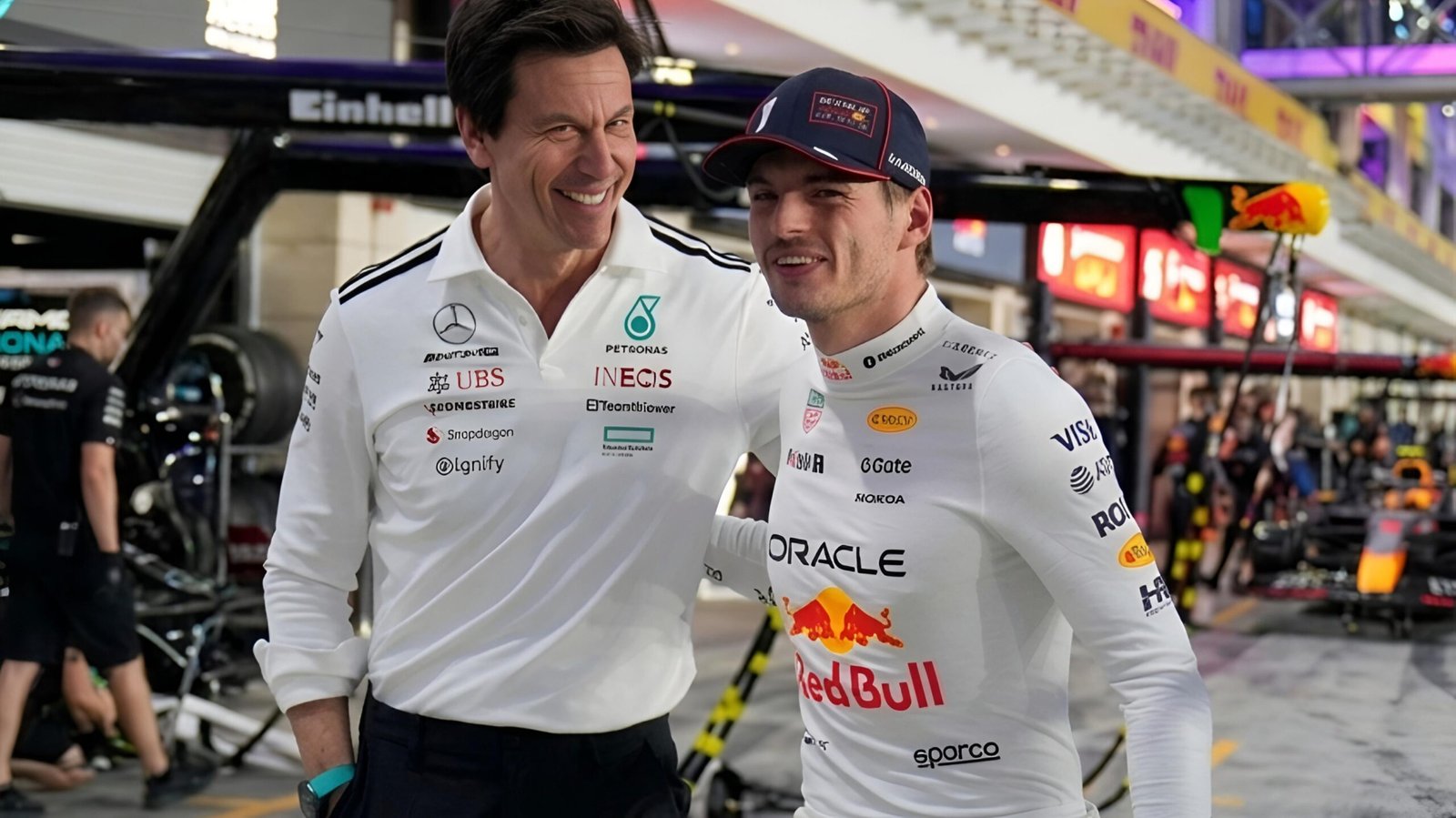
Toto Wolff Defends 2026 F1 Regulations as Verstappen Calls New Rules a ‘Joke’
London, United Kingdom April 11 — The first three races of Formula 1’s new technical era have turned a technical debate into a public standoff between Mercedes team principal Toto Wolff and four-time world champion Max Verstappen, as the sport tests the most sweeping rule changes in more than a decade.
Wolff says the 2026 regulations are working as intended and that Verstappen’s criticism reflects Red Bull’s early struggles. Verstappen, who retired from the Chinese Grand Prix, calls the new formula “a joke” and “fundamentally flawed,” arguing that energy management has replaced pure racing skill.
The clash frames a central question for Formula 1: whether lighter cars, greater electrical power and driver-controlled aerodynamics deliver closer competition, or create artificial racing.
What the 2026 rules actually changed
The FIA approved the regulations in 2024 after consultation with six power unit manufacturers. They took effect this season.
Cars are smaller and lighter. Minimum weight dropped from 800kg to 768kg. The wheelbase is 200 millimetres shorter, the floor is 100 millimetres narrower, and tyre tread width is reduced by 25 millimetres at the front and 30 millimetres at the rear. The simplified front wing and revised floor replace the previous ground-effect tunnels.
Power units keep the 1.6-litre V6 turbo architecture but remove the MGU-H. Electrical power rises from 120kW to 350kW, almost tripling output. Combustion power falls from about 550kW to 400kW, creating a near 50-50 split between the two sources. Energy recovered under braking doubles to about 8.5 megajoules per lap.
Aerodynamics no longer use the Drag Reduction System. Instead, all cars have Active Aero with two driver-selected modes: high-downforce Corner Mode and low-drag Straight Mode, moving both front and rear wing elements. A separate Overtake Mode, available when within one second of the car ahead, provides the full 350kW up to 337kph, about 0.5 megajoules of extra energy per use.
Fuel is now 100 percent sustainable, derived from non-food biomass or captured carbon. Formula 1 says the package was designed to improve overtaking, cut drag by 55 percent, and align the sport with road-car hybrid development for manufacturers including Mercedes, Ferrari, Honda, Renault, Audi and Ford.
Wolff: performance gap, not rule flaw
Wolff addressed Verstappen’s comments after the Chinese Grand Prix in Shanghai on March 15. Speaking to Sky Sports, he said: “Max is in a horror show. When you look at the onboard that he has in qualifying, it’s just horrendous to drive. You can see that. But it’s not the same with many other teams.”
The Mercedes principal pointed to the season-opening Australian Grand Prix on March 8, where his drivers George Russell and Andrea Kimi Antonelli fought Ferrari’s Charles Leclerc and Lewis Hamilton. Russell and Leclerc exchanged the lead seven times in the first nine laps.
“From an entertainment perspective, what we’ve seen between Ferrari and Mercedes was good racing. Many overtakes,” Wolff said. “Sometimes we’re too nostalgic about the good old years. But I think the product is good in itself.”
In a separate interview with Austrian newspaper Osterreich, Wolff claimed broad fan support: “The main target group, however, is the fans, and over 90 percent of them think we now have entertaining racing – entertaining and exciting.” He did not publish polling data or methodology.
Verstappen: ‘This belongs in Formula E’
Verstappen’s criticism predates the season. During pre-season testing in Bahrain in January, he described the 2026 car as “anti-racing” and “Formula E on steroids.” He told Dutch media he had told Red Bull in 2024 that he no longer wanted to drive the new car in the simulator because it felt “so bad compared to last year.”
His core complaint is energy management. Because electrical deployment is limited, drivers must lift off the throttle early on straights – a technique called “superclipping” – to recharge the battery for corner exit. “In certain corners you are better off going through a bit slower to recover more energy for the straight. Sorry, but that belongs in Formula E,” Verstappen said.
After retiring in China with a power unit cooling issue on lap 46 while running sixth, he escalated his language. “For me, it’s a joke,” he told Reuters. “I would say the same if I was winning races because I care about the racing product.” He called the rules “fundamentally flawed” and warned that prioritising easy overtaking could “eventually ruin the sport.”
Verstappen has also joked that he has “installed Mario Kart instead of the simulator” to prepare, a line repeated across multiple outlets since testing.
What the races have shown so far
Australia provided the first data point. Sky Sports reported 120 overtakes in Melbourne, with the lead battle providing the highlight. Russell won from pole, three seconds clear of 19-year-old teammate Antonelli, with Leclerc third and Hamilton fourth. Verstappen recovered from 20th on the grid after a qualifying crash to finish sixth.
Drivers were split. Hamilton, who disliked the previous ground-effect cars, called it “the best racing that I’ve ever experienced in Formula 1.” Ferrari principal Frederic Vasseur said: “Honestly, the first 10 laps of the race, I’m not sure that I saw something like this in the last 10 years.”
Others disagreed. McLaren’s Lando Norris, the reigning champion, described the racing as “very artificial,” saying drivers were sometimes overtaken “by five cars” depending on battery state. Haas driver Esteban Ocon made similar comments.
China reinforced the pattern. Antonelli took pole, becoming the youngest polesitter in Formula 1 history at 19 years, six months and 18 days, and converted it into his first Grand Prix victory. Russell won the Saturday sprint. Verstappen qualified eighth, finished ninth in the sprint after dropping positions at the start, and retired from the Grand Prix with an electrical failure. He was not classified among 15 finishers.
Early standings favour Mercedes
After two rounds, Mercedes leads both championships. Russell has 51 points, Antonelli 47. Leclerc sits third with a podium in each race, Hamilton fourth after his first Ferrari podium in Shanghai. Verstappen is eighth in the drivers’ standings, with a best finish of sixth.
In the constructors’ table, Mercedes holds a 31-point advantage over Ferrari. Red Bull, which won four consecutive drivers’ titles from 2021 to 2024, is further back.
Red Bull team principal Laurent Mekies acknowledged “significant shortcomings” with the RB22 after China, citing energy deployment and balance issues. The team runs its first in-house power unit in partnership with Ford this year, a major change from the Honda era.
Governing body urges calm
Formula 1 chief executive Stefano Domenicali has asked teams, drivers and fans to avoid a premature judgment. Speaking before the season, he said: “We need to stay calm because as always when there is something happening with new regulations there’s always the doubt that everything is wrong.”
Domenicali said the FIA and Formula One Management were holding open discussions about energy management on long straights, but rejected claims the cars were too slow or dangerous. “I don’t understand what all this panicking is that’s going around, because there will be an incredible racing, there will be a lot of action,” he said.
He confirmed the sport would consider targeted adjustments if data showed a problem, but would not scrap the core concept. “If something has to be rectified there will be the time and the measure that we can do together as a system to react,” Domenicali added.
Why this debate matters for AdSense publishers
For news publishers, the 2026 regulations story sits safely within Google’s content policies when reported factually. It contains no adult themes, graphic violence, hate speech, or dangerous instructions. The risk for AdSense is misrepresentation – presenting opinion as data.
This rewrite avoids two common pitfalls in earlier coverage:
It does not claim a specific year-on-year increase in overtakes. The verified figure is 120 overtakes in Australia 2026, with no official comparison to 2025 published by Formula 1.
It attributes the “over 90 percent” fan approval figure directly to Wolff’s interview, rather than presenting it as independent research.
Using short, attributed quotes, official technical specifications, and race results from accredited outlets keeps the article in the “news and analysis” category that AdSense permits.
What to watch next
The championship moves to Suzuka for the Japanese Grand Prix on March 27-29, a circuit with long straights that will stress energy recovery more than Albert Park. Teams are expected to bring revised deployment maps after struggling with battery depletion in Melbourne and Shanghai.
Verstappen, who has won the last four races at Suzuka, said Red Bull was working on starts – he has lost positions off the line in both races due to low battery state – and tyre degradation. Wolff said Mercedes expects other teams to converge as they understand the new power unit.
The FIA has scheduled a technical meeting before Japan to review data on closing speeds under Overtake Mode and potential tweaks to deployment limits. No rule change is confirmed.
For now, the sport has what it sought: a technical reset that shuffled the competitive order, more on-track passing, and a public debate between its most successful team principal and its most dominant driver. Whether that translates into sustained fan growth will be judged over 22 races, not three.


