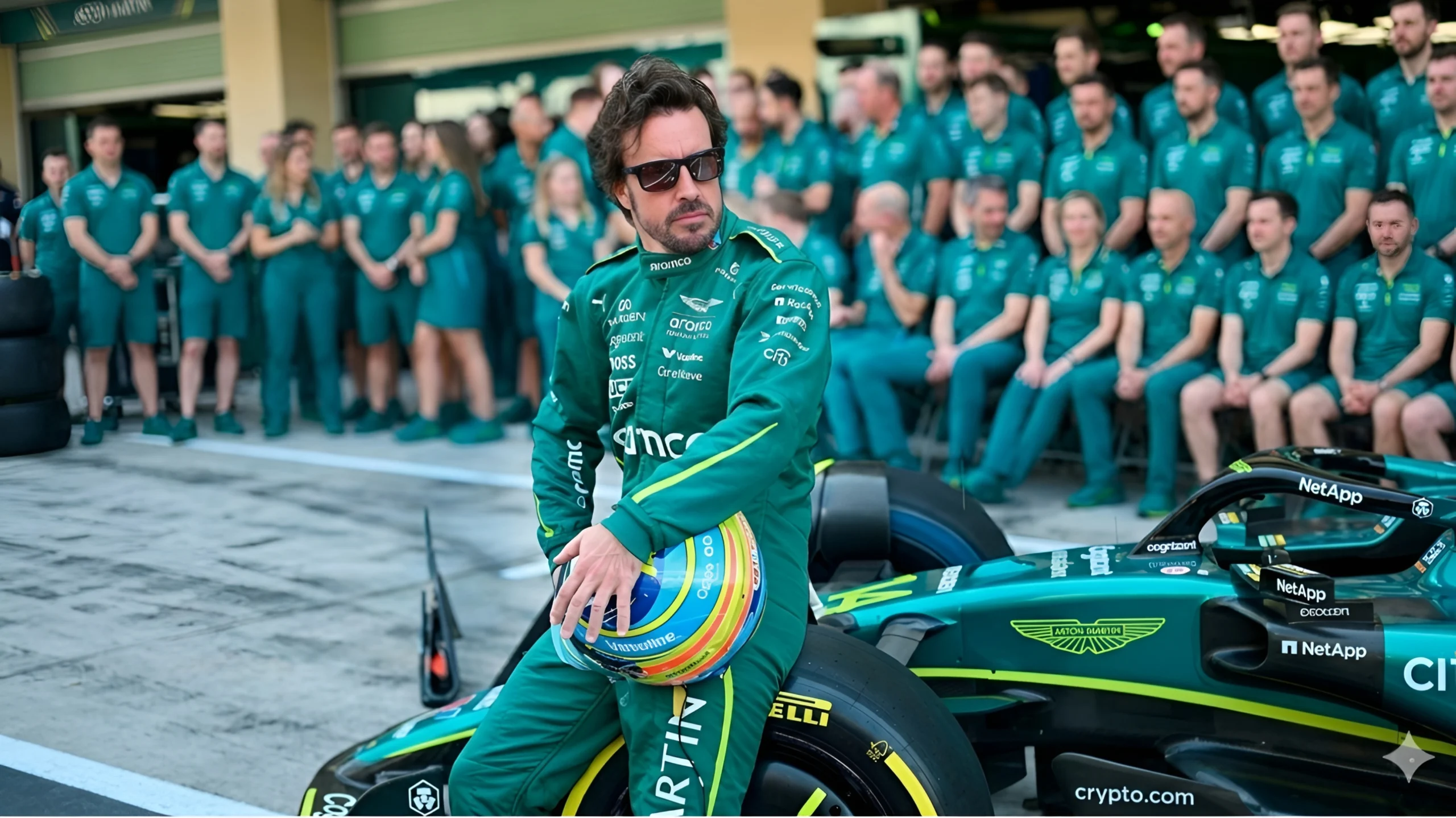
Fernando Alonso alongside the struggling AMR26 during the 2026 season opener: A partnership under technical and psychological scrutiny.
Published by: AutodromeF1 Editorial Team
Fernando Alonso and the 2026 Reckoning: Jock Clear’s Critique Illuminates the Delicate Calculus of Driver Selection in an Era of Radical Technical Rebirth
London, 23 March – In the rarefied ecosystem of Formula 1, where engineering precision collides with the unyielding demands of competition, few voices command the quiet authority of Jock Clear. A veteran whose career trajectory has traversed the engineering nerve centres of Ferrari and other leading squads, Clear has long been regarded as a dispassionate analyst whose insights cut through the noise of paddock rhetoric. His recent commentary on Aston Martin’s nascent 2026 campaign, therefore, carries particular weight. In a measured yet unambiguous appraisal, Clear has posited that Fernando Alonso—the two-time world champion whose competitive instincts remain as acute as ever—may not represent the optimal fit for the team’s present phase of foundational reconstruction. “Alonso is not the right driver” for where Aston Martin finds itself, he declared, framing the Spaniard’s profile as one better suited to immediate contention than the patient, iterative toil required of a squad still delineating its long-term architectural contours.
This assertion arrives at a pivotal juncture. The 2026 season, heralded by sweeping regulatory overhauls encompassing chassis architecture, aerodynamics, and power-unit specifications, was anticipated to serve as the proving ground for Aston Martin’s ambitious convergence of resources: the architectural genius of Adrian Newey, the factory-backed propulsion expertise of Honda, and the financial stewardship of Lawrence Stroll. Yet the opening rounds have instead unveiled a disquieting narrative of mechanical fragility and competitive shortfall. The AMR26 has yet to register a classified finish across the initial Grands Prix, beset by recurrent reliability failures, floor integrity concerns precipitated by the novel regulatory framework, and a conspicuous deficit in outright pace relative to the established front-runners from Mercedes, Red Bull, and Ferrari.
Clear’s intervention transcends mere observation; it interrogates the very ontology of driver utility within a rebuilding paradigm. He argues compellingly that the exigencies of the current milieu necessitate a temperament calibrated for equanimity amid protracted adversity—one capable of assimilating data, refining feedback loops, and sustaining morale through the protracted gestation of a ground-up redevelopment. In contrast, a “seasoned title-chaser” such as Alonso, whose career has been defined by an unremitting pursuit of victory and whose competitive horizon is inexorably contracting at the age of 44, may find such forbearance antithetical to his intrinsic wiring. “If you had to choose a driver to help you fight your way out of this deep hole, Alonso isn’t going to be the one you’re going to choose,” Clear elaborated, underscoring a perceived misalignment between the driver’s skill set and the team’s immediate imperatives. “This really doesn’t play to his skill set.”
To appreciate the profundity of this critique, one must contextualise Aston Martin’s trajectory within the broader continuum of Formula 1’s cyclical reinventions. The squad’s evolution from its Racing Point antecedents to a bona fide constructor of aspiration has been nothing short of audacious. The integration of Newey’s design philosophy—renowned for its capacity to extract latent performance from ostensibly restrictive regulations—coupled with Honda’s re-entry as a full works partner, embodied a strategic bet on 2026’s transformative landscape. Newey’s involvement was widely interpreted as a catalyst for technical ascendancy, promising a car whose conceptual elegance would mitigate the teething pains of regulatory novelty. Yet the empirical record of the early season paints a more sobering tableau: repeated mechanical interruptions, exacerbated by Honda power-unit vibrations that have transmitted unsettling oscillations through the chassis, have curtailed meaningful track time and compromised developmental momentum.
Insiders within the organisation have candidly conceded their position “behind the development curve,” acknowledging the necessity of temporal latitude to rectify the AMR26’s multifaceted deficiencies. Floor-damage anomalies attributable to the revised aerodynamic regulations, coupled with power-delivery inconsistencies and ancillary reliability gremlins, have collectively conspired to render the car not merely uncompetitive but operationally precarious. In such an environment, the role of the driver shifts from protagonist to diagnostician—a conduit for empirical intelligence that informs iterative refinement. Clear’s implication is clear: a younger, more process-oriented pilot might more readily embody this function, absorbing the vicissitudes of a multi-year project without the psychological tax imposed by late-career imperatives.
Alonso himself, to his considerable credit, has maintained a posture of resolute optimism. Publicly, he has articulated an unwavering conviction that Newey’s stewardship portends a future of competitive primacy, a perspective that underpinned his decision to extend his association with the team through the conclusion of the 2026 campaign. Having navigated analogous crucibles in prior incarnations—most notably the arduous gestation periods at Renault in the early 2000s and the McLaren-Honda alliance—Alonso possesses an institutional memory of resurgence that few contemporaries can rival. His feedback, drawn from an unparalleled repository of experiential acuity, remains an invaluable asset; he has consistently emphasised the latent potential within the project, framing current tribulations as transient waypoints on a longer arc toward excellence.
Yet herein lies the crux of Clear’s reservation. Alonso’s public buoyancy, while admirable, may inadvertently mask an internal dissonance. Accustomed to contesting at the vanguard—securing pole positions, podiums, and championships through sheer force of will and technical mastery—his tolerance for systemic instability is, by necessity, finite. Insiders familiar with the team’s internal dynamics have quietly echoed this sentiment, suggesting that a more “project-oriented” driver might better insulate the engineering cadre from the subtle pressures of expectation. The core of Clear’s critique, therefore, resides not in a diminution of Alonso’s prodigious talents—indeed, he has readily conceded that “Alonso has done some things in cars that are unbelievable”—but in a pragmatic appraisal of temporal and psychological congruence.
This discourse invites a deeper philosophical inquiry into the anthropology of Formula 1 driver selection. History furnishes instructive precedents. Consider the 2010s Mercedes renaissance, wherein Lewis Hamilton’s arrival catalysed an already promising technical foundation into sustained hegemony; or Sebastian Vettel’s tenure at Ferrari, where initial promise yielded to the complexities of cultural and developmental friction. In each instance, the driver’s disposition—whether one of adaptive resilience or exacting urgency—interacted dynamically with the team’s maturity level. Rebuilds, by their nature, reward those who derive fulfilment from incremental validation rather than immediate validation. Alonso’s late-career chapter, while luminous with the wisdom of experience, may inadvertently amplify the urgency that characterises a championship contender rather than the stoicism demanded of a developmental steward.
Furthermore, the 2026 regulatory paradigm amplifies these considerations. The introduction of new power-unit architectures, sustainable fuel mandates, and chassis innovations has precipitated a wholesale recalibration across the grid. Teams such as Aston Martin, leveraging Newey’s bespoke vision and Honda’s bespoke propulsion, entered the fray with elevated expectations. The reality of floor-induced performance erosion and Honda-specific vibrational pathologies—issues that have manifested in physical discomfort for drivers, including reports of numbness during extended running—has underscored the precariousness of such transitions. Management has publicly underscored the requirement for patience, yet the paddock’s collective gaze remains fixed upon measurable progress. Clear’s prognosis is sobering: absent a serendipitous breakthrough—perhaps a targeted power-unit amelioration yielding substantial horsepower gains—tangible advancement may not materialise until 2027.
From a strategic vantage, Aston Martin’s predicament compels introspection. The team’s commitment to Alonso was predicated upon his capacity to accelerate the learning curve, providing incisive telemetry and motivational ballast while Newey and Honda harmonised their respective contributions. That calculus retains merit; his institutional knowledge has, on occasion, proven instrumental in analogous scenarios. Nevertheless, the early-season evidence—zero classified finishes, compounded by the operational decision to field reserve talent such as Jak Crawford in Friday practice sessions—suggests a broadening recognition of long-term imperatives. The tension between short-term exigency and sustained reconstruction thus crystallises around the driver lineup.
In summation, Jock Clear’s intervention represents more than a singular pundit’s provocation; it encapsulates the perennial tension between individual brilliance and collective gestation in Formula 1’s unforgiving arena. Alonso’s enduring excellence is beyond dispute, as is his embodiment of the sport’s most indomitable competitive spirit. Yet in the crucible of Aston Martin’s 2026 odyssey—characterised by technical flux, regulatory novelty, and the inexorable march toward Newey-Honda fruition—Clear compels a necessary interrogation: does the team’s present exigency demand a driver whose primary virtue is unyielding patience, or can Alonso’s singular acuity yet prove the accelerant for resurgence? The forthcoming races, commencing with anticipated upgrades in Japan, will furnish preliminary answers. Until then, the narrative remains one of cautious optimism tempered by pragmatic realism—a narrative in which Clear’s candour serves not as condemnation, but as a clarion call for alignment between vision and execution.
As the season unfolds, the broader Formula 1 community would do well to heed this dialogue. In an era defined by regulatory flux and escalating technical complexity, the alchemy of driver-team symbiosis may ultimately delineate not merely podium aspirations but the very architecture of future success. Aston Martin, for all its current travails, retains the foundational elements—visionary design, committed partnership, and substantial resource—to transcend its present station. The question that lingers, articulated with characteristic lucidity by Jock Clear, is whether its current driver configuration optimally equips it to navigate the intervening turbulence. Only time, and the relentless iteration of development, will adjudicate.


