Published by: AutodromeF1 Editorial Team
Mario Andretti Offers Measured Rebuttal to Max Verstappen’s Critique of 2026 Formula 1 Regulations: Adaptation as the Enduring Cornerstone of Elite Competition
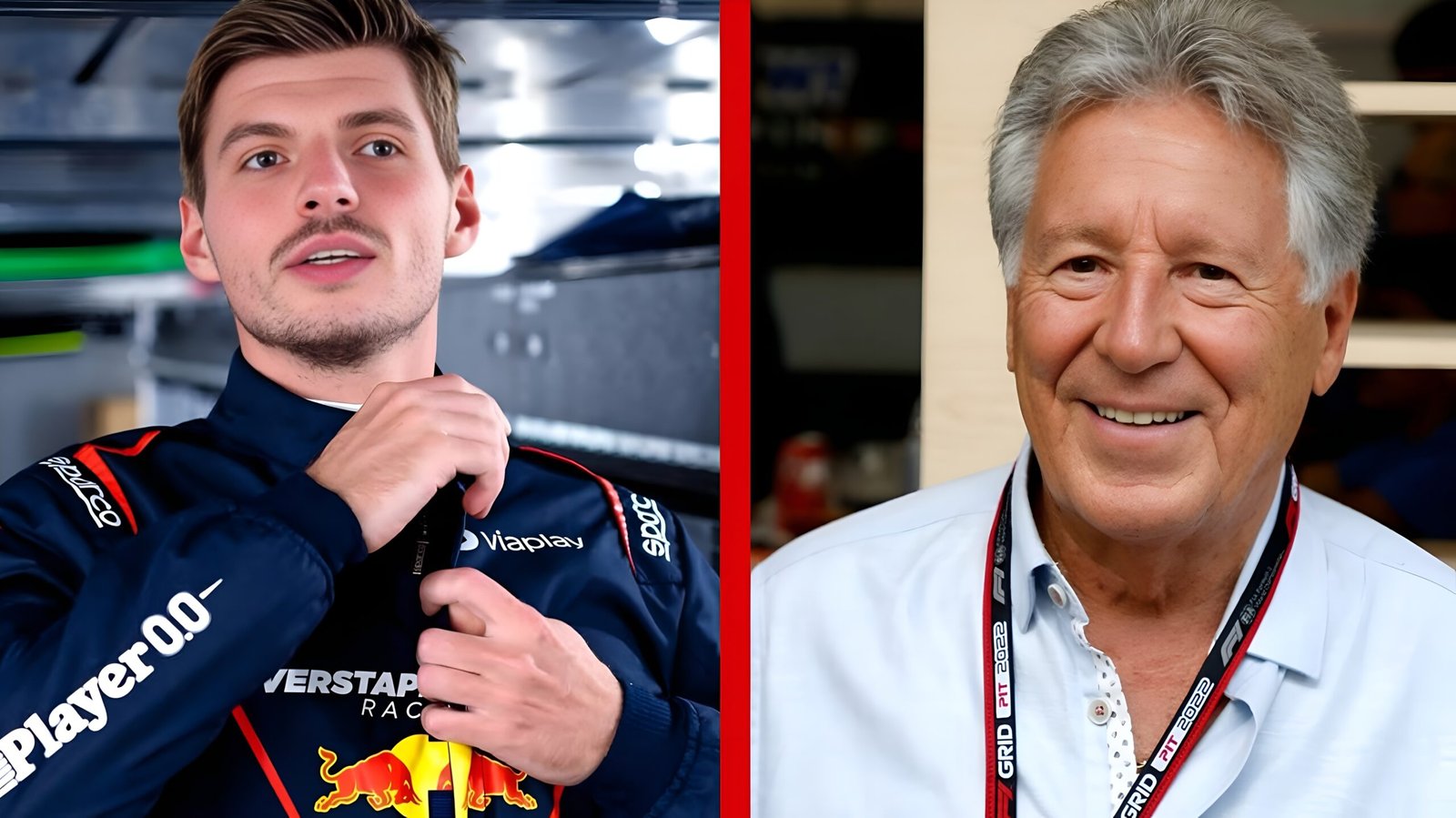
In the ever-evolving landscape of Formula 1, where technological upheaval routinely tests the resilience of even the most accomplished protagonists, Mario Andretti has articulated a perspective rooted in decades of institutional wisdom. The 1978 World Champion’s response to Max Verstappen’s outspoken dissatisfaction with the 2026 regulatory framework transcends mere commentary; it constitutes a philosophical affirmation of the sport’s immutable demand for adaptability. Delivered during a recent appearance on the Drive to Wynn podcast, Andretti’s observations arrive at a pivotal juncture, mere days after Verstappen’s retirement from the Chinese Grand Prix and amid a season that has already exposed the fragility of previously unchallenged hierarchies.
Verstappen, the four-time World Champion whose supremacy has defined the hybrid era since 2021, did not temper his assessment following the early-season setbacks. Having accumulated a mere eight points across the opening two rounds—a stark departure from the dominance that yielded consecutive titles—he described the new regulations as “a joke.” The Dutchman further likened the on-track spectacle to the chaotic energy management of the video game Mario Kart, contending that those who derive enjoyment from the revised format “really don’t know what racing is.” His retirement in China, precipitated by an ERS coolant failure, served as a tangible manifestation of the transitional vulnerabilities that have afflicted Red Bull Racing. What was once a seamless orchestration of power-unit efficiency and aerodynamic superiority has, under the 2026 dispensation, revealed itself as an intricate puzzle of battery deployment, active aerodynamics, and thermal management that not every outfit has yet solved with equal proficiency.
Andretti, whose own career spanned the transition from ground-effect aerodynamics to turbocharged supremacy and beyond, declined to engage in polemics. Instead, he located the source of Verstappen’s discontent in the champion’s accustomed vantage point at the front of the grid. “Max is used to being up front,” Andretti noted, “and not having as much fun as he would like right now.” The observation is neither dismissive nor condescending; it is diagnostic. It acknowledges that prolonged hegemony can recalibrate one’s tolerance for uncertainty. When a driver has spent years extracting maximum performance from a package engineered to exploit every marginal gain within a stable regulatory environment, the sudden imposition of novel constraints—greater electrical power contribution, mandatory energy-recovery thresholds, and dynamic aerodynamic devices—can feel less like progress and more like disruption.
Yet Andretti’s counsel extends far beyond empathy. He urged every competitor, irrespective of pedigree or current standing, to “just deal with whatever hand that they’re dealt and make the best of it.” This maxim, delivered with the understated authority of a man who contested 128 Grands Prix across four decades, encapsulates the professional ethos that has sustained Formula 1 through successive revolutions. The 2026 regulations, conceived to enhance sustainability, reduce costs, and foster closer competition, have introduced variables that reward not raw horsepower alone but strategic orchestration of hybrid energy flows and opportunistic overtaking. Andretti highlighted precisely these elements as sources of renewed excitement: the refined battery dynamics that permit more frequent and decisive power boosts, and the aerodynamic flexibility that promises genuine overtaking opportunities rather than the processional parades that occasionally characterised the latter stages of the previous regulatory cycle.
To appreciate the profundity of Andretti’s stance, one must situate the current discourse within the broader continuum of Formula 1’s regulatory history. Each major revision—be it the 1989 prohibition of turbochargers, the 1994 curtailment of electronic driver aids, the 2014 introduction of hybrid power units, or the 2022 ground-effect revival—has elicited analogous laments from drivers whose teams lagged in the developmental race. Those who ultimately prevailed were rarely the most vocal critics; they were the practitioners who recalibrated their approach, refined their feedback loops with engineers, and extracted incremental advantages from ostensibly restrictive parameters. Andretti himself navigated the shift from the winged wonders of the late 1970s to the ferocious turbo era of the 1980s, then witnessed the sport’s pivot toward fuel efficiency in the 1990s. At each inflection point, the essential challenge remained identical: to maximise the potential of the equipment provided, irrespective of its configuration.
The 2026 framework represents arguably the most ambitious recalibration since the hybrid era’s inception. By increasing the electrical power contribution to approximately fifty percent of total output, mandating more sophisticated energy-recovery systems, and incorporating active aerodynamic elements that alter drag and downforce in real time, the regulations seek to diminish the primacy of internal-combustion dominance while elevating strategic and regenerative efficiency. Early indications suggest that several constructors—most notably those whose power-unit development programmes aligned more closely with the new architecture—have navigated the transition with greater alacrity. The consequence is a grid that, after only two races, already exhibits a broader distribution of competitive potential than observers had anticipated. Verstappen’s modest points tally, juxtaposed against the successes of rival outfits, illustrates not a systemic failure but the uneven diffusion of technical mastery that invariably accompanies paradigm shifts.
Critics may contend that the Mario Kart analogy, while colourful, oversimplifies a sophisticated engineering endeavour. The intermittent deployment of electrical energy does indeed create phases of acceleration and conservation that can appear staccato to the uninitiated. Yet Andretti correctly identifies this as an opportunity rather than a detriment. The sport’s appeal has never resided solely in unrelenting flat-out velocity; it has always encompassed the intellectual contest of managing resources, anticipating rivals’ energy states, and executing decisive manoeuvres when windows of opportunity materialise. The enhanced overtaking potential promised by the new aerodynamic freedom and power-boost mechanics may ultimately yield the very spectacle that purists claim to cherish—provided the competing parties master the new lexicon of performance.
Moreover, Andretti’s intervention carries particular resonance given his ongoing engagement with the sport’s future. As the figurehead of the prospective Cadillac entry, scheduled to join the grid in 2026, he possesses an intimate appreciation of the regulatory intent. His emphasis on the enduring joy of “extracting maximum from capable equipment” reframes the debate away from nostalgia toward pragmatism. The core exhilaration of Formula 1, he argues, remains unaltered: the symbiosis between driver intuition and machine capability. Whether that machine deploys its energy in discrete bursts or continuous surges is secondary to the driver’s capacity to harmonise with its behaviour.
The broader paddock reaction remains heterogeneous. While some drivers have echoed Verstappen’s reservations regarding the initial learning curve, others have welcomed the prospect of more dynamic racecraft. Team principals, bound by commercial and technical confidentiality, have largely refrained from public critique, choosing instead to channel resources into rapid iteration. The consensus among engineering departments appears to be that the regulations are neither inherently flawed nor irrevocably “broken,” but rather demanding of accelerated development cycles. Red Bull Racing, whose technical architecture was optimised for the preceding dispensation, now confronts the necessity of recalibrating both power-unit calibration and chassis philosophy—an undertaking that history suggests is achievable within a single season when executed with requisite focus.
As the championship calendar resumes at the Japanese Grand Prix, the Suzuka circuit—renowned for its uncompromising high-speed demands and technical precision—will serve as an instructive barometer. The undulating layout, with its rapid direction changes and limited overtaking zones in conventional years, may yet reveal whether the new aerodynamic flexibility can generate genuine passing opportunities even on a track historically resistant to such manoeuvres. For Verstappen and Red Bull, Suzuka represents not merely another race but a diagnostic arena: a venue where incremental gains in battery management and thermal resilience can begin to narrow the competitive deficit.
Beyond the immediate sporting narrative lies a deeper institutional question. Formula 1’s regulatory philosophy has always balanced spectacle with progress. The 2026 changes were ratified not in isolation but as part of a coherent vision endorsed by the FIA, the commercial rights holder, and the majority of teams. They reflect imperatives of environmental responsibility, cost containment, and audience engagement in an era when motorsport must justify its relevance against competing entertainment forms. Andretti’s perspective—that drivers must adapt rather than resist—mirrors the sport’s own institutional imperative. Those who prosper will be those who internalise the new constraints as creative boundaries rather than limitations.
In an age when instantaneous digital commentary amplifies every expression of frustration, Andretti’s measured intervention serves as a salutary corrective. It reminds observers that Formula 1’s greatness has never derived from static excellence but from the capacity of its participants to reinvent themselves amid perpetual change. Verstappen’s candour is understandable; the champion’s competitive instinct recoils at any diminution of performance parity. Yet Andretti’s counsel carries the weight of empirical precedent: those who master the hand they are dealt invariably find themselves holding stronger cards by season’s end.
The coming months will determine whether Red Bull’s renowned adaptability reasserts itself or whether the 2026 regulations herald a genuinely pluralistic era. Regardless of the outcome, Mario Andretti has articulated the timeless verity that distinguishes elite sport from mere entertainment: true champions are defined not by the conditions they inherit but by the grace and ingenuity with which they navigate them. As the grid assembles in Suzuka, the narrative shifts from criticism to execution—the ultimate arbiter in a discipline that rewards neither complaint nor complacency, but only the relentless pursuit of optimisation within whatever parameters the regulations prescribe.


