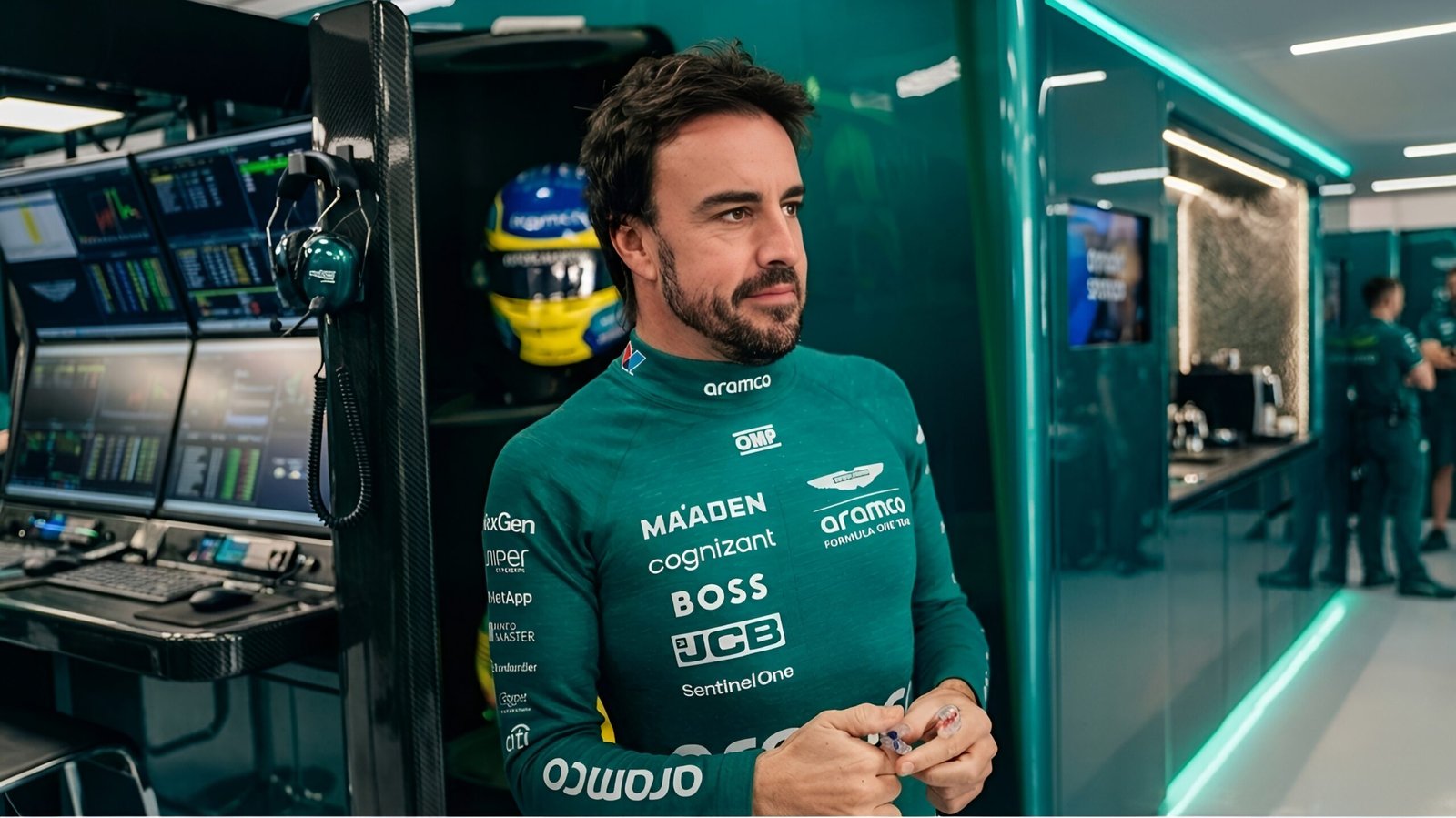
Fernando Alonso in the Aston Martin garage at the 2026 Japanese Grand Prix, where the team achieved its first full-distance finish under new power unit regulations.
Published by: AutodromeF1 Editorial Team
Aston Martin and Honda Confront the 2026 Reckoning: Suzuka Milestone Signals Reliability Breakthrough Yet Underscores Daunting Performance Chasm
London, United Kingdom – 30 March 2026
In the unforgiving crucible of Formula 1’s new regulatory era, where power-unit architecture has been fundamentally rewritten to demand an unprecedented 50:50 split between internal-combustion and electrical energy deployment, Aston Martin Racing’s alliance with Honda has encountered its sternest test yet. The 2026 Japanese Grand Prix at Suzuka delivered a pivotal, if bittersweet, milestone: for the first time, the AMR26 chassis completed an entire race distance with a fully functional battery pack. Fernando Alonso’s 18th-place finish—one lap in arrears—fulfilled Honda’s explicit home-grand-prix objective of basic operational continuity. Yet the result, achieved amid unrelenting vibrations emanating from the RA626H power unit’s combustion component, simultaneously laid bare the scale of the aerodynamic, power-delivery, and tyre-management deficits that continue to relegate the emerald-liveried cars to the absolute rear of the field.
This was no ordinary reliability validation. Pre-season testing had been crippled by recurrent battery failures triggered by severe harmonic vibrations from the internal-combustion engine. Teams across the paddock logged thousands of kilometres; Aston Martin, by contrast, recorded the fewest laps of any competitor—materially below even the most conservative estimates from rivals such as Mercedes-AMG Petronas. The consequent shortage of developmental mileage has left the Silverstone-based outfit potentially as much as three seconds adrift on outright pace, a margin that no amount of strategic opportunism can mask over 57 laps of Suzuka’s high-speed sweeps and technical hairpins.
Alonso, the two-time world champion whose return to Aston Martin in 2023 was predicated on the promise of sustained competitiveness, crossed the line with characteristic candour. “We have made progress—there is no denying that the car finished the race with the battery intact,” he stated post-race. “But the performance gap is obvious to everyone. Straight-line speed, aerodynamic efficiency, tyre degradation: every area requires urgent attention if we are to move beyond simply completing the distance.” His teammate Lance Stroll, whose own race ended prematurely with a water-pressure issue, echoed the sentiment with a mixture of realism and wry humour. Stroll’s description of their intra-team contest as the “Aston Martin championship” captured the grim reality: at present, the primary competition for the AMR26s lies not with the leaders but with each other at the back of the grid.
The visual spectacle of the cars—resplendent in their deep emerald green livery, accented by the silver wings of the Aston Martin badge—remains one of the season’s aesthetic highlights. Yet the data paints a far less flattering portrait. Telemetry from Suzuka revealed persistent understeer through the high-speed esses, compromised traction out of the Degner curves, and a conspicuous lack of electrical deployment consistency under the new regulations’ heavier emphasis on hybrid energy recovery and deployment. Honda’s engineers have confirmed that the root cause of the vibrations lies partly in the interaction between the power unit and the chassis architecture, necessitating a collaborative resolution rather than a supplier-only fix.
Technical Diagnosis: The Vibration Conundrum and Battery Fragility
The 2026 power-unit regulations represent the most significant technical reset since the hybrid era began in 2014. By mandating a near-equal contribution from electric motors—effectively doubling the electrical power relative to previous generations—the regulations have exposed vulnerabilities in every manufacturer’s design philosophy. For Honda, returning to the grid as Aston Martin’s exclusive supplier after a successful but ultimately title-winning partnership with Red Bull, the transition has been particularly exacting.
Internal sources within the Honda Racing Development facility in Sakura describe the vibrations as “unprecedented in amplitude and frequency spectrum.” These oscillations, generated primarily within the 1.6-litre V6 turbocharged internal-combustion engine, propagate through the mounting points and into the battery enclosure. The resultant micro-movements have repeatedly compromised cell integrity, leading to thermal runaway risks and outright failures during early-season running. Parts shortages—particularly of specialised damping materials and reinforced battery casings—have compounded the issue, forcing Aston Martin to cannibalise components from test rigs and even static dyno units simply to field cars at race weekends.
The consequence has been a developmental bottleneck. While rivals have iterated aggressively on aerodynamic packages and energy-management software, Aston Martin has been compelled to prioritise survival over optimisation. Wind-tunnel and CFD correlation data suggest the AMR26’s current floor and diffuser configuration generates insufficient downforce at the low-to-medium ride heights demanded by the new ground-effect regulations. Power delivery, meanwhile, exhibits lag in the critical 200-300 km/h acceleration zones, where the hybrid system’s 50:50 balance should theoretically confer an advantage.
Independent power-unit analysts, speaking on condition of anonymity, estimate that the RA626H currently operates at approximately 85-90% of its theoretical thermal efficiency ceiling. The electrical side—encompassing the MGU-K and MGU-H derivatives—has shown greater promise in isolation, yet integration challenges persist. “The 2026 architecture demands symbiosis between combustion and electrification that previous generations never required,” noted one veteran engineer with experience across multiple manufacturer programmes. “Aston Martin and Honda are not alone in this struggle, but their limited testing mileage has amplified the learning curve.”
Strategic Context: A Partnership Built for the Long Game
The Aston Martin-Honda alliance was forged in the crucible of the 2026 regulations. Lawrence Stroll’s vision for the Silverstone squad has always extended beyond short-term results; the arrival of Adrian Newey as Chief Technical Officer in late 2025 was explicitly timed to coincide with the new formula. Newey’s influence on the AMR26’s fundamental architecture—particularly its suspension geometry and underfloor airflow management—remains a cornerstone of the team’s long-term strategy. Yet even Newey’s legendary ability to extract performance from constrained regulations cannot compensate for a power-unit handicap measured in tenths of a second per lap.
Honda, for its part, has reiterated its commitment. “Suzuka was not about points; it was about validation,” said a senior Honda spokesperson. “We have gathered critical data on vibration damping strategies that will inform both immediate interim upgrades and the next specification of the power unit. Incremental progress is the only viable path under these regulations.” Team principal Mike Krack has been equally measured, emphasising that the organisation’s focus remains on “building a foundation that can sustain multiple seasons of development rather than chasing transient gains.”
Driver Perspectives and Team Morale
Alonso, at 44, brings a unique perspective shaped by multiple regulatory transitions. His post-Suzuka debrief highlighted the importance of tyre management—a perennial challenge exacerbated by the 2026 cars’ altered weight distribution and energy deployment profiles. “The degradation is higher than we anticipated,” he observed. “We must find a way to preserve the rubber while still extracting the electrical boost when it matters most.”
Stroll, driving with renewed maturity in his sixth season with the team, has channelled frustration into constructive feedback. His light-hearted “Aston Martin championship” remark belies a steely determination to contribute to the car’s evolution. Behind the scenes, the engineering team reports that both drivers have been instrumental in identifying subtle chassis-balance shifts that telemetry alone cannot quantify.
The Road Ahead: Incrementalism Versus Transformation
Honda’s technical roadmap calls for a series of phased upgrades beginning with the Miami Grand Prix. These will address vibration isolation through revised mounting systems and enhanced battery-cooling pathways. A more substantial power-unit specification—incorporating refined combustion-chamber design and improved energy-recovery mapping—is targeted for the European summer. Whether these measures will suffice to close the three-second deficit remains an open question.
Broader paddock observers draw parallels with past manufacturer transitions. Honda’s own journey with McLaren in the late 2010s was similarly turbulent before yielding results; Red Bull’s recent championship dominance with the Japanese supplier offers a more optimistic precedent. Yet the 2026 landscape is markedly different: every team is navigating the same regulatory unknown, and the margin for error has narrowed.
For Aston Martin, the season ahead will test not merely engineering prowess but organisational resilience. The infrastructure investments at Silverstone—new simulator facilities, expanded wind-tunnel capabilities, and the integration of Newey’s design philosophy—represent a multi-year commitment. Success, when it arrives, will be measured not in isolated race wins but in sustained progression up the constructors’ standings.
As the grid prepares for the next chapter in Shanghai, the narrative surrounding the green cars has shifted subtly. No longer is the conversation solely about survival; it now encompasses the credible prospect of incremental gains. The emerald livery may still trail the leaders through the esses, but the first full-race completion at Suzuka has injected a measure of cautious optimism.
In Formula 1, as in any high-stakes engineering endeavour, reliability is the prerequisite for competitiveness. Aston Martin and Honda have taken the first essential step. The mountain that remains—bridging the performance gulf under regulations that reward precision and integration above all else—will define the partnership’s legacy. The 2026 season is young, the data is accumulating, and the grind, as both drivers and engineers acknowledge, has only just begun.


