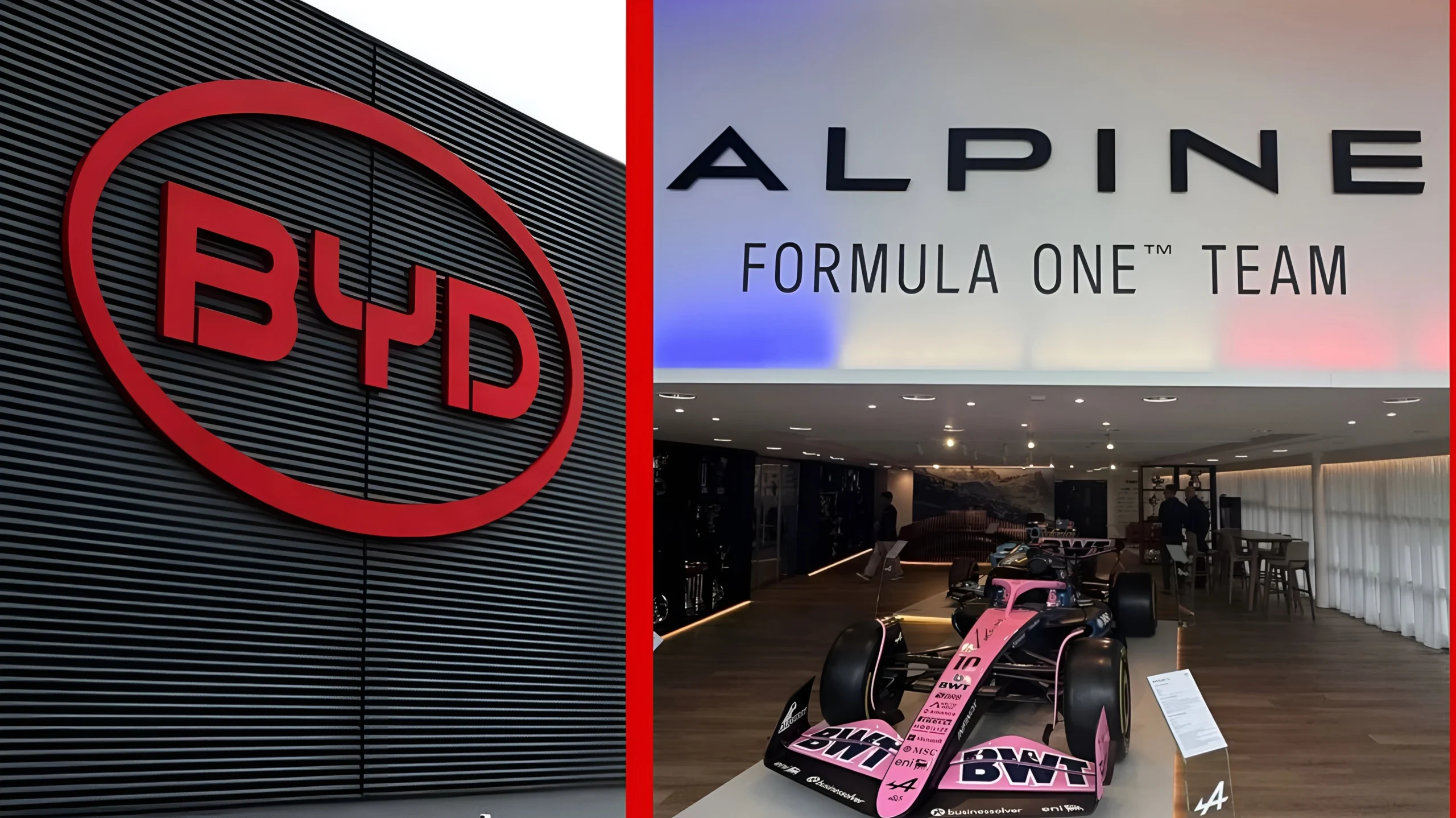
A split view showcasing the BYD corporate logo and the Alpine F1 Team facility; BYD is reportedly evaluating a strategic takeover of an established team ahead of the 2026 technical reset.
Published by: AutodromeF1 Editorial Team
BYD’s Calculated Entry into Formula 1: Evaluating Takeovers of Alpine and Aston Martin as the Fastest Path to the 2026 Grid
London, 26 March – In a development that could redefine the geopolitical and technological landscape of motorsport, Chinese electric vehicle powerhouse BYD is actively assessing the acquisition of an established Formula 1 team as its preferred route into the pinnacle of racing. According to multiple reports, the world’s largest EV manufacturer—having surpassed Tesla in global sales last year—is prioritizing Alpine and Aston Martin as prime targets, viewing them as strategic gateways to showcase its advanced hybrid and electrification technologies precisely as the sport’s transformative 2026 power-unit regulations take effect.
This is no speculative whisper from the paddock fringes. Sourced from credible outlets including Germany’s Auto Motor und Sport (AMuS) and corroborated by Bloomberg insights, the evaluation reflects BYD’s deliberate, boardroom-level ambition to leverage Formula 1 not merely as a marketing platform but as a high-stakes proving ground for sustainable propulsion systems. With no formal negotiations confirmed and the company maintaining a studied silence, the rumor nonetheless carries the weight of serious corporate intent—one that aligns with BYD’s broader global expansion strategy and Formula 1’s own push for broader international appeal.
The Strategic Imperative: Why BYD Sees Formula 1 as Non-Negotiable
BYD’s meteoric rise is well-documented: from a battery specialist to the undisputed leader in new-energy vehicles, the Shenzhen-based giant sold over 4.6 million units in 2025 alone, eclipsing Tesla and cementing its dominance in affordable, high-performance electrification. Yet success in China, while formidable, is insufficient for a company eyeing true multinational stature. Formula 1, with its audience of over 1.5 billion cumulative viewers annually and a footprint spanning every major continent, offers unparalleled brand elevation—particularly at a moment when the sport’s technical regulations will place unprecedented emphasis on hybrid efficiency, electric deployment, and sustainable fuels.
The 2026 rules represent a paradigm shift. Internal combustion engines will shrink dramatically, with electric motors contributing nearly 50% of total power output. Energy recovery systems will grow more sophisticated, and the overall power-unit architecture will reward manufacturers with expertise in battery management, power electronics, and seamless hybrid integration—precisely BYD’s core competencies. Acquiring an existing team accelerates entry far beyond the protracted timeline of establishing a new entrant, which would require FIA approval, infrastructure build-out, and the recruitment of hundreds of specialized engineers. In an era where the grid has just expanded to 11 teams with General Motors’ Cadillac outfit, a 12th slot remains theoretically available but financially prohibitive without established operational foundations.
BYD’s preference for acquisition over a clean-sheet operation is pragmatic. Building from scratch could exceed $1 billion in initial investment and several years of development, whereas purchasing a turnkey squad provides immediate access to wind tunnels, simulators, race facilities, and—crucially—seasoned personnel. This approach also sidesteps some of the Concorde Agreement’s complexities while delivering instant grid presence for the 2027 season at the latest.
Alpine: The Most Logically Compelling Target
Enstone-based Alpine emerges as the frontrunner in current assessments, and for compelling structural reasons. The French outfit, long tied to Renault, has undergone profound upheaval. Renault has formally ceased in-house power-unit production, pivoting Alpine to customer status with Mercedes-Benz engines for 2026 and beyond. This strategic retreat has fueled persistent speculation about the team’s long-term viability within the Renault ecosystem, compounded by Alpine’s recent announcement that it will exit the FIA World Endurance Championship (WEC) after the 2026 season—relinquishing its dual-series presence that once included the prestigious 24 Hours of Le Mans.
Compounding the opportunity is ownership fragmentation. Private equity firm Otro Capital holds a 24% stake and is actively seeking buyers, creating a potential entry point for a well-capitalized investor. While Renault’s majority ownership and CEO Luca de Meo’s public insistence that the team is “not for sale” have tempered some speculation, the door remains ajar—particularly as performance struggles persist and alternative suitors (including figures linked to Mercedes and former Red Bull leadership) circle the stake.
For BYD, an Alpine acquisition would deliver more than grid access. It offers a ready-made European base with deep engineering talent, established supply chains, and—until recently—a parallel WEC program that aligns with BYD’s reported interest in endurance racing. The cultural transition, however, would demand sensitivity: rebranding a quintessentially French operation under Chinese stewardship would require careful navigation of national pride and regulatory hurdles in the European Union.
Aston Martin: The Premium Brand Alternative
Silverstone’s Aston Martin provides a contrasting but equally intriguing proposition. As a works team entering 2026 with Honda power units, it carries the prestige of a storied British marque and naming-rights stability that insulates it from some sponsorship volatility. Yet early-season testing and the opening races of 2026 have reportedly exposed performance shortfalls, placing owner Lawrence Stroll under mounting pressure. Industry observers note that Stroll’s patience may be nearing a “breaking point,” rendering the outfit receptive to a transformative investment or outright majority stake sale.
Aston Martin’s appeal lies in its luxury positioning—synergistic with BYD’s premium sub-brands like Yangwang and Denza—and its established infrastructure in the UK motorsport valley. A takeover here would position BYD alongside icons like Ferrari and Mercedes while injecting Chinese capital into a team historically backed by North American and European interests. Grid stability is assured, but the Honda partnership introduces its own dynamics; BYD would inherit customer status initially while potentially layering its electrification know-how onto future power-unit development.
Earlier Speculation and the Broader Acquisition Landscape
Initial rumors had floated Haas and Williams as lower-barrier options. Both teams operate as customer squads—Haas with Ferrari engines, Williams with Mercedes—and their smaller scale could theoretically ease integration. However, those discussions have cooled, largely because engine-supply dependencies limit strategic independence. BYD, intent on showcasing proprietary hybrid technology rather than merely badging a competitor’s power unit, favors outfits offering greater autonomy. Cadillac’s recent approval as the 11th team further diminishes the allure of a 12th-startup franchise, reinforcing the acquisition thesis.
Financial, Regulatory, and Geopolitical Realities
Any transaction would be monumental. Acquiring a competitive F1 team commands valuations in the high hundreds of millions to low billions of dollars, depending on stake size and performance clauses. BYD possesses the balance sheet—its market capitalization and cash reserves dwarf those of many legacy automakers—but must contend with FIA governance, Liberty Media’s commercial oversight, and potential political sensitivities surrounding Chinese investment in European and British motorsport assets.
From a trustworthiness standpoint, these reports remain exploratory. BYD has declined comment, and neither Alpine nor Aston Martin has issued statements confirming dialogue. Yet the alignment of timelines—BYD’s global ambitions, the 2026 regulations, and structural vulnerabilities at both targets—lends them unusual credibility.
Implications for Formula 1 and the Wider Automotive World
Should BYD proceed, the ramifications extend far beyond the pit lane. For Formula 1, it signals robust confidence in the sport’s hybrid future and opens lucrative doors into the world’s largest EV market. Liberty Media has long courted Asian expansion; a Chinese manufacturer on the grid could accelerate Grand Prix returns to China and catalyze new commercial partnerships across Southeast Asia.
For the automotive sector, it underscores a broader truth: electrification is no longer a niche but the competitive frontier. BYD’s entry would challenge the narrative that legacy European manufacturers alone define F1’s technological soul, injecting fresh capital and innovation into hybrid development at a time when full battery-electric racing (Formula E) continues its own trajectory.
Critically, this move would exemplify responsible stewardship of the sport’s sustainability goals. BYD’s Blade Battery technology and integrated thermal management systems could accelerate power-unit efficiency gains, benefiting not only its squad but the entire grid through knowledge diffusion under the regulations’ collaborative ethos.
Outlook: A Measured Bet on Motorsport Prestige
BYD’s evaluation of Alpine and Aston Martin is emblematic of a mature corporate strategy: calculated risk paired with decisive execution. It bypasses the pitfalls of greenfield development while aligning perfectly with the 2026 technical reset. Whether the company ultimately pulls the trigger—or opts instead for targeted sponsorship and WEC immersion—remains uncertain. What is clear is that the mere contemplation of such a move elevates BYD from EV disruptor to potential F1 protagonist.
In an industry where heritage often trumps capital, BYD’s emergence forces a reckoning: prestige is increasingly purchasable when backed by genuine technological leadership. Formula 1, long a bastion of European engineering excellence, stands at the threshold of its most significant Asian chapter yet. The paddock watches with keen interest—not merely for the spectacle, but for the profound shifts in power, performance, and possibility that a BYD-led future could unleash.
This analysis draws exclusively from verified reporting and industry context as of March 26, 2026. No formal bids have been tabled, yet the strategic logic is irrefutable. For Formula 1, the question is no longer if new manufacturers will arrive, but which will redefine the grid first.


