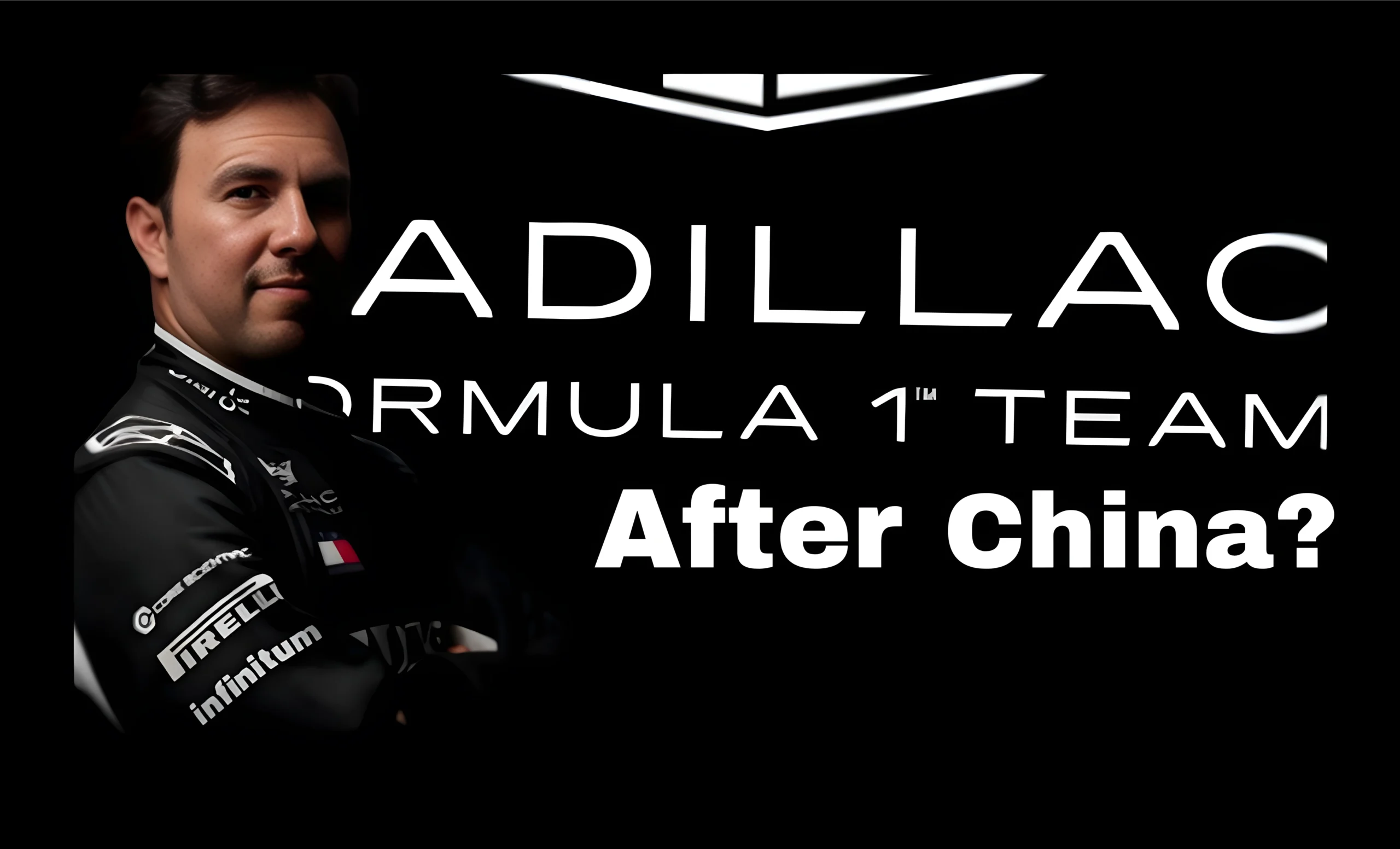
Sergio Pérez stands before the Cadillac Formula 1 Team logo following a challenging 2026 debut season start in Australia and China.
Published by: AutodromeF1 Editorial Team
Cadillac Formula 1: From Inaugural Promise to the Inevitable Realities of Independent Development in the 2026 Regulatory Framework
New York, 24 March – In the high-stakes arena of Formula 1, where innovation and execution intersect under the unrelenting scrutiny of global audiences, the arrival of a new manufacturer entrant represents both a bold affirmation of the sport’s enduring appeal and a formidable test of engineering resilience. Cadillac’s entry into the championship for the 2026 season, under the stewardship of General Motors and in partnership with the Andretti Global organisation, was heralded as a transformative moment. It promised to inject fresh capital, advanced American engineering expertise, and renewed competitive depth into a grid long dominated by established European powerhouses. Yet, scarcely two races into the campaign, the team’s trajectory has illustrated a timeless truth: the transition from conceptual ambition to operational excellence is seldom seamless. As articulated by driver Sergio Pérez, the “honeymoon is over,” signalling a decisive pivot from ceremonial debut to the protracted, often arduous process of closing performance and reliability gaps.
The Australian Grand Prix on 8 March 2026 marked Cadillac’s maiden competitive outing at the pinnacle of motorsport. Held under the iconic lights of Melbourne’s Albert Park circuit, the event offered an unforgiving baptism. Pérez, the team’s lead driver with extensive experience forged at Red Bull Racing, crossed the finish line in 16th position, trailing the leaders by three full laps. His teammate, Valtteri Bottas—veteran of multiple constructors’ titles with Mercedes—fared even less auspiciously, retiring on lap 16 owing to a persistent low-pressure fuel system malfunction. These outcomes, while disappointing, were not entirely unanticipated for an organisation constructing its entire technical ecosystem from foundational principles rather than relying on established supply chains. Two weeks later, at the Chinese Grand Prix in Shanghai on 15 March, a modest yet meaningful progression materialised. Both Cadillac entries completed the full race distance, with Bottas securing a 13th-place finish. Notably, this result followed a qualifying performance in which he outperformed Aston Martin’s Lance Stroll, underscoring incremental gains in operational consistency and driver-car synergy.
Such early results encapsulate the dual narrative defining Cadillac’s nascent campaign: visible promise tempered by systemic vulnerabilities that distinguish the team from its more entrenched rivals. Unlike entities that inherit mature power-unit architectures or aerodynamic philosophies through long-term partnerships, Cadillac operates within a paradigm of self-reliance. The 2026 regulations, which introduce radically revised power units emphasising sustainable fuels and electrical deployment alongside chassis evolutions, have compelled every constructor to recalibrate. However, for Cadillac, the absence of a pre-existing technical alliance akin to Haas’s historic integration with Ferrari has amplified the developmental burden. Components that seasoned teams refine over decades—fuel delivery systems, energy-recovery deployment algorithms, and stress-tested chassis interfaces—must now be engineered in parallel with competitive participation.
Central to the team’s immediate tribulations is the recurrent low-pressure fuel system anomaly. This issue first surfaced during pre-season testing at Barcelona, resurfaced in Australia, and persisted into Shanghai, manifesting as inconsistent pressure regulation that compromises both engine output and thermal management. In an era where power units must seamlessly integrate internal combustion elements with hybrid electric systems under stringent efficiency mandates, even marginal deviations can cascade into significant performance penalties or outright failures. Deployment troubles—referring to the controlled release of stored electrical energy—further compound the challenge, particularly under variable race conditions involving safety-car periods or defensive manoeuvres. These “relentless small issues,” as internal briefings have described them, stand in stark contrast to the refined, iteratively optimised systems employed by manufacturers such as Mercedes, Ferrari, and Red Bull Powertrains. The latter benefit from institutional knowledge accumulated across multiple regulatory cycles, whereas Cadillac’s access to open-source fuel system designs was granted only subsequent to its formal entry approval in late 2025. This temporal constraint has necessitated a compressed validation timeline, rendering the team uniquely exposed during the championship’s opening phase.
Team principal Graeme Lowdon, a figure whose career spans pivotal roles at Manor Racing and the FIA, has framed these early setbacks within a broader context of foundational progress. In a measured assessment shared with select media outlets following the Chinese Grand Prix, Lowdon characterised the completion of both cars in Shanghai as “a solid foundation upon which to build.” He acknowledged the “painful learnings” derived from real-world stress-testing of procedures that, in simulation and laboratory environments, had appeared robust. “The transition from dyno to track reveals nuances that no amount of virtual modelling can fully replicate,” Lowdon observed, emphasising the iterative nature of Formula 1 development. Pre-season preparations deliberately prioritised reliability over outright velocity, a strategic calculus that enabled Cadillac to complete every allocated testing day—an achievement unmatched by several rivals hampered by component failures or logistical disruptions. This methodical approach, while yielding no headline-grabbing lap times, has equipped the team with empirical data sets essential for targeted refinements.
From an engineering standpoint, the performance metrics emerging from telemetry and comparative analysis reveal a nuanced picture. Cadillac’s deficit relative to the frontrunners hovers between 4.7 and 5.2 percent in downforce generation, a quantifiable shortfall that manifests most acutely in high-speed corners and during qualifying simulations. Yet, the chassis itself garners praise for its “tidy handling” characteristics: responsive steering inputs, predictable balance under braking, and minimal porpoising tendencies even on bumpy surfaces. Such attributes suggest that the aerodynamic philosophy—centred on ground-effect principles mandated by the 2026 regulations—aligns conceptually with contemporary benchmarks. The shortfall, therefore, resides not in fundamental design flaws but in the refinement of surfaces, bargeboards, and floor geometries that established teams have optimised across thousands of wind-tunnel and computational fluid dynamics hours. Power-unit output, while compliant with regulatory ceilings, similarly trails in deployment efficiency, particularly under sustained high-load scenarios.
This developmental posture reflects Cadillac’s overarching philosophy: an unyielding commitment to vertical integration rather than opportunistic outsourcing. In contrast to customer-model entrants that leverage partner technology to accelerate competitiveness, the American manufacturer has elected to cultivate proprietary solutions across chassis, power unit, and electronics. The rationale is strategic longevity; by internalising expertise now, Cadillac positions itself to evolve independently as regulations stabilise post-2026. Nevertheless, this purity incurs short-term costs. Historical precedents within the sport illuminate the trajectory. Teams such as USF1 in 2010 or Caterham and Marussia in subsequent eras faltered precisely because independent development outpaced financial and temporal resources. Conversely, Haas’s 2016 debut—facilitated by extensive Ferrari technical collaboration—achieved immediate points-scoring finishes, albeit without the same depth of intellectual property ownership. Cadillac’s path, while slower initially, may ultimately yield greater autonomy and brand differentiation, provided the organisation sustains investment through the inevitable lean seasons ahead.
Looking forward, the team’s immediate horizon centres on the Miami Grand Prix in early May 2026, where a comprehensive upgrade package is scheduled for introduction. These revisions encompass aerodynamic appendages calibrated to address the identified downforce deficit, alongside recalibrated fuel-system software and enhanced deployment mapping derived from the cumulative data of the Australian and Chinese weekends. The objective is twofold: to consolidate position within the midfield and to demonstrate tangible in-season development velocity amid a grid where every constructor continues advancing. Analysts anticipate that, even with these enhancements, Cadillac will remain focused on damage limitation rather than podium contention. Long-term aspirations—securing race victories or constructors’ championship honours—remain realistically situated in the 2028–2029 timeframe, contingent upon the maturation of both personnel and infrastructure.
The broader implications of Cadillac’s early campaign extend beyond the team’s garage. In an era when Formula 1 seeks to broaden its geographic and corporate appeal, the successful integration of a major American manufacturer carries symbolic weight. It underscores the viability of the 2026 regulations in attracting new investment while simultaneously exposing the technical and logistical barriers that persist. For the sport’s governing body, the Fédération Internationale de l’Automobile, Cadillac’s experiences may inform future entry protocols, particularly regarding data-sharing timelines and testing allocations. Moreover, the team’s resilience in completing races despite adversity reinforces a narrative of methodical perseverance—one that resonates with stakeholders evaluating the championship’s commercial and technological trajectory.
As the season unfolds, Cadillac’s journey will serve as a case study in the economics of ambition. The initial promise observed in pre-season testing and the incremental strides in China provide grounds for cautious optimism. Yet Pérez’s candid declaration serves as a salient reminder: the glamour of a debut weekend swiftly yields to the rigours of incremental progress. Reliability must now be rendered routine, performance gaps systematically narrowed, and operational processes hardened against the variables of weather, circuit characteristics, and regulatory evolution. Only through this disciplined progression can Cadillac transform its foundational presence into sustained competitiveness.
In the final analysis, the team’s story is less about immediate results and more about the quiet architecture of endurance. Formula 1 has always rewarded those who navigate the chasm between aspiration and execution with precision and patience. Cadillac, armed with substantial resources and a clear vision of self-determined excellence, stands at the threshold of that journey. The coming months—and the Miami upgrades in particular—will reveal whether the organisation’s independent ethos can accelerate beyond the early hurdles or whether further recalibrations become necessary. For now, the focus remains resolute: convert painful learnings into tangible gains, one race at a time, thereby honouring the legacy of innovation that defines both Cadillac’s heritage and the sport’s future.


