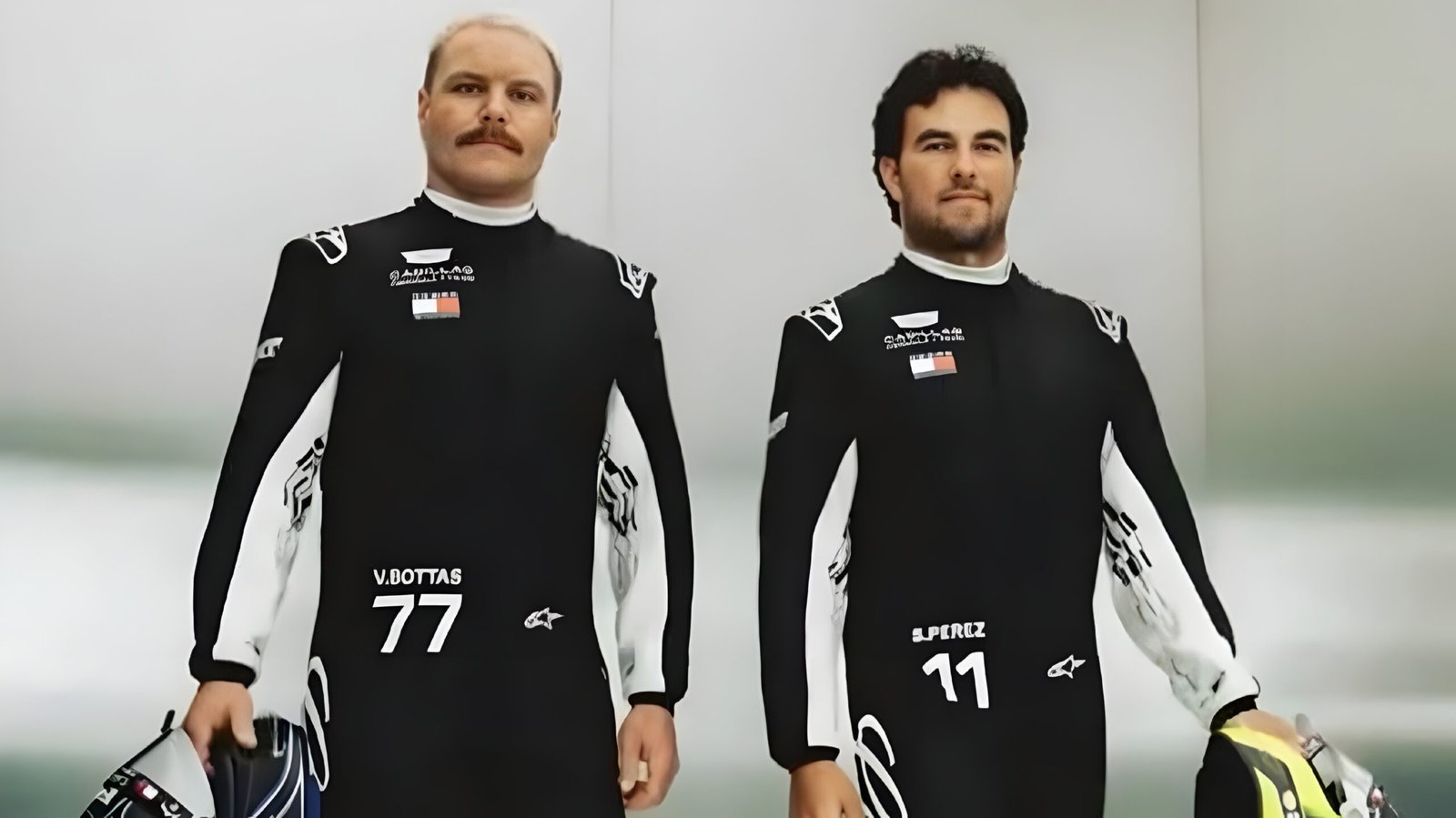
Cadillac Formula 1 drivers Valtteri Bottas and Sergio Perez representing the American constructor during its inaugural 2026 campaign.
Published by: AutodromeF1 Editorial Team
Cadillac Formula 1 Team Signals Maturity Beyond Expectations: Consecutive Double Finishes Underscore Rapid Ascent in Inaugural 2026 Campaign
New York, 30 March – In the high-stakes arena of Formula 1, where new entrants often endure protracted periods of adaptation amid the sport’s unforgiving technical and competitive demands, the Cadillac Formula 1 Team has emerged as a compelling outlier. With just three races completed in the 2026 season—spanning the Australian, Chinese, and now Japanese Grands Prix—the American outfit has already delivered back-to-back double-car finishes, a milestone that belies its status as a debutant constructor. This achievement, realized through the disciplined execution of the MAC-26 chassis powered by a Ferrari power unit, reflects not mere survival but a deliberate, data-driven progression that positions Cadillac as a credible midfield contender far earlier than industry observers anticipated.
At the storied Suzuka Circuit, host of the Japanese Grand Prix, the team’s resilience was on full display. Starting from the 19th and 20th positions on the grid—positions that underscored the ongoing challenges of qualifying pace in a fiercely competitive field—both drivers navigated the 53-lap contest with clinical efficiency. Sergio Perez, the seasoned Mexican veteran, crossed the line in 17th place, marking a significant milestone as he completed the full race distance on the lead lap for the first time this season. His teammate, Valtteri Bottas, the Finnish stalwart known for his precision and consistency, finished 19th after a strategic blue-flag sequence late in the race saw him finish one lap adrift of the leaders. While points remain elusive, these results have propelled Cadillac to 10th in the Constructors’ Championship, moving them narrowly ahead of Aston Martin and signaling an early psychological edge in the lower-midfield battle.
Such outcomes are the product of incremental yet meaningful strides in reliability and racecraft. The MAC-26, Cadillac’s inaugural ground-effect machine conceived under the sport’s evolving aerodynamic regulations, has demonstrated a robustness that many rival new teams historically lacked in their formative phases. Team Principal Graeme Lowdon, a figure whose pedigree spans decades in motorsport management, was unequivocal in his assessment post-race. “We have seen a tangible edge in race pace compared to Aston Martin,” he noted, crediting the aerodynamic upgrades introduced specifically for the Japanese round. These revisions—targeted enhancements to the diffuser and surrounding flow structures—translated directly into improved mechanical grip and reduced tyre degradation over long stints, allowing both drivers to maintain competitive lap times despite their grid disadvantage.
Perez himself echoed this optimism, describing the Suzuka weekend as “our strongest race yet” and highlighting how “our pace is getting closer” to the established midfield pack. For a driver with extensive experience across multiple constructors, his feedback carries particular weight; it underscores the symbiotic relationship between veteran input and the team’s engineering evolution. Bottas, meanwhile, has provided a steadying influence, his methodical approach to setup and feedback proving instrumental in refining the car’s balance through high-speed sections such as Suzuka’s Esses and the daunting 130R corner. Together, the duo has helped the squad extract maximum value from limited track time, turning potential vulnerability into a platform for steady gains.
The broader context of Cadillac’s 2026 entry amplifies the significance of these results. Entering the sport amid a new regulatory cycle designed to promote closer competition and technological parity, the team has prioritized foundational elements—structural integrity, power-unit integration, and operational cohesion—over premature performance chasing. The MAC-26’s Ferrari-derived powertrain has exhibited exemplary reliability, a critical factor in an era where hybrid systems and energy-recovery demands place unprecedented stress on components. Starting both cars from the back of the grid yet finishing on the lead lap speaks volumes about strategic race management and the drivers’ ability to conserve resources while navigating traffic.
Equally noteworthy is the team’s global operational footprint, which Lowdon has repeatedly emphasized as a cornerstone of their accelerated development timeline. Facilities in Indianapolis and Charlotte in the United States, complemented by European hubs in Silverstone and Germany, form an integrated network that facilitates round-the-clock collaboration. This distributed yet synchronized model enables rapid iteration: aerodynamic data gathered in one location can inform chassis refinements in another within hours, bypassing the bottlenecks that once plagued fledgling outfits. The result is a development cadence that rivals more established teams, positioning Cadillac to capitalize on upcoming opportunities with precision.
Aesthetically and symbolically, the team’s crisp white livery has become an unmistakable presence on the grid, evoking the heritage of American automotive excellence while projecting modernity and clarity. Adorned with the iconic Cadillac crest and subtle nods to sponsor partners, the design stands in elegant contrast to the technicolour spectacle of Suzuka’s cherry-blossom-lined straights. More than a visual statement, it embodies the squad’s headquarters in Fishers, Indiana—a deliberate anchor in the American heartland that reinforces the brand’s commitment to U.S.-centric innovation within a global sport. This livery, unveiled to widespread acclaim prior to the season, has already become a fan favourite, symbolizing a fresh chapter in Formula 1’s transatlantic narrative.
Looking ahead, the team’s trajectory appears poised for further inflection. A comprehensive upgrade package is scheduled for deployment at the Miami Grand Prix, Cadillac’s de facto home event given its alignment with American motorsport audiences and the venue’s proximity to key operational bases. This package, building upon the aerodynamic revisions debuted in Japan, is expected to address remaining deficits in low-speed cornering and overall downforce efficiency. Lowdon has described the Miami update as “a significant step forward,” one that will integrate learnings from the first three races while leveraging the collective expertise of the global engineering cadre. With the midfield tightly bunched—often separated by mere tenths of a second per lap—the potential for Cadillac to secure its maiden points haul is tangible, provided the upgrades deliver the anticipated performance uplift.
Yet the story extends beyond immediate results. Cadillac’s approach exemplifies a mature philosophy: one that values sustainable progress over short-term headlines. In an era where regulatory stability and cost-cap constraints reward disciplined resource allocation, the team’s emphasis on reliability first has mitigated the typical debutant pitfalls of mechanical failures and strategic missteps. This methodical ethos mirrors successful historical precedents—teams that invested early in infrastructure and culture rather than chasing fleeting glory. By fostering an environment where engineering excellence and driver synergy converge, Cadillac is not merely participating; it is laying the groundwork for long-term competitiveness.
Analysts within the paddock have taken note. The ability to outpace Aston Martin in race trim, despite starting further back, suggests Cadillac’s baseline performance is evolving faster than some rivals’ development curves. The Constructors’ standings may currently read zero points, but the underlying metrics—race pace, tyre management, and consistency—paint a picture of a constructor on the cusp of relevance. As the season progresses through demanding venues like Bahrain, Imola, and beyond, these early indicators will be stress-tested. However, the foundation established in the opening trio of events provides a robust platform from which to launch.
In summation, the Cadillac Formula 1 Team’s back-to-back double finishes at the Chinese and Japanese Grands Prix represent far more than statistical footnotes; they embody a deliberate, expertly orchestrated entry into the pinnacle of motorsport. From the precision engineering of the MAC-26 to the strategic vision articulated by Lowdon and executed by Perez and Bottas, every element reflects a commitment to excellence that transcends the rookie label. As the squad prepares for its symbolic homecoming in Miami, equipped with further technical enhancements and buoyed by growing confidence, the prospect of inaugural points—and perhaps greater heights—looms with increasing certainty. In a sport defined by relentless evolution, Cadillac has demonstrated that patience, partnership, and professionalism can yield results that resonate far beyond the chequered flag. The 2026 season, still in its infancy, already carries the hallmarks of a compelling American success story in the making.


