Published by: AutodromeF1 Editorial Team
Cadillac’s Deliberate Entry: Forging Credibility Through Reliability in Formula 1’s Expanded Grid
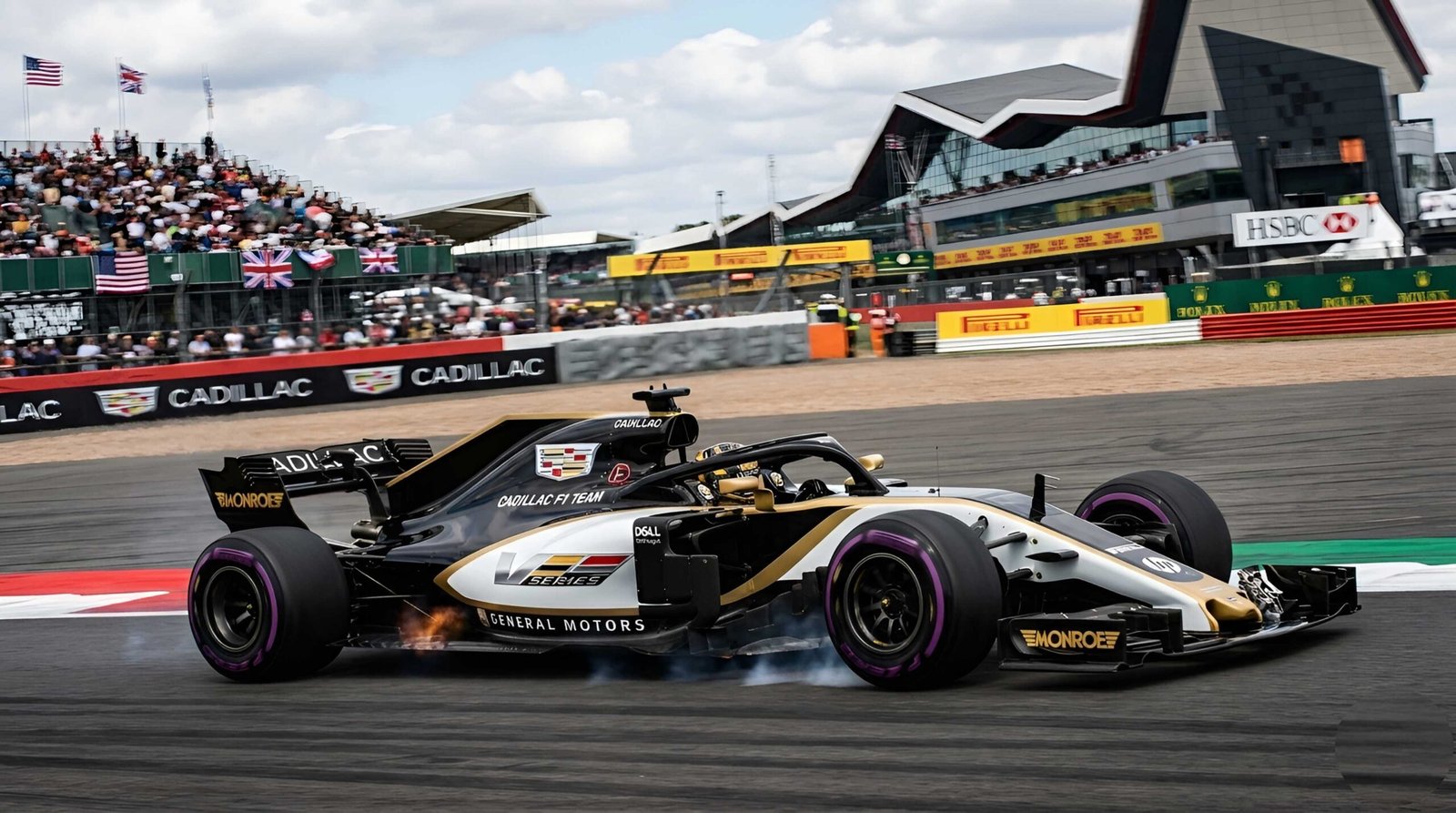
London, United Kingdom April 6 – In the high-stakes arena of Formula 1, where debut seasons for new entrants have historically been defined by either spectacular failure or cautious anonymity, the Cadillac Formula 1 Team has charted a markedly different course. As the sport’s 11th constructor, the American outfit—backed by General Motors and TWG Motorsports—has completed its first three Grands Prix with a poise and operational maturity that belies its embryonic status. Achieving five car finishes out of six entries across the Australian, Chinese, and Japanese rounds, while occupying 10th place in the constructors’ standings with no points to its name, represents not mere survival but a calculated assertion of competence. This is no opportunistic cameo; it is the opening chapter of a meticulously engineered long-term strategy, one that prioritises foundational resilience over fleeting headlines.
Team principal Graeme Lowdon, a veteran whose stewardship of the former Marussia squad provided invaluable institutional memory, has been unequivocal in framing the team’s early narrative. “We have earned the respect of our rivals,” he noted in the aftermath of the Australian Grand Prix, underscoring that reliability and data acquisition form the bedrock upon which future competitiveness will be constructed. Far from the performative optimism that often accompanies new-team launches, Lowdon’s assessment reflects a pragmatic realism honed by decades in the paddock: in an era of unprecedented regulatory complexity—with 2026 ushering in radical power-unit and aerodynamic reforms—simply reaching the chequered flag consistently is an achievement worthy of measured celebration.
The debut weekend in Melbourne offered an immediate litmus test. Sergio Pérez, the experienced Mexican with over 250 Grand Prix starts and multiple podium pedigree from his Red Bull tenure, guided the Ferrari-powered MAC-26 to 16th position, albeit three laps in arrears. His Finnish counterpart, Valtteri Bottas—likewise a ten-time Grand Prix winner and former Mercedes stalwart—retired on lap 16 due to an early technical concern. Yet even in adversity, the squad demonstrated flashes of promise: both drivers extracted competitive qualifying performances relative to certain established midfield rivals, avoiding the wholesale mechanical meltdowns that have plagued less disciplined newcomers. The focus, as Lowdon reiterated, was never victory but the systematic harvesting of telemetry, tyre degradation insights, and aerodynamic behaviour under race conditions.
Shanghai’s Chinese Grand Prix marked a tangible step forward. Both cars completed the full race distance for the first time, with Bottas crossing the line in 13th and Pérez in 15th. This double finish, achieved amid the logistical intricacies of an international sprint-format weekend and despite a first-lap skirmish between the teammates, signalled operational cohesion. Lowdon’s post-race reflections captured the essence of Cadillac’s ethos: “We can be very pleased with that result… to get two cars to the finish at the end of our second-ever race weekend is a great achievement for everyone.” The result was not merely statistical; it validated the decision to pair two battle-hardened veterans whose combined 527 starts provided the feedback loop essential for rapid iteration in an all-new chassis.
By the time the field arrived at Suzuka for the Japanese Grand Prix, the narrative had evolved from cautious optimism to quiet confidence. Both drivers again saw the flag—Pérez and Bottas finishing 17th and 19th respectively—prompting Pérez to declare it “our strongest race so far.” The circuit’s demanding high-speed corners exposed persistent shortcomings in downforce generation and mechanical grip through medium- and high-speed turns, yet the cars’ ability to maintain structural integrity and power-unit reliability across 53 gruelling laps underscored a consistency that has already surpassed preseason expectations. In an environment where even veteran squads encountered reliability gremlins with the new-generation machinery, Cadillac’s error-free progression stood in stark relief.
This emphasis on endurance over outright pace is deliberate. The MAC-26 was conceived as a “baseline” machine—signed off early to guarantee grid presence—prioritising robustness and data fidelity over ultimate aerodynamic efficiency. Weaknesses in downforce and cornering speed, openly acknowledged by the team, are not hidden embarrassments but acknowledged engineering realities to be methodically addressed. Major upgrade packages are scheduled for the European leg of the calendar, beginning in earnest after the initial flyaway races. These will target aerodynamic surfaces, suspension geometry, and power-unit integration, informed by the terabytes of data accumulated thus far. Lowdon has been clear: instant results are secondary to earning the paddock’s respect through visible competence. “We are way ahead of where we really should be,” he has observed, a statement that resonates not as bravado but as evidence-based confidence in the project’s trajectory.
Central to this data-centric philosophy is Cadillac’s strategic alliance with Core Scientific, formalised in early March as the team’s Official Data Center Partner. The collaboration extends far beyond sponsorship; Core Scientific is providing architectural guidance, optimisation expertise, and high-density computing infrastructure for Cadillac’s forthcoming Indianapolis headquarters. This encompasses advanced simulation environments, real-time analytics platforms, and hybrid cloud architectures capable of supporting the immense computational demands of modern Formula 1 development—from computational fluid dynamics to digital twin modelling of race operations. In an era where simulation has become the lifeblood of competitive advantage, this partnership positions Cadillac to accelerate its learning curve exponentially. It is a forward-looking investment that distinguishes the team from predecessors who relied solely on on-track mileage; here, virtual prototyping and machine-learning-driven insights will compress development timelines and refine upgrade pathways with surgical precision.
Viewed through a wider historical lens, Cadillac’s approach merits particular admiration. The last true startup constructor, Haas in 2016, opted for a customer-car model that yielded early points but ultimately constrained long-term autonomy. Cadillac, by contrast, is building a genuine in-house capability from Silverstone’s operational hub, complemented by burgeoning North American facilities. The appointment of technical luminaries such as Nick Chester (former Renault technical director) as chief technical officer and Pat Symonds as executive engineering consultant further evidences a commitment to intellectual capital over short-term spectacle. With GM’s own power unit slated for introduction in 2029, the current Ferrari customer arrangement serves as a bridge, allowing the squad to master chassis integration while laying the groundwork for full vertical integration.
The driver pairing itself is emblematic of strategic foresight rather than headline-chasing. Pérez and Bottas bring not only racecraft but also leadership and technical acuity—qualities that translate directly into actionable development input. Their feedback during pre-season testing was described by Lowdon as “super accurate,” accelerating the team’s understanding of the 2026 regulations’ nuances. This veteran presence mitigates the rookie pitfalls that have historically hampered new entries, allowing engineers to focus on systemic improvement rather than basic operational teething issues.
Yet the road ahead remains demanding. The midfield battle is ferocious, and Cadillac’s current deficit in qualifying pace—particularly in sectors requiring high downforce—will require targeted aerodynamic and mechanical solutions. Points remain the ultimate currency, and while the team harbours realistic ambitions of scoring before the summer break, the true inflection point is anticipated with the European upgrades. Consistency, however, has already exceeded expectations, providing a platform from which sustainable progress can be launched.
In the broader context of Formula 1’s evolution, Cadillac’s measured debut carries symbolic weight. The sport’s expansion to 11 teams enhances its global appeal, particularly in the vital North American market, while underscoring the commercial and technological allure of the championship. For General Motors and the Cadillac marque, this is more than motorsport participation; it is a platform to showcase American engineering ingenuity on the world’s premier stage. The partnership with Core Scientific further signals a fusion of cutting-edge digital infrastructure with automotive heritage, potentially yielding transferable technologies in high-performance computing and sustainable energy management.
As the season progresses, Cadillac’s story will be one of incremental elevation rather than overnight transformation. In an industry prone to hyperbole, the team’s refusal to overpromise while quietly delivering on fundamentals represents a refreshing departure. Reliability has earned them respect; data infrastructure will fuel their evolution; targeted upgrades will unlock competitiveness. This is not the narrative of a team merely turning up—it is the disciplined genesis of a constructor with ambitions as expansive as the grid it has joined. The checkered flags of Melbourne, Shanghai, and Suzuka are not endpoints but waypoints on a meticulously plotted journey toward enduring relevance in Formula 1’s demanding ecosystem.


