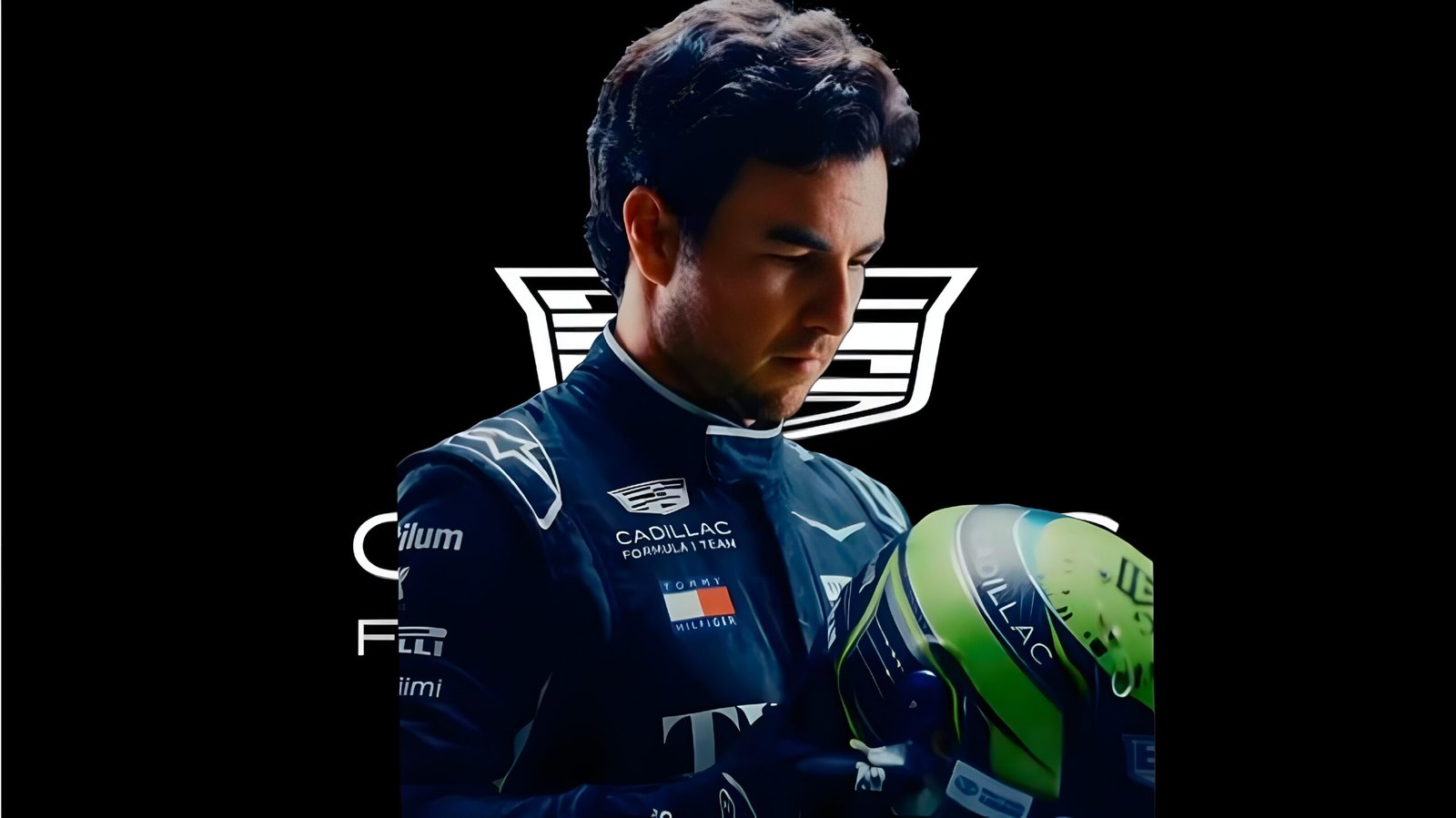
Sergio Pérez evaluates the technical data at Suzuka as Cadillac Racing debuts its first major 2026 aerodynamic overhaul to improve high-speed stability.
Published by: AutodromeF1 Editorial Team
Cadillac’s Suzuka Aero Debut: Engineering Precision Meets the Demands of F1’s Most Demanding High-Speed Arena
Suzuka, Japan 28 March – In the rarefied world of Formula 1, where every tenth of a second is the product of months of computational fluid dynamics, wind-tunnel validation, and relentless iteration, the arrival of a new constructor is never merely an addition to the grid—it is a statement of engineering ambition. Cadillac Racing, the eleventh team to join the 2026 Formula 1 World Championship, has now taken its first substantive technical stride on the global stage. At the Suzuka Circuit in Japan, the American squad unveiled its inaugural major aerodynamic upgrade package, a carefully orchestrated development step that, while not yet translating into front-row pace, has delivered tangible gains in high-downforce stability on one of the most technically unforgiving tracks in the calendar.
Qualifying on Saturday saw Valtteri Bottas and Sergio Pérez line up 19th and 20th respectively, a result that, on paper, appears modest for a squad still finding its competitive footing. Yet beneath the surface statistics lies a more nuanced narrative of progress. Team engineers and senior management were unequivocal in their post-session assessments: the upgraded package has introduced measurable improvements in the car’s behavior through Suzuka’s high-speed sweeps, particularly in sectors where sustained aerodynamic load is paramount. The revisions—focused on optimizing flow management around the diffuser and associated end-plate geometry—represent Cadillac’s first significant investment in performance since the season-opening rounds in Australia and China, where the car operated in a more conservative baseline specification.
Suzuka, with its unique figure-eight configuration, places extraordinary demands on aerodynamic efficiency. The circuit’s combination of long, high-speed corners—most notably the 130R, the ultra-fast left-hander taken at speeds exceeding 300 km/h—requires a delicate balance between downforce generation and drag minimization. The elevated ride heights and aggressive camber settings typical of a high-downforce setup can expose weaknesses in mechanical grip and aero consistency if the underlying package is immature. Cadillac’s decision to debut the upgrade here was therefore both strategic and courageous: a deliberate choice to test the car’s limits against the very layout that has historically separated well-developed machines from those still in their developmental infancy.
Internal team reports, shared with select media partners under embargo, describe “clear progress” in rear-end stability under load. The revised diffuser and fence architecture have evidently enhanced the pressure recovery characteristics in the underfloor region, allowing the car to maintain a more consistent ride height through compression zones and high-G corners. Drivers reported improved confidence in the rear axle, particularly on corner entry and mid-corner, where previous iterations had exhibited a degree of nervousness that compromised lap time. That said, the higher-downforce configuration introduced its own set of compromises—most notably a slight increase in drag that manifested in reduced straight-line speed on the circuit’s two long acceleration zones. Such trade-offs are the inevitable consequence of early-season development on a brand-new platform; they are not setbacks but data points in an iterative learning curve.
This measured assessment aligns closely with the public comments of Sergio Pérez, the Mexican veteran who brings more than 250 Grand Prix starts and hard-won experience of multiple team transitions to the Cadillac garage. Speaking after qualifying, Pérez emphasized the squad’s “methodical, session-by-session” philosophy—an approach that deliberately prioritizes understanding over immediate headline results. “We are not here to chase miracles in race one,” he noted. “Every run, every data trace, every tire degradation profile is teaching us something fundamental about this car and this power unit. The stability we have gained today is real. It is the foundation upon which we will build.” His words carry the weight of authenticity; Pérez has seen enough rookie outfits come and go to recognize the difference between cosmetic optimism and genuine engineering momentum.
The weekend in Japan did not occur in isolation. Cadillac’s early-season performances in Melbourne and Shanghai provided critical baseline data. In Australia the team recorded two solid but unspectacular finishes within the lower reaches of the classification; in China both drivers delivered improved results, with Bottas crossing the line 13th and Pérez 15th. Those two-car finishes—unremarkable in isolation—acquired greater significance when viewed against the backdrop of a completely new organization still calibrating its operational rhythms. The Ferrari power unit beneath the Cadillac skin has proven reliable, delivering consistent power delivery and thermal management that have allowed the team to focus developmental bandwidth on chassis and aero rather than firefighting engine-related reliability concerns.
As a consequence, Cadillac currently sits 10th in the Constructors’ Championship with zero points to its name. In the context of a rookie campaign, however, this ranking is less a reflection of failure than of prudent conservatism. The 2026 regulations introduced a new generation of power units and chassis architecture, and Cadillac elected to enter the championship with a conservative initial specification, prioritizing systems integration and long-term durability over early-season heroics. The Suzuka package marks the first visible departure from that baseline, and the team’s leadership has already signaled that further evolutions are scheduled for the upcoming Miami Grand Prix weekend, with additional aerodynamic and mechanical refinements anticipated before the European leg of the calendar.
Pérez’s stated ambition—securing the team’s first World Championship points by the summer break—feels both realistic and strategically sound. The summer shutdown in late July traditionally serves as a natural inflection point for mid-season evaluation. By that stage Cadillac will have contested ten Grands Prix, accumulated thousands of kilometers of race and test data, and implemented at least two more major upgrade packages. The presence of two highly experienced drivers is proving invaluable in this process. Bottas, with his meticulous feedback style honed over more than a decade at the front of the grid, and Pérez, whose instinctive understanding of tire management and race-craft remain elite, are providing the kind of high-fidelity telemetry and subjective input that accelerates development far beyond what rookie drivers could achieve.
From an engineering standpoint, the significance of the Suzuka upgrade extends beyond the immediate lap-time gains. It demonstrates that Cadillac’s design office—operating out of a newly established technical center in the United States with satellite operations in Europe—possesses the capability to identify circuit-specific weaknesses, model solutions in CFD, validate them in the wind tunnel, and manufacture components in time for a fly-away event. In an era when the cost cap and technical regulations place severe constraints on development tokens, the ability to execute a targeted, high-impact upgrade package so early in a team’s existence speaks volumes about organizational maturity.
Moreover, the choice of Ferrari as power-unit partner has proven astute. The Italian manufacturer’s 2026-spec hybrid system has already shown competitive straight-line performance and strong energy-recovery characteristics, attributes that complement the Cadillac chassis philosophy of prioritizing mechanical balance and aerodynamic efficiency. The seamless integration of the power unit and chassis electronics—often the Achilles’ heel of new entries—appears to have been achieved with minimal teething troubles, allowing the aerodynamic department to push forward without distraction.
Looking further ahead, the 2026 season promises to be one of the most competitive in recent memory. With regulatory stability now locked in for several seasons and the grid expanded to eleven teams, the battle for the lower half of the order will be every bit as intense as the fight at the front. Cadillac’s early approach—methodical, data-driven, and focused on incremental but compounding gains—mirrors the successful trajectories of previous successful newcomers who resisted the temptation of headline-grabbing short-term fixes. The team’s management has repeatedly stressed that 2026 is a foundation year; the objective is not merely to score points but to establish a sustainable development culture capable of challenging the established order by 2028 and beyond.
As the lights go out for the Japanese Grand Prix, the focus shifts from qualifying to race-day execution. The improved high-downforce stability should allow both drivers to maintain cleaner lines through the technical sections and preserve tire life over the 53-lap distance. Whether that translates into a points-scoring finish remains to be seen; the midfield remains ferociously competitive. Yet the narrative emerging from the Cadillac garage is not one of frustration but of quiet confidence. In an age when social media amplifies every qualifying lapse into crisis, the team’s internal discipline—refusing to overstate progress while quietly accumulating knowledge—sets it apart.
The Suzuka upgrade is therefore more than a set of new carbon-fiber components. It is tangible proof that Cadillac Racing has transitioned from concept to credible competitor. With experienced leadership, a proven power-unit partnership, and a clear developmental roadmap, the American marque is writing the opening chapter of what promises to be a compelling long-form story in Formula 1. The points will come; the question is not if, but when the team’s methodical investment in stability, understanding, and iterative improvement begins to deliver the results its engineering ambition so clearly deserves.


