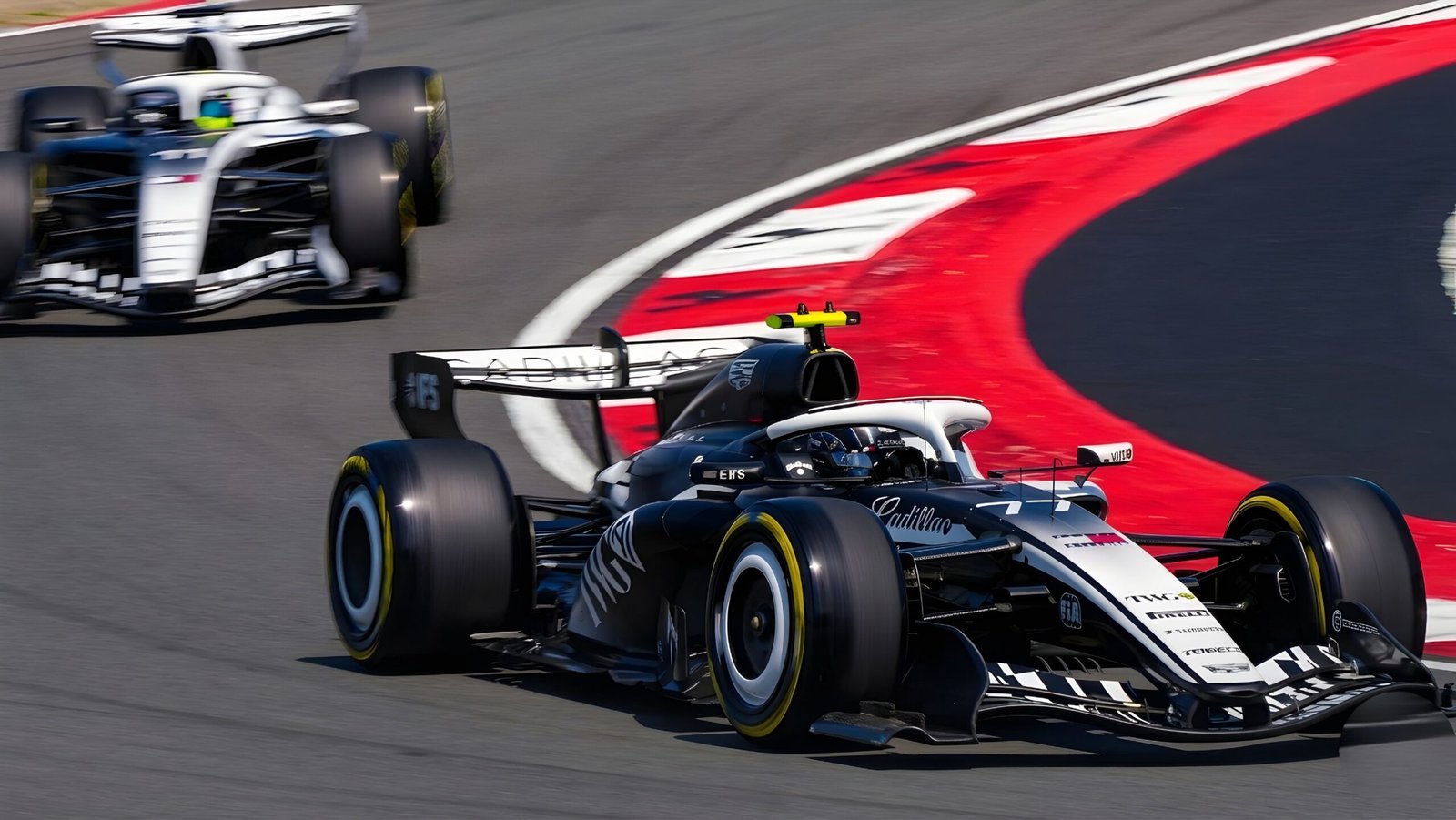
Sergio Pérez pilots the Cadillac MAC-26 through the high-speed curves of Suzuka during the 2026 Japanese Grand Prix, evaluating new aerodynamic upgrades.
Published by: AutodromeF1 Editorial Team
Cadillac F1’s Measured Progress at Suzuka: Pérez’s Team Radio Captures the Nuances of a Debutant Team’s Maturation
London, United Kingdom 30 March – In the unforgiving crucible of Suzuka Circuit, where technical precision and tire management converge with the relentless demands of high-speed corners, the Cadillac Formula 1 Team recorded another chapter in its inaugural 2026 campaign. Finishing 17th with Sergio Pérez at the wheel—his first completion of the full race distance on the lead lap—may appear modest on the surface. Yet the post-race team radio exchange between the Mexican veteran and his race engineer, Carlo Pasetti, revealed a deeper narrative of incremental, yet tangible, advancement. Far from the hyperbole that often accompanies early-season narratives for new entrants, this dialogue exemplified the disciplined ethos required to build competitiveness in Formula 1’s most stringent regulatory era.
The exchange, now circulating widely among aficionados, unfolded with characteristic restraint and focus:
Pérez: “There was an improvement with the engine this time!”
Pasetti: “Your stint on the mediums was very good, and also on the hards; you did a great job.”
Pérez: “We need to reduce the gap; we’re not too far off, eh?”
Pasetti: “Yeah, I can see it; we’re a bit closer to the Williams now.”
These words, delivered amid the post-race cooldown, encapsulate Cadillac’s strategic reality: not revolutionary leaps, but steady refinement amid the complexities of a brand-new chassis, Honda power unit integration, and the 2026 technical regulations that have reshaped aerodynamics, power deployment, and overall vehicle architecture.
Technical Foundations: The Suzuka Upgrade Package
Suzuka, with its demanding 5.807-kilometer layout featuring sweeping high-speed sections such as the 130R and the iconic Spoon Curve, has long served as a litmus test for aerodynamic efficiency and mechanical balance. Cadillac arrived equipped with targeted upgrades centered on a revised diffuser and an accompanying diffuser fence. These modifications were engineered to enhance rear-end downforce generation and improve ride-height sensitivity—critical attributes for maintaining stability under the variable loads imposed by Suzuka’s cambered turns and rapid direction changes.
Pérez, starting from 19th on the grid, navigated a race strategy that leveraged the upgraded package effectively. His stints on medium and hard compound Pirelli tires drew explicit praise from the pit wall, reflecting improved energy management and reduced degradation relative to prior outings. The team’s data indicated gains in rear load and overall stability, allowing the MAC-26 chassis to extract more consistent performance across varying fuel loads. While still trailing the established midfield benchmark set by Williams, Cadillac demonstrated moments of parity—and occasional superiority—over Aston Martin, particularly in longer-run pace.
This progress did not occur in isolation. It built upon the foundation established in the preceding rounds at Melbourne and Shanghai, where the team secured its first double finish. Reliability has emerged as a cornerstone: both cars completed the Japanese Grand Prix without mechanical interruption, a testament to the collaborative engineering efforts spanning Cadillac’s operational hubs in Silverstone, Indianapolis, and Charlotte. The Ferrari power unit, in its maiden full-works integration with an American manufacturer team, exhibited the noted improvement Pérez highlighted—an early validation of the partnership’s potential under the 2026 power regulations, which emphasize sustainability alongside performance.
Pérez’s Leadership: Experience as Catalyst
At 36, Sergio “Checo” Pérez brings a wealth of institutional knowledge to Cadillac, having amassed six Grand Prix victories and 39 podiums across more than a decade at the pinnacle of the sport. His role transcends mere driving; he functions as a de facto development driver, providing nuanced feedback that accelerates the team’s learning curve. Post-race, Pérez characterized the weekend as the squad’s strongest to date, underscoring not only the quantifiable gains in balance and pace but also the intangible momentum derived from trouble-free practice sessions and methodical setup iterations.
Pasetti’s responses on the radio further illuminate the engineering dialogue at play. The acknowledgment of tire performance and the confirmation of closing the gap to Williams reflect a data-driven culture that prioritizes incremental targets over premature declarations of arrival. In an era where 2026’s smaller, more agile cars and revised power units have compressed competitive margins at the front, such pragmatism distinguishes Cadillac from teams prone to volatility.
Valtteri Bottas, Pérez’s teammate and fellow veteran, mirrored this sentiment in his own assessments, noting the upgrades delivered expected aerodynamic benefits without constituting a “game-changer” yet still advancing the baseline. The Finnish driver’s 19th-place finish complemented Pérez’s result, securing the second consecutive double completion and reinforcing operational maturity.
Contextualizing Cadillac’s Debut in the 2026 Landscape
The entry of Cadillac as Formula 1’s 11th team coincides with profound regulatory transformation. The 2026 ruleset—featuring downsized aerodynamics, active suspension elements in some interpretations, and power units with a greater emphasis on electric deployment—has recalibrated expectations for newcomers. General Motors’ luxury marque joins alongside established powerhouses and other fresh entrants, yet its approach stands apart: a deliberate, multi-year investment in infrastructure and human capital rather than a speculative sprint for early points.
Early-season indicators placed the team toward the rear of the field, a predictable outcome for any organization navigating homologation, wind-tunnel correlation challenges, and the integration of a new powertrain supplier. Honda’s return as a full manufacturer further adds layers of complexity, with initial teething issues in vibration management and energy deployment documented across the grid. Yet Cadillac’s trajectory—evident in Suzuka’s closer proximity to Williams and selective outpacing of Aston Martin—signals a trajectory aligned with long-term midfield aspirations.
This weekend’s performance also highlighted the circuit-specific demands of Suzuka. The circuit’s combination of low- and high-speed corners rewards precise mechanical grip and efficient cooling, areas where the revised diffuser has begun to yield dividends. Pérez’s ability to advance two positions despite a practice incident involving contact with another competitor further attests to resilience under pressure.
Strategic Horizons: Momentum Toward Miami and Beyond
As the championship transitions to the Miami International Autodrome, Cadillac’s development pipeline promises additional aerodynamic and power-unit refinements. The team has publicly committed to race-by-race evolution, a cadence that aligns with the iterative philosophy articulated in Pérez’s radio communications. Points remain a realistic medium-term objective, with the summer break serving as an informal milestone for evaluating whether consistent top-15 finishes can translate into championship classification advancement.
Broader implications extend beyond the scoreboard. Cadillac’s presence injects American industrial heritage into Formula 1’s global fabric, fostering potential synergies in technology transfer between automotive production and motorsport innovation. For Pérez, the project represents a homecoming of sorts—a chance to impart hard-earned wisdom to a squad unburdened by decades of institutional inertia.
In the final analysis, the Suzuka team radio does not herald overnight transformation. Instead, it offers a candid, authoritative glimpse into the patient craftsmanship demanded of a modern F1 constructor. By focusing on engine harmony, tire longevity, and targeted gap reduction, Cadillac has signaled its intent to compete not through spectacle but through substance. As the 2026 season unfolds, this measured optimism may prove the most enduring asset of all.
The Japanese Grand Prix thus stands as more than a P17 result. It represents validation of a process: one where expertise accumulates lap by lap, upgrade by upgrade, and conversation by conversation. For an American team powered by Japanese ingenuity on one of motorsport’s most revered stages, few outcomes could prove more symbolically resonant—or more promising for the campaigns ahead.


