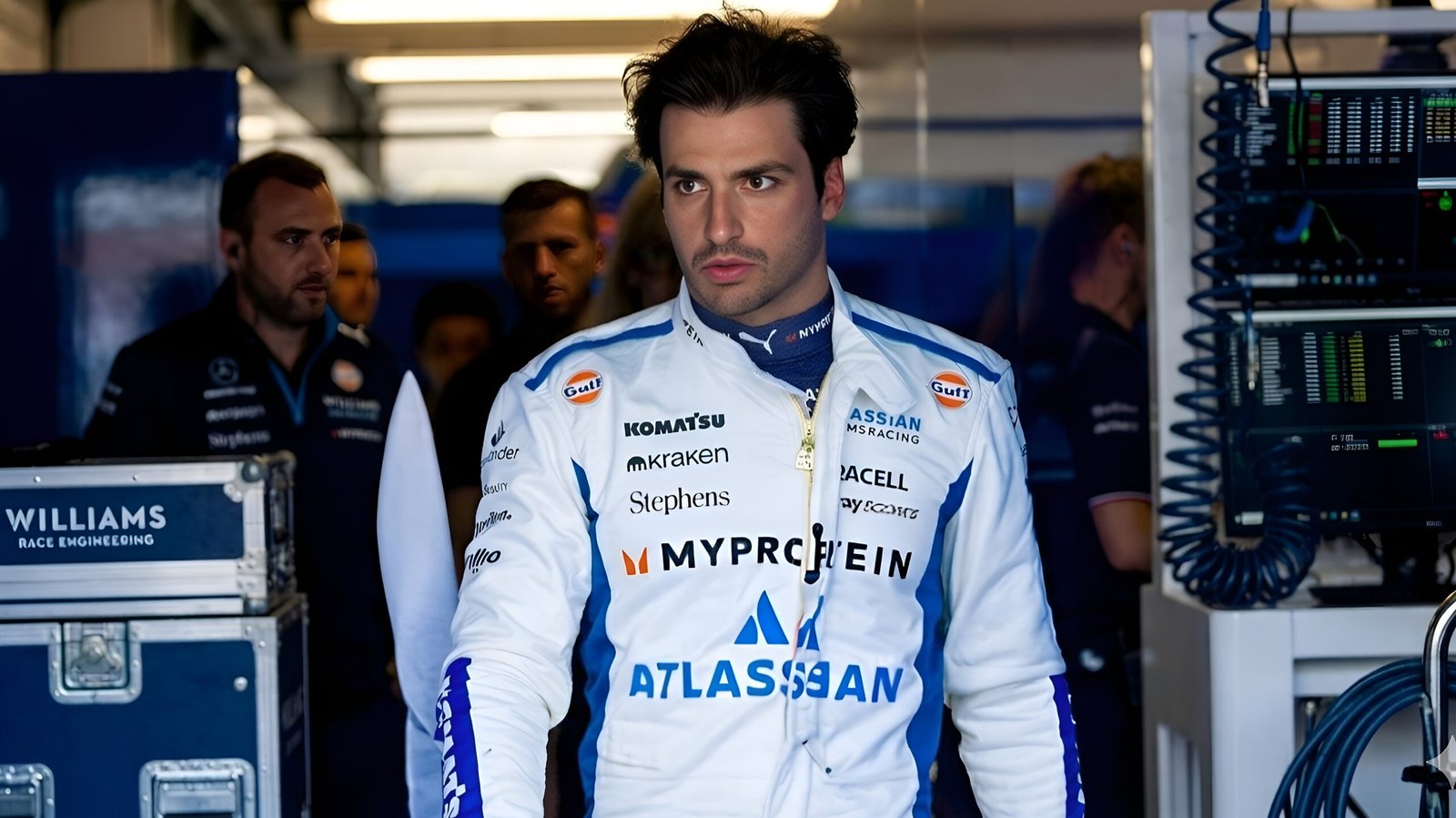
Carlos Sainz Jr. in the Williams Racing garage during the 2026 season, where he has become a leading voice against the sport’s new “Formula E-style” energy management rules.
Published by: AutodromeF1 Editorial Team
Carlos Sainz Jr. Issues Measured Critique of Formula 1’s 2026 Technical Regulations, Urging Regulatory Flexibility to Safeguard the Sport’s Core Identity
London, 24 March – In an era defined by rapid technological evolution and an unwavering commitment to sustainability, Formula 1 stands at a pivotal crossroads. The introduction of the 2026 technical regulations, intended to herald a new chapter of innovation and environmental responsibility, has instead sparked candid debate among the sport’s most respected voices. Carlos Sainz Jr., the seasoned Spanish driver and current Grand Prix Drivers’ Association representative, has emerged as a prominent critic, publicly describing the framework as fundamentally “flawed” and markedly divergent from his vision of the sport’s essence. His observations, which resonate deeply with concerns previously raised by reigning champion Max Verstappen, underscore a growing apprehension that the new regulations may inadvertently prioritize artificial constraints over the instinctive, high-stakes racing that has long defined Formula 1’s global appeal.
Sainz’s commentary arrives at a moment when the paddock is still acclimating to the inaugural season under the revised rules. Far from a knee-jerk reaction, his assessment reflects a considered evaluation rooted in extensive simulation data, early-season on-track experience, and collaborative discussions among drivers and engineers. At its heart lies a profound unease with the energy-management architecture embedded within the revised power-unit specifications. These provisions, designed to enhance efficiency through advanced hybrid systems and stringent recovery protocols, are instead compelling drivers toward a style of racing that Sainz characterizes as overly prescriptive and strategically burdensome. Rather than unleashing the full spectrum of driver skill in pursuit of outright velocity and tactical wheel-to-wheel combat, the regulations appear to demand perpetual calibration of energy deployment, transforming circuits into arenas of conservation rather than conquest.
Central to Sainz’s critique are three interrelated deficiencies that, in his view, erode the sport’s traditional virtues. First, the imposition of tight energy-harvesting limits has necessitated frequent “lift-and-coast” maneuvers, wherein drivers must deliberately reduce throttle input on straights to preserve battery reserves for subsequent deployment zones. This practice, while engineered to promote efficiency, disrupts the fluidity of racing lines and diminishes the exhilarating, uninterrupted power delivery that spectators have come to expect from Formula 1 machinery. On high-speed circuits, these interventions manifest as abrupt deceleration points, often mid-straight, that compromise both lap times and overtaking opportunities. Sainz has articulated that such constraints shift the competitive emphasis away from mechanical grip and aerodynamic mastery toward a more calculated, almost formulaic energy-budgeting exercise.
Compounding this issue is the proliferation of power modes and associated electronic settings. The 2026 power units incorporate an expanded array of configurable parameters, requiring drivers and their strategists to navigate a labyrinth of deployment maps, harvest thresholds, and recovery algorithms in real time. What was once a domain of instinctive decision-making—gauging slipstream advantages or exploiting tire degradation—now incorporates layers of system-tuning that demand constant cognitive overhead. Sainz contends that this complexity not only burdens the driver but also obscures the spectacle for audiences. Telemetry overlays and broadcast graphics, already strained in conveying the nuances of hybrid energy flow, risk alienating casual viewers who tune in for visceral speed rather than esoteric energy-flow diagrams. In essence, the regulations risk rendering Formula 1 less accessible and more esoteric, a concern that extends beyond the cockpit to the very sustainability of the sport’s fan base.
Perhaps most tellingly, Sainz draws a direct parallel between the emerging dynamic and the energy-centric ethos of Formula E, albeit amplified by the superior performance envelope of current-generation Formula 1 cars. Echoing Verstappen’s earlier characterization of the regulations as “Formula E on steroids,” the Ferrari driver emphasizes that the emphasis on sustainable energy management, while laudable in principle, has supplanted the raw, unfiltered pursuit of speed and mechanical prowess that historically distinguished the pinnacle of motorsport. Traditional F1 values—slipstream battles waged at full throttle, the tactile feedback of mechanical grip through high-downforce corners, and the unyielding demand for driver precision under sustained power—have been subordinated, he argues, to a regime of strategic energy husbandry. This philosophical departure, Sainz maintains, threatens to dilute the sport’s unique DNA at a time when global audiences seek escapism through uncompromised athletic and technological excellence.
Yet Sainz’s intervention is neither polemical nor defeatist. In his capacity as a GPDA director, he has framed his remarks as a constructive appeal for institutional agility. He has explicitly urged the Fédération Internationale de l’Automobile (FIA) to remain receptive to iterative adjustments, particularly concerning energy-allowance thresholds and select elements of the revised start procedures. These procedural modifications, intended to standardize launch protocols under the new hybrid architecture, have introduced additional variables that, according to Sainz, could inadvertently elevate safety risks during the critical opening seconds of a Grand Prix. By advocating for “tweaks” ahead of demanding venues such as the high-energy circuits of Melbourne, Monza, and Spa-Francorchamps, Sainz underscores a pragmatic recognition that regulatory perfection on debut is improbable. “I acknowledge the FIA is unlikely to get everything right on day one,” he has observed, while simultaneously stressing that a broad consensus exists among drivers and teams that the current trajectory deviates from the Formula 1 they aspire to represent.
This collective sentiment, though articulated most vocally by Sainz and Verstappen, reflects a wider undercurrent within the paddock. Multiple squads have encountered early reliability challenges attributable to the heightened complexity of the power units, including intermittent deployment failures and thermal-management anomalies that have precipitated several did-not-starts in opening rounds. Such teething troubles, while anticipated in any paradigm shift, amplify the urgency of Sainz’s call for flexibility. The 2026 regulations were conceived in partnership with manufacturers to achieve ambitious targets: a substantial reduction in fossil-fuel dependency, enhanced energy-recovery efficiency exceeding 50 percent, and a recalibrated chassis philosophy emphasizing active aerodynamics and sustainable materials. These ambitions remain commendable. However, Sainz’s critique illuminates a tension between environmental imperatives and the sport’s entertainment mandate—a tension that, if unresolved, could undermine the very progress the regulations seek to embody.
From a broader historical perspective, Formula 1 has repeatedly demonstrated resilience through regulatory upheaval. The transition to hybrid power in 2014, the aerodynamic simplifications of 2017, and the ground-effect revival of 2022 each prompted initial skepticism, only to yield spectacular racing once refinements were implemented. The 2026 framework, with its mandated 50/50 split between internal-combustion and electrical power alongside mandatory sustainable fuels, represents the most holistic redesign in decades. Yet Sainz’s intervention serves as a timely reminder that technical ambition must be tempered by operational realism and spectator resonance. Drivers, after all, are not merely operators of machinery but custodians of the sport’s emotional core. Their feedback, grounded in thousands of competitive kilometers, constitutes an irreplaceable barometer of regulatory efficacy.
Looking ahead, the coming months will prove decisive. High-energy circuits on the 2026 calendar will expose the regulations’ limits with unforgiving clarity, potentially magnifying the very issues Sainz has delineated. Should the FIA heed the call for measured recalibration—perhaps through interim directives on energy ceilings or simplified mode architectures—the sport may yet realize its dual objectives of sustainability and spectacle. Conversely, an inflexible adherence to the original blueprint risks entrenching a perception of Formula 1 as a laboratory exercise rather than a gladiatorial contest. Stakeholders, from team principals to broadcast partners, are already monitoring audience metrics and social sentiment with heightened vigilance. Early indications suggest that while technical purists applaud the engineering ingenuity, a significant cohort of enthusiasts yearns for the unbridled drama that once rendered Formula 1 incomparable.
In conclusion, Carlos Sainz Jr.’s public stance transcends mere dissatisfaction; it constitutes an eloquent defense of Formula 1’s soul. By highlighting the perils of excessive energy husbandry, the opacity of proliferating settings, and the resultant departure from instinctive racing, he has articulated a vision that prioritizes driver agency, fan engagement, and competitive purity. His alignment with Verstappen and the tacit endorsement of fellow competitors signal a rare moment of paddock unity on a foundational issue. As the season unfolds, the onus rests with the FIA and Formula One Management to demonstrate the adaptability that has sustained the sport through previous evolutions. Only through such responsiveness can the 2026 regulations evolve from a promising blueprint into a triumphant realization—one that honors both ecological responsibility and the timeless thrill of motorsport at its most exalted.
The discourse initiated by Sainz invites all participants—regulators, manufacturers, teams, and aficionados—to reflect upon the delicate equilibrium that has long elevated Formula 1 above its rivals. In preserving that equilibrium, the sport ensures not merely survival but continued preeminence as the preeminent theater of speed, strategy, and human endeavor. The coming races will offer the first substantive verdict on whether the necessary recalibrations materialize, yet the clarity and conviction of Sainz’s message have already enriched the conversation immeasurably. Formula 1, in its finest tradition, thrives on challenge; the question now is whether its governing bodies will rise to meet this one with equal resolve.


