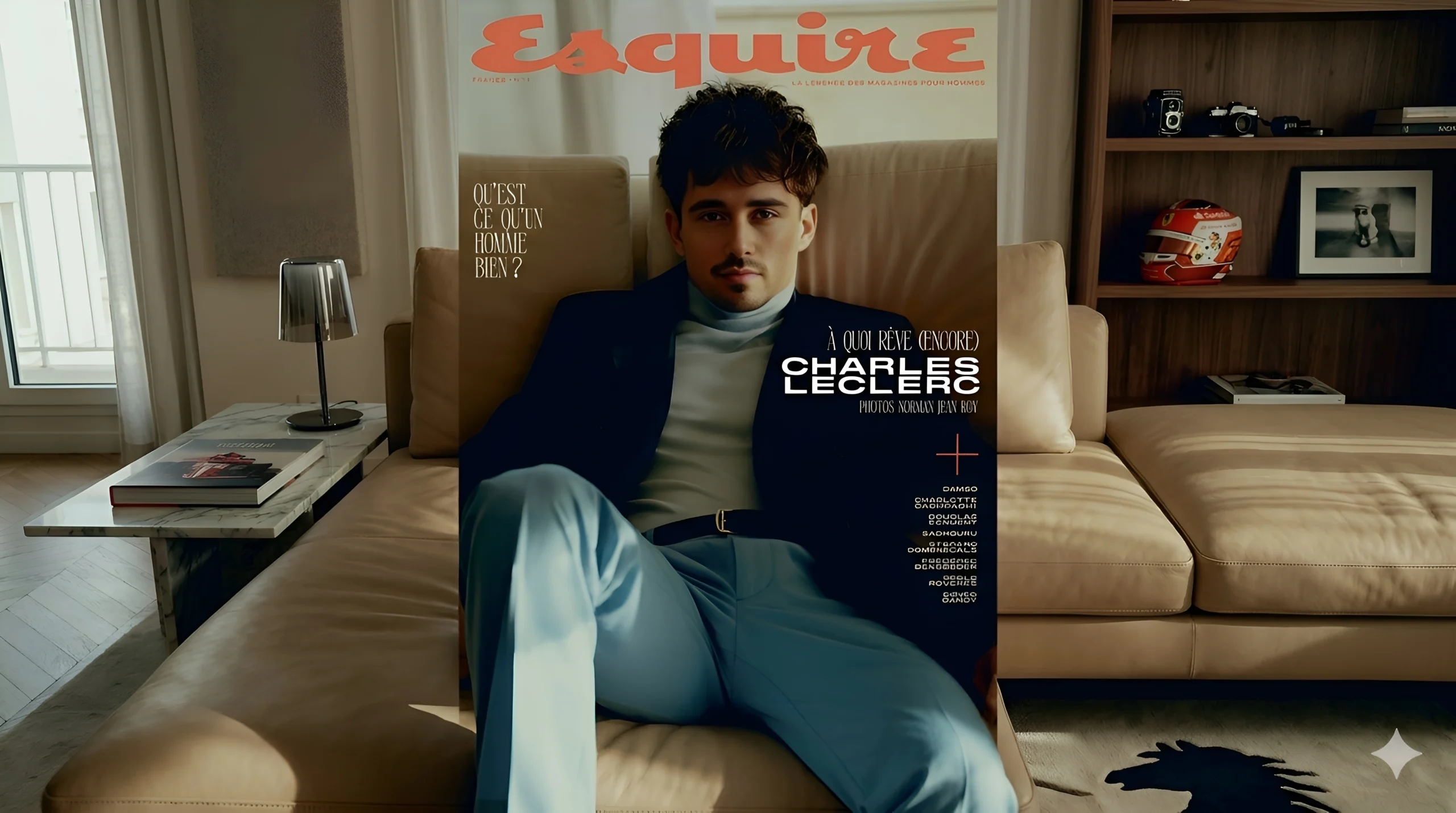
Charles Leclerc on the cover of the inaugural Esquire France (March 2026), photographed by Norman Jean Roy.
Published by: AutodromeF1 Editorial Team
Charles Leclerc and the Inaugural Esquire France: An Intimate Portrait of Ambition, Reflection, and the Relentless Pursuit of Time
Paris, France 26 March – In a landmark moment for French publishing and motorsport culture, Charles Leclerc has been selected to front the debut cover of Esquire France, the long-awaited national edition of the iconic American men’s magazine. Launched in April 2026 and now gracing newsstands across the country, the first issue signals a sophisticated new voice in lifestyle journalism—one that marries intellectual depth with unapologetic elegance. The cover, captured by renowned photographer Norman Jean Roy, presents Leclerc in a composition of quiet confidence: reclined on a neutral-toned sofa, clad in a crisp white turtleneck beneath a tailored black blazer, paired with flowing light-blue wide-leg trousers that evoke effortless French chic. The tagline, rendered in bold typography, poses a provocative question: “À quoi rêve (encore) Charles Leclerc?”—“What does Charles Leclerc still dream of?” A secondary interrogative, “Qu’est-ce qu’un homme bien?”, invites readers to ponder the essence of a good man in an era of relentless performance.
Leclerc himself acknowledged the honour with characteristic humility on social media on 24 March 2026: “Honoured to be on the cover of the first-ever ESQUIRE edition in France.” The post, which quickly amassed hundreds of thousands of engagements, captured the Monaco-born Ferrari driver in a moment of genuine pride. Yet the accompanying Esquire France feature—titled with the same introspective query—transcends mere celebrity endorsement. It offers a rare, extended conversation conducted in the sanctuary of his newly appointed Monaco apartment, overlooking the Mediterranean’s azure expanse. The setting itself becomes a character: sunlight filtered through “Greek light,” an immobile sky, and the subtle domestic details that humanise a man more accustomed to the roar of 1.6-litre hybrid power units than the hush of a Sunday morning at home.
This is no superficial fashion spread. Norman Jean Roy’s lens lingers on intimate details—a hand casually raking through tousled hair, the athletic breadth of shoulders beneath casual layers, and a domestic “temple” featuring an enormous Ferrari-branded champagne bottle (a magnum of mythic proportions) displayed alongside Leclerc’s red helmet from his triumphant 2024 Monaco Grand Prix victory. The imagery underscores a central theme: the tension between velocity and stillness, between public triumph and private equilibrium. For a driver whose career has been defined by razor-thin margins—pole positions that slipped away, heartbreaks on home soil, and the weight of Ferrari’s storied legacy—this cover represents a deliberate pause, an invitation to reflect on what endures once the chequered flag falls.
To appreciate the significance of Leclerc’s selection, one must consider the broader evolution of Formula 1’s cultural footprint. Once confined to the paddock and pit lane, today’s elite drivers navigate a multifaceted existence. Leclerc, at 28, embodies this shift. A prodigy who began karting on the streets of Monte Carlo, he progressed through the Ferrari Driver Academy with a blend of precocious talent and quiet resilience. His Formula 1 debut with Sauber in 2018 was followed by a seamless promotion to the Scuderia in 2019. Since then, he has amassed pole positions with metronomic precision—more than any active driver in recent memory—yet world championship contention has remained tantalisingly elusive, often thwarted by strategy calls, mechanical gremlins, or sheer bad fortune. The 2024 Monaco Grand Prix victory, however, rewrote the narrative. Starting from pole in the principality where he learned to drive, Leclerc finally exorcised the “curse” that had haunted him and predecessors alike. Crossing the line, his radio cries of raw elation—“Yeahhh!”—echoed across global broadcasts. Prince Albert II of Monaco was moved to tears in the subsequent embrace, a moment that transcended sport and affirmed Leclerc’s status as the principality’s favourite son.
The Esquire France interview delves deeper into this catharsis. Leclerc recounts the visceral surge of emotion as he exited the tunnel on those final laps, the circuit’s familiar contours suddenly feeling like an extension of himself. “The joy was surreal,” the piece notes, referencing footage still widely viewed on YouTube. Yet the conversation pivots swiftly from past glory to the philosophical undercurrents of his craft. Racing, he explains, is an exercise in temporal mastery. With 24 Grands Prix spanning from Australia in March to Abu Dhabi in December, there is no luxury of choice—only relentless execution. He recalls his rookie F1 laps: the overwhelming speed that eventually “slowed” in his perception after adaptation, the brain’s remarkable capacity to recalibrate. “The only moment I control time,” he reflects, “is when I enter the car. I know exactly how to go faster.” It is a statement of hard-earned expertise, delivered without bravado.
Equally compelling is Leclerc’s account of transcending the terrestrial. In 2024, he was granted the rare privilege of piloting a Rafale fighter jet from Saint-Dizier. Accompanied by a support aircraft with its rear ramp open for filming, he pushed the aircraft through the sound barrier above the Mediterranean, deliberately routing over Monaco. The sensations, he observes, diverged profoundly from those of an F1 car. On the ground, speed is tactile—felt through the track’s undulations, the scent of rubber and fuel, the wind’s buffet mere centimetres from the asphalt. In the air, it becomes abstract, rendered real only by G-forces pressing against the body. This juxtaposition illuminates a driver who, despite living at the extreme edge of velocity, seeks nuance in contrasting experiences. It is the mark of an athlete who understands performance as both physical and intellectual.
The feature also situates Leclerc within a more personal timeline. By early 2026, he had proposed to longtime partner Alexandra Saint Mleux on the very day they moved into their new Monaco residence. Their February wedding—intimate, with the sea as witness—marked another milestone. The article portrays the couple as “the most glamorous of the moment,” yet resists tabloid sensationalism, instead framing their union as a deliberate anchoring amid the chaos of a 24-race calendar. In the off-season, Leclerc speaks of “slowing down” and “walking in life,” a conscious counterpoint to the sport’s demands. Marriage, he suggests, offers a moment when “time will stop.” Such reflections carry added weight in an industry where careers can be curtailed by a single miscalculation or a rival’s superior machinery.
What distinguishes this Esquire France debut from typical sports-media fare is its refusal to reduce Leclerc to statistics or podium anecdotes. Instead, it interrogates the very nature of aspiration. The cover’s secondary question—“What is a good man?”—resonates beyond the racetrack. In an age when athletes are brands, influencers, and cultural figures, Leclerc emerges as a study in balance: fiercely competitive yet introspective, stylish without ostentation, rooted in Monaco yet global in appeal. His fashion choices on the cover—turtleneck layered with tailoring, wide-leg trousers that nod to contemporary menswear—reinforce this. They are not costume; they are an extension of a personality comfortable in both fireproof overalls and tailored separates. Esquire’s editorial team, by choosing him to launch their French edition alongside rapper Damso, signals an intentional fusion of high-performance sport, music, and refined masculinity.
For Ferrari, the partnership is equally symbolic. The Scuderia has long cultivated an aura of elegance alongside engineering excellence; Leclerc’s presence on a publication synonymous with timeless style amplifies that heritage. As the team prepares for the 2026 season—complete with new technical regulations and an evolving driver lineup—Leclerc’s public maturation adds narrative depth. Observers note that his re-signing with the team through the end of the decade provides stability amid speculation. Yet the Esquire piece gently reminds us that even a Ferrari driver harbours dreams beyond the championship. The article closes on a meditative note, pondering whether, in the maelstrom of chronometers and G-forces, Leclerc can ever fully extract himself from time’s grip. The answer, it implies, lies in moments of deliberate stillness: a Sunday morning at home, a proposal by the sea, the quiet satisfaction of a dream realised in front of his childhood circuit.
This cover is more than a fashion milestone; it is a cultural benchmark. In elevating a Formula 1 driver to the status of thoughtful protagonist in a literary men’s magazine, Esquire France challenges preconceptions about what constitutes “men’s interests.” Speed and introspection need not be opposites. For Leclerc, the dreams that remain—whether another title, deeper personal fulfilment, or simply the mastery of time itself—continue to propel him forward. As the 2026 season unfolds, with its fresh regulations promising closer competition, one suspects the question posed on that debut cover will linger in the minds of fans and rivals alike.
In an era when sporting icons are expected to excel in every arena, Charles Leclerc demonstrates that true distinction arises not from ceaseless acceleration, but from the wisdom to recognise when to slow down and reflect. Esquire France’s inaugural issue does not merely celebrate a driver; it captures a man at the intersection of legacy and possibility. For the Tifosi and beyond, it is a reminder that the most compelling stories are those still being written—one measured lap, one deliberate breath, one enduring dream at a time.


