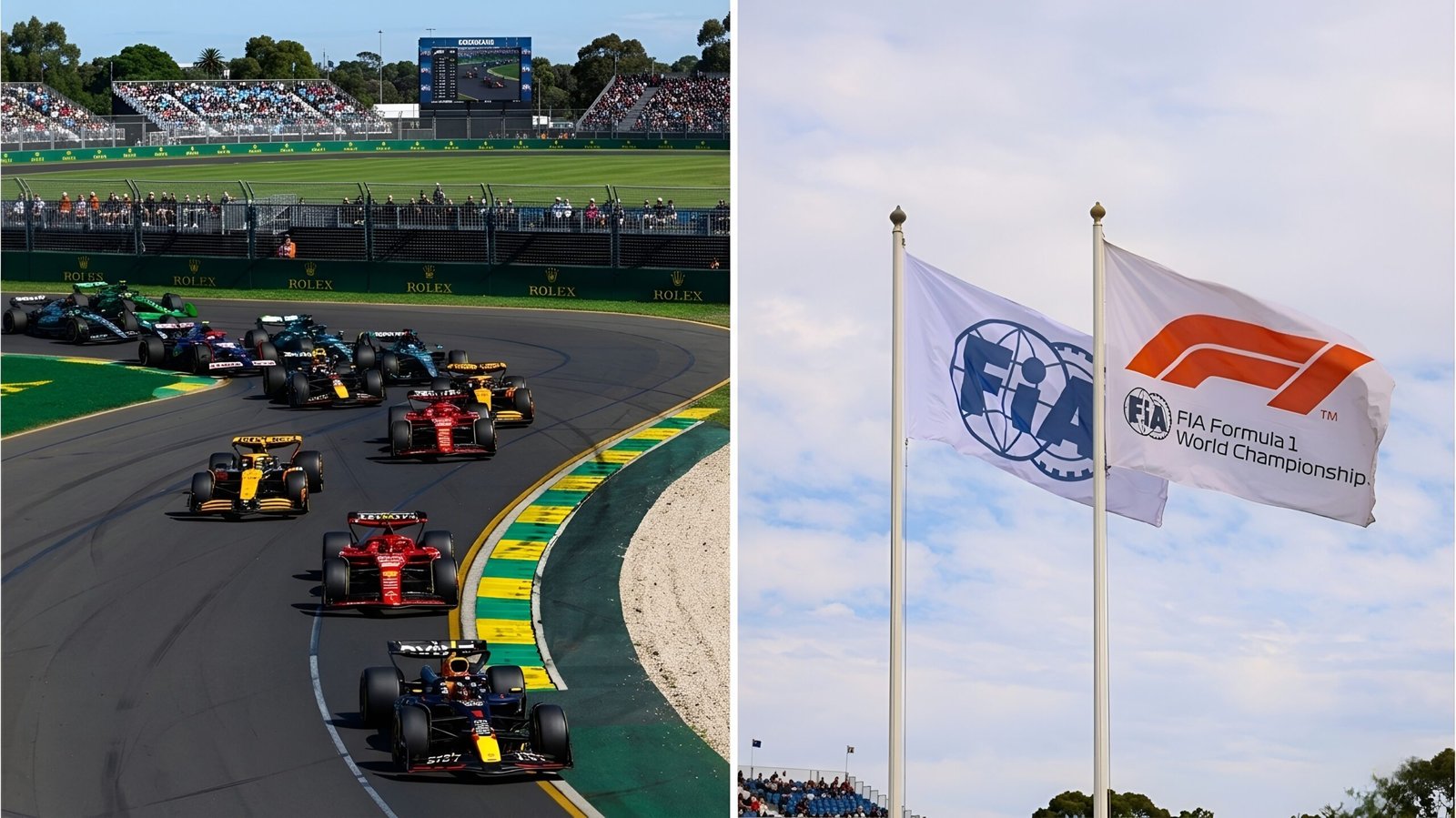
Formula 1 faces a fractured 2026 calendar as the FIA investigates “closing speed” safety risks following the cancellation of Middle Eastern rounds.
Published by: AutodromeF1 Editorial Team
F1 2026: Geopolitical Shockwaves and Regulatory Reckoning – Bahrain and Saudi Arabian Grands Prix Cancelled, Leaving a Fractured Calendar and Urgent Safety Imperatives
London. United Kingdom 30 March – In a development that has sent seismic ripples through the pinnacle of motorsport, Formula 1 has formally cancelled the 2026 Bahrain Grand Prix (originally scheduled for April 10-12) and the Saudi Arabian Grand Prix (April 17-19). The decision, driven by escalating regional instability stemming from the ongoing Middle East conflict, marks the first time in the modern era that two consecutive flyaway rounds have been excised from the calendar without immediate replacement. With the season now contracted to 22 races from the planned 24, the sport finds itself confronting not only logistical voids but also profound questions about the viability of its 2026 technical regulations amid emerging safety concerns.
This is no mere scheduling footnote. It represents a confluence of geopolitical reality and engineering ambition that threatens to redefine the narrative of the season. As the grid prepares for an extended five-week hiatus following the Japanese Grand Prix at Suzuka (March 27-29), the hiatus before the Miami Grand Prix (May 1-3, incorporating a sprint weekend) stands as the longest mid-season interruption in recent memory. The absence of these two iconic events – one a cornerstone of the sport’s Middle Eastern expansion since 2010, the other a high-stakes night race on the Jeddah Corniche Circuit – deprives the championship of 100 points’ worth of competitive drama and exposes the fragility of F1’s global footprint in an era of heightened geopolitical volatility.
Formula 1’s governing body, the FIA, and commercial rights holder Liberty Media issued a joint statement late last week, citing “unacceptable risks to personnel, logistics chains, and stakeholder safety” as the decisive factors. Unlike previous disruptions – such as the COVID-19-induced cancellations or the 2022 Russian GP withdrawal – no contingency venues were activated. Logistical constraints proved insurmountable: the intricate ballet of freight aircraft, customs clearances, hospitality setups, and personnel visas could not be replicated on short notice. Early speculation in paddock circles about relocating one or both events to later in the season (perhaps September or October) has evaporated, as the existing 22-race framework already operates at maximum capacity with no slack for rescheduling without compromising other commitments.
The calendar now presents a stark asymmetry. After the high-octane drama of Suzuka’s sweeping curves and technical demands, teams will return to their European bases for an unprecedented reset. The five-week chasm – stretching from late March into early May – will afford rare breathing room for engineering debriefs, but it also risks dissipating the early-season momentum that typically separates title contenders from the pack. For drivers chasing championship glory, this enforced sabbatical arrives at a critical juncture: with only three races completed, the points table remains fluid, yet the hiatus could blunt the psychological edge built through consecutive weekends.
Support series have been equally disrupted. Formula 2, Formula 3, and F1 Academy – the vital feeder and development pipelines – lose their double-header platform in the Gulf, forcing recalibrations to their own calendars. Young talents who rely on these weekends for seat time and sponsorship visibility now face gaps that could hinder career trajectories. The ripple effects extend to broadcasters, sponsors, and local economies in Bahrain and Saudi Arabia, where motorsport has become a cornerstone of diversification strategies. Estimates suggest combined losses exceeding $150 million in direct revenue, hospitality, and tourism, underscoring F1’s role as both a sporting and economic force.
Yet the cancellations are only one facet of a broader turbulence. Compounding the calendar upheaval is a mounting safety crisis tied directly to the sport’s bold 2026 power-unit and chassis regulations. Drivers have repeatedly voiced alarm over “super-high closing speeds” inherent in the new-generation cars, a phenomenon starkly illustrated by a high-speed incident at Suzuka’s Spoon Curve just two days ago. On lap 22 of the Japanese Grand Prix, Oliver Bearman (Haas) was closing on Franco Colapinto (Alpine) at a differential approaching 50-60 km/h. Colapinto, engaged in energy harvesting on the straight leading into the flat-out right-hander, inadvertently created a scenario where Bearman – travelling at approximately 308 km/h – was forced onto the grass, triggering a spin and a 50G barrier impact. Remarkably, Bearman emerged with only a minor knee contusion, but the incident has crystallised long-standing concerns.
The root cause lies in the 2026 technical blueprint itself. Designed to deliver more sustainable, electrically dominant power units with heavier energy-harvesting deployment and significantly reduced overall drag, the regulations prioritise efficiency and closer racing in theory. In practice, they have unleashed dynamics that test the limits of human reaction and chassis integrity. Lower drag coefficients allow cars to carry higher top speeds on straights, while aggressive boost modes and energy-recovery systems create unpredictable deceleration profiles. A slower car harvesting aggressively can suddenly become a stationary target relative to a pursuing machine operating at peak output. George Russell, a vocal critic since pre-season testing in Barcelona, summarised the issue succinctly: the combination of reduced aerodynamic resistance and electric focus has produced closing-speed differentials unseen in the hybrid era.
Testing data from Barcelona had already flagged these risks, with several drivers – including Russell and Carlos Sainz – urging the FIA to revisit energy-management protocols. The Spoon Curve shunt, captured in vivid telemetry and onboard footage, has accelerated calls for immediate intervention. Possible remedies under discussion include software limits on energy-harvesting timing, incremental chassis aero adjustments to mitigate straight-line stability, and revised driver aids for differential-speed awareness. The FIA has convened an emergency technical working group for early April, with Sainz among those pressing for driver-centric input: “We warned this was inevitable. The regs looked spectacular on paper, but real-world execution demands respect for physics and human limits.”
This is not the first time regulatory ambition has intersected with safety imperatives in F1. Echoes of the 2022 ground-effect revival – which initially exposed porpoising and bottoming issues – resonate here, yet the 2026 challenges feel more systemic. The cars’ lighter weight, active aerodynamics, and power-unit architecture represent the most profound reset since the 2014 hybrid introduction. While promising reduced fuel consumption and closer on-track battles, they have inadvertently amplified straight-line hazards, particularly at circuits with long acceleration zones followed by technical corners like Suzuka’s Spoon or, hypothetically, the high-speed sweeps of Baku or Jeddah had those races proceeded.
From an engineering standpoint, the issue demands nuanced calibration. Energy-harvesting strategies, optimised for efficiency under the new fuel-flow and battery regulations, create transient speed drops that telemetry now quantifies in real time. Teams are already modelling “worst-case” closing scenarios using simulator data, with some suggesting minor aerodynamic tweaks – perhaps revised bargeboard or diffuser specifications – to restore marginal stability without sacrificing the regs’ core sustainability goals. The FIA’s approach will likely balance pragmatism with preservation: no full regulatory overhaul is expected before Miami, but targeted directives could be issued via technical bulletins.
The human dimension cannot be overstated. Drivers, operating at the edge of physiological tolerance, now confront cognitive loads amplified by these dynamics. Bearman’s incident, while non-fatal, serves as a cautionary tale: at 50G, survival hinged on the halo, survival cell, and rapid medical response. Paddock veterans draw parallels to the 1990s era of unrestricted power, albeit through a modern lens of data-driven governance. Team principals, speaking off-record, express guarded optimism that the five-week gap will allow collective reflection rather than knee-jerk panic. “We have time to engineer solutions without compromising the vision,” one senior figure noted.
Broader implications for the championship are multifaceted. The calendar contraction preserves competitive integrity by avoiding patchwork replacements that could disadvantage certain teams logistically. Yet it compresses the narrative arc: fewer races mean every point carries amplified weight, potentially magnifying the impact of early incidents or strategic calls. Constructors’ and drivers’ titles remain wide open after three rounds, with the reset offering a blank slate for midfield squads to refine setups. Sponsorship and broadcast deals, predicated on a 24-race slate, may require renegotiation, while fan engagement strategies shift toward virtual content and simulator events to bridge the gap.
Geopolitically, the cancellations spotlight F1’s evolving relationship with the Middle East. Bahrain and Saudi Arabia have invested billions in infrastructure and soft-power projection through the sport. Their absence raises questions about long-term regional viability, even as other venues – Qatar, Abu Dhabi – remain secure. Liberty Media’s commitment to a truly global calendar appears tested, prompting quiet discussions about diversification into emerging markets in Asia or the Americas.
As the sport enters this enforced interlude, the 2026 season stands at a crossroads. The cancellations have imposed a rare pause for reflection; the safety concerns demand proactive evolution. For a series that prides itself on innovation under pressure, the coming weeks represent an opportunity to demonstrate resilience. Technical tweaks, if executed with precision, could transform early vulnerabilities into strengths, reinforcing the narrative of sustainable, thrilling competition. Yet failure to address closing-speed dynamics risks eroding driver confidence and public trust at a time when F1 seeks to broaden its appeal.
The five-week intermission, therefore, is more than downtime – it is a crucible. Teams will dissect data from Suzuka, the FIA will refine protocols, and drivers will reconvene with fresh perspective ahead of Miami. Whether the championship emerges fortified or further fragmented remains to be seen. One certainty endures: in 2026, Formula 1 is navigating uncharted territory where geopolitics, physics, and ambition collide. The sport’s ability to adapt – with the expertise, transparency, and foresight that have defined its 75-year legacy – will determine not merely the outcome of this season, but its trajectory for the decade ahead.


