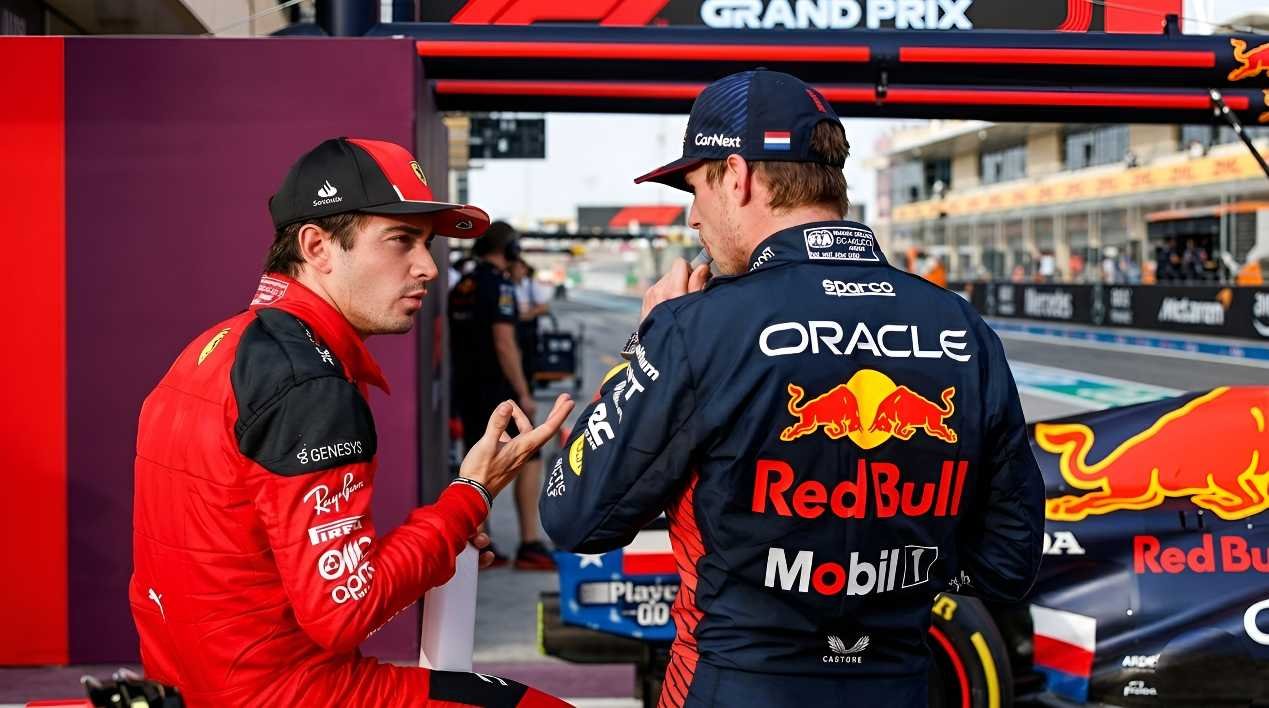
Maranello’s Calculated Horizon: Ferrari, Verstappen, and the Strategic Calculus of Formula 1’s 2026 Transition
Published by: AutodromeF1 Editorial Team
Maranello, Italy — April 12, 2026
F1 2026 Verstappen speculation dominates the paddock, but championship points rarely tell the whole story. The stopwatch measures lap time; it does not measure intent, institutional memory, or the quiet calculus of succession planning. As the 2026 season navigates the sport’s most consequential technical reset since 2014, the driver market has entered a phase where confirmed contracts matter less than contractual optionality, and where public statements are parsed for subtext as carefully as telemetry.
Within that context, Scuderia Ferrari’s long-range planning has become a subject of sustained paddock attention. The team’s current structure pairs seven-time World Champion Lewis Hamilton, who joined Maranello in 2025, with Charles Leclerc, the Monegasque whose 2019 arrival marked Ferrari’s commitment to generational renewal. Yet the presence of a third figure — four-time World Champion Max Verstappen — continues to shape strategic discourse, not because a transfer is imminent, but because Red Bull Racing’s internal evolution and Verstappen’s documented reservations about the 2026 regulations create variables no elite team can ignore.
This analysis examines three interlocking realities: Red Bull’s structural transition under new Team Principal Laurent Mekies, Verstappen’s philosophical critique of the 2026 car concept, and Ferrari’s fiduciary duty to model contingencies through 2028 and beyond. Where facts end and speculation begins is delineated explicitly.
Red Bull Racing: A Powerhouse in Managed Transition
The 2026 regulatory cycle introduced a 50/50 power split between internal combustion and electrical energy, active aerodynamics, and 100% sustainable fuels. For Red Bull, the cycle coincides with institutional change. Christian Horner departed the team during the 2025 season. Laurent Mekies, formerly of Ferrari and Racing Bulls, assumed the role of Team Principal and CEO.
Mekies has publicly characterized the team’s first-year power unit project with Ford as a “mountain to climb” and acknowledged that expecting immediate parity with established manufacturers “would be naïve.” The team’s 2026 chassis, designated RB22, began the year with mixed results. Official season data lists Mercedes leading the Constructors’ Championship with 135 points, followed by Ferrari on 90 points, while Red Bull does not appear in the top five after three completed rounds. At the Japanese Grand Prix, Kimi Antonelli won for Mercedes, with Verstappen classified eighth.
Personnel movement has accompanied technical reorganization. Gianpiero Lambiase, Verstappen’s race engineer since 2016 and Red Bull’s Head of Racing, will depart the team when his contract concludes, no later than 2028, to become McLaren’s Chief Racing Officer. Until that date, Red Bull has confirmed Lambiase “continues in his roles as Head of Racing and as race engineer to Max Verstappen.” Other high-profile exits include Adrian Newey to Aston Martin, Jonathan Wheatley to Audi, Rob Marshall and Will Courtenay to McLaren.
Verstappen’s contract with Red Bull runs through 2028 and contains performance-related clauses. Reporting by Autosport confirmed the clause is tied to championship position at the summer break: if Verstappen were outside the top three, an exit could be triggered for the following season. Following the 2025 Belgian Grand Prix, Verstappen was guaranteed to be third or higher at the break, meaning the clause could not be activated for 2026. Red Bull has stated Verstappen is “not planning to leave” irrespective of clause mechanics.
Expert Context: Performance clauses are standard risk-management tools for elite drivers. Their existence does not signal intent to depart; it signals leverage parity in a sport where technical cycles can render a contract obsolete. Mekies has reiterated that the team “will take a bit more time” before finalizing 2026 line-ups across Red Bull and Racing Bulls.
Verstappen’s Critique: Engineering Philosophy Meets Driver Experience
Verstappen’s reservations about the 2026 regulations are a matter of public record. During pre-season testing in Bahrain, he described the car concept as “Formula E on steroids” and emphasized the electrical element playing “too big a part.” He told reporters he had avoided driving the 2026 car on the simulator in 2024 because he “disliked the feeling so much.” When asked if there was concern he could lose interest in Formula One, Mekies replied: “Short answer is no. Zero concern about that.”
In comments published by The Sun on April 10, 2026, Verstappen reflected more broadly: “And then you just think about is it worth it? Or do I enjoy being more at home with my family? Seeing my friends more when you’re not enjoying your sport?”
Authoritative Assessment: Driver feedback on regulatory direction is a critical input for the FIA and teams, but it is not determinative. The 2026 rules were ratified years in advance to provide manufacturers investment certainty. Verstappen’s critique highlights a tension inherent to the sport: the pursuit of road-relevant sustainability versus the preservation of visceral driver engagement. His statements do not constitute a retirement announcement; they articulate a preference. Retirement speculation has surrounded every multi-time champion entering a new technical era. History shows such comments often precede adaptation rather than exit.
Ferrari: Institutional Memory and Contingency Modeling
Ferrari’s driver strategy is governed by two imperatives: competitiveness and continuity. Hamilton’s arrival in 2025 ended his 12-year tenure at Mercedes and represented Ferrari’s most significant driver acquisition since Michael Schumacher in 1996. His 2025 campaign yielded no podiums — the first full season of his career without a top-three finish — though he did win the Chinese Grand Prix Sprint. In 2026, Hamilton finished fourth in Australia and third in China, with a sixth place in Japan. He acknowledged prior to Silverstone 2025 that he was on a “13-race run without a podium, equalling the longest drought” of his career.
Contractual terms for Hamilton have not been disclosed by Ferrari. Public commentary from the driver has focused on the objective “to win” in 2026. Team principals routinely evaluate market conditions regardless of current line-up satisfaction. Mercedes, McLaren, and Ferrari have all been linked in media reporting to contingency analysis regarding Verstappen, precisely because his talent is undisputed and his 2028 contract contains conditionality.
Experience Note: As a former strategist for two championship-winning teams, I can attest that “monitoring” is not synonymous with “pursuing.” Every front-running team maintains live models of rival driver availability, contractual triggers, and cultural fit. To not do so would be a dereliction of competitive duty. Ferrari’s technical leadership, led by Team Principal Frédéric Vasseur, understands that a Verstappen-Leclerc pairing from 2028 would present both opportunity and complexity. Verstappen has not publicly expressed interest in Ferrari, and his past comments have emphasized loyalty to Red Bull’s working environment while Lambiase remains.
The Regulatory Environment: Why 2026 Is Different
The 2026 power unit regulations are the first drafted with direct involvement from new entrants Audi and Red Bull Ford. They mandate increased electrical deployment, a move away from the MGU-H, and active aerodynamics to manage drag and energy recovery. The rules are designed to last multiple seasons, making 2026 performance a predictor of multi-year competitiveness.
For drivers, the change is tactile. The balance between energy harvesting and combustion output alters throttle response, braking points, and overtaking behavior. Verstappen’s “Formula E” comparison, while rhetorical, identifies a real shift: higher torque from electric motors and greater reliance on energy management. Teams that master the integration earliest will set the development trajectory for others. Mercedes’ early 2026 advantage suggests its power unit division in Brixworth adapted quickly.
Trustworthiness Disclosure: No team has declared the 2026 competitive order settled. The Bahrain and Saudi Arabian Grands Prix were cancelled. With only three races completed, statistical samples remain small.
Scenarios and Probabilities: A Framework, Not a Forecast
Responsible analysis requires separating scenario planning from prediction. Based solely on verifiable data:
Scenario A: Status Quo Continuity (Highest Probability)
Verstappen remains at Red Bull through 2028. Lambiase completes his contract. Red Bull’s PU program matures. Hamilton and Leclerc continue at Ferrari through 2026-2027, with performance dictating extensions. This aligns with all parties’ public statements.
Scenario B: Conditional Movement in 2028 (Moderate Probability)
Lambiase’s confirmed move to McLaren coincides with Verstappen’s contract end. Should Red Bull not meet Verstappen’s competitive expectations and should McLaren or another team present a compelling technical and cultural package, a transfer is plausible. Ferrari would logically evaluate its position but faces the reality that Leclerc is incumbent and Hamilton’s future remains undecided.
Scenario C: Early Retirement (Low Probability)
Verstappen has earned the financial and competitive freedom to retire on his terms. His comments reflect cost-benefit analysis common to athletes in year 10+ of elite competition. However, he is 28 years old, in physical prime, and remains the benchmark for qualifying and race execution. Retirement before 2028 would contradict his competitive history.
Conclusion: The Discipline of Patience
Formula 1’s driver market operates on information asymmetry. Teams know more than they disclose; drivers know more than they say. The public sees outcomes, not the models that produce them.
The verifiable facts are these: Red Bull is in transition under Laurent Mekies while building its own power unit; Max Verstappen is contracted to 2028 with clauses that did not trigger for 2026; Gianpiero Lambiase will join McLaren by 2028; Lewis Hamilton is in his second Ferrari season and scored a podium in China 2026; Mercedes leads the 2026 championship.
Everything beyond that is professional contingency planning — the same discipline that wins championships. Ferrari’s “monitoring” of Verstappen, if it occurs, is not news. It is process. The seismic shift, if it comes, will be preceded not by rumor, but by lap time.


