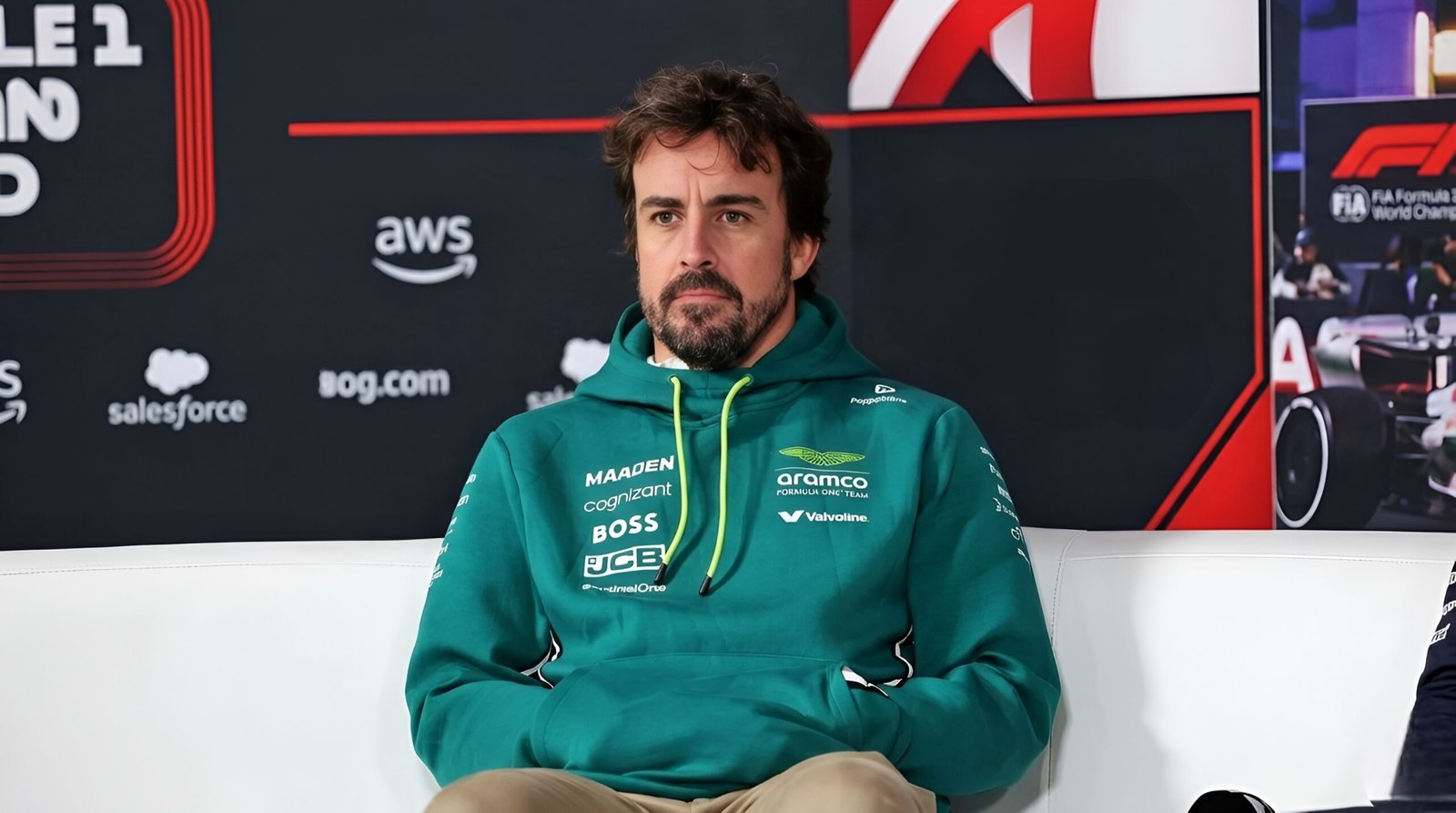
Published by: AutodromeF1 Editorial Team
Fernando Alonso’s Enduring Competitive Fire: Karting as a Lifeline and the High-Stakes Calculus of a 2026 Farewell
London. United Kingdom 31 March – In the rarefied world of Formula 1, where careers are measured in milliseconds and legacies forged under relentless pressure, Fernando Alonso stands as a singular archetype of uncompromised excellence. At 44 years of age—approaching his 45th birthday in the thick of the 2026 campaign—the two-time world champion continues to defy the conventional narrative of athletic decline. His most recent remarks, shared in an exclusive interview with Aston Martin’s media channels, encapsulate a philosophy that has defined his two-decade-plus tenure in the pinnacle of motorsport: an unwavering refusal to depart the grid on anything less than his own uncompromising terms.
Alonso’s words reveal not merely a driver contemplating retirement but a master craftsman still sharpening his tools against the sharpest edges available. “When I’m in Spain, I go karting and I race with kids who are 9, 12, or 15 years old,” he stated. “And I still battle with them with the same mental age.” This is no casual admission of a hobby. It is a deliberate, almost ritualistic practice that underscores his refusal to allow age to erode the razor-sharp reflexes and tactical acuity that have sustained him through eras of dominance, frustration, and improbable resurgence. By pitting himself against competitors young enough to be his grandchildren in chronological terms, Alonso maintains a competitive equilibrium that transcends mere physical conditioning. It is mental calibration at its most primal—proof, in his estimation, that the fire within remains undimmed.
The Karting Crucible: Honing Reflexes in the Cradle of Talent
To appreciate the depth of Alonso’s karting regimen, one must first understand its roots in his own origin story. Born in Oviedo, Asturias, in 1981, Alonso’s earliest memories are intertwined with the raw, unforgiving discipline of go-kart racing on Spain’s variable-weather circuits. From the age of three, under the watchful eye of a father who built his own karts, he learned that talent alone was insufficient; survival demanded adaptability, resilience, and an almost feral hunger. Those formative years—racing locally before conquering national and international titles—instilled a baseline of competitiveness that has never wavered.
Today, those same Spanish karting circuits serve as Alonso’s private forge. Far from the glare of Formula 1’s global spotlight, he returns regularly to sessions where lap times matter less than the intangible edge they preserve. The abrupt inputs, direct feedback, and unfiltered sensations of karting replicate the neural demands of an F1 cockpit in microcosm: rapid decision-making under g-forces, spatial awareness at the limit, and the psychological warfare of wheel-to-wheel combat. In an era when simulator technology and data analytics dominate driver preparation, Alonso’s insistence on this analog pursuit signals a deeper expertise. It is the embodiment of experiential wisdom—an acknowledgment that no amount of telemetry can substitute for the lived intensity of real-time rivalry against opponents unburdened by experience yet brimming with youthful aggression.
This practice is not performative. It directly counters the narrative that a driver entering his mid-forties must inevitably yield to younger talents. By maintaining parity with drivers a generation his junior, Alonso demonstrates that chronological age is a poor proxy for competitive vitality. His “mental age,” as he terms it, remains locked in the same fierce, uncompromising mode that propelled him to world titles in 2005 and 2006 with Renault. It is a masterclass in longevity, one that other veterans—whether in Formula 1 or endurance racing—would do well to study. In a sport increasingly populated by athletes in their early twenties, Alonso’s approach offers a blueprint for sustained relevance: treat every lap as a test, every rival as a benchmark, and never permit complacency to take root.
A Career of Relentless Pursuit: From Prodigy to Elder Statesman
Alonso’s refusal to entertain an uncompetitive exit is rooted in a career defined by chasing excellence amid adversity. Twice a world champion by the age of 25, he has since navigated the highs of podium contention and the lows of midfield anonymity with the same intensity. His stints at McLaren, Ferrari, and Alpine were marked by near-misses and political intrigue, yet he consistently extracted maximum performance from machinery that often fell short of championship pedigree. The 2010s, in particular, saw him endure seasons of “inferior equipment,” as he has candidly described it—campaigns where raw talent and strategic brilliance were the only weapons against superior engineering.
His 2023 return to Aston Martin, initially under the rebranded Racing Point outfit, was framed as a calculated gamble on a team in ascent. By 2025, expectations had crystallized around the 2026 regulatory overhaul: a comprehensive reset featuring lighter, more agile chassis, revised power-unit architecture emphasizing sustainable fuels, and aerodynamic philosophies designed to promote closer racing. Alonso approached these changes with characteristic pragmatism, viewing them not as a threat but as a potential swansong opportunity. His contract, running through the end of 2026, aligned perfectly with this horizon.
Yet the reality of the 2026 season has introduced fresh layers of complexity. Early indications suggest Aston Martin’s Honda-powered AMR26 has encountered significant teething troubles, placing the team in a challenging position relative to frontrunners. Team principal Adrian Newey has publicly acknowledged the strain this has placed on Alonso’s mindset, describing it as a “hard mental place.” In such a context, Alonso’s karting declarations take on heightened resonance: they are not abstract musings but a public reaffirmation of his internal compass amid external turbulence.
The 2026 Reckoning: Competitive Promise Versus the Pain of Mediocrity
Central to Alonso’s outlook is a binary proposition articulated with surgical precision in recent team interviews. “If things go well, I think it’s a very good moment to stop because I’ve been chasing a competitive car and competitive racing for many, many years, and if I have that I think it’s a very good way to close my career,” he explained. “Let’s say that if we are competitive, there is more chance that I stop. If we are not competitive, it will be very hard to give up without trying again.”
This is no hedging. It is a sophisticated risk assessment born of decades at the coalface. A competitive 2026 package—one capable of delivering race wins or championship contention—would represent the narrative closure Alonso has long sought: a triumphant exit on merit, after years of valiant overachievement. Conversely, a non-competitive Aston Martin would render retirement “extremely challenging,” as the script of his current statements suggests. At 45, the physical and mental toll of another season in the wilderness would test even his legendary fortitude, yet the prospect of walking away mid-struggle appears antithetical to his core identity.
The broader 2026 regulatory landscape amplifies these stakes. The FIA’s overhaul—intended to reduce downforce, enhance overtaking, and integrate more hybrid and sustainable elements—promises a potential grid shake-up reminiscent of 2009 or 2022. For a team like Aston Martin, backed by Lawrence Stroll’s vision and now armed with Honda’s expertise following its full works return, the window for ascent is narrow but real. Alonso has maintained close dialogue with Stroll, emphasizing team-first priorities while evaluating his personal timeline “day by day.” This measured approach reflects not indecision but strategic maturity: an elder statesman guiding a project while safeguarding his own legacy.
Philosophical Underpinnings: Age, Legacy, and the Human Element in Formula 1
What sets Alonso apart from contemporaries is his refusal to conform to the sport’s ageist undercurrents. Formula 1 has historically rewarded youth—witness the precocity of Max Verstappen or the current crop of academy graduates—yet history also records outliers who thrived later: Nigel Mansell’s late bloom, or Michael Schumacher’s post-comeback masterstrokes. Alonso belongs in this rarefied company, but with a twist. Where others relied on experience alone, he actively combats entropy through practices like karting, which serve as both physical therapy and psychological anchor.
His stance challenges the prevailing media narrative of inevitable decline. In an era of data-driven performance metrics, Alonso reminds us that motorsport remains a profoundly human endeavor. Mental resilience, tactical cunning, and raw desire often eclipse raw speed. By measuring himself against 9-to-15-year-olds, he rejects the notion that reflexes atrophy inexorably. Instead, he posits that competitive hunger can be cultivated indefinitely—provided the external machinery aligns with internal capacity.
This perspective carries implications beyond one driver. For Aston Martin, Alonso’s presence exerts a gravitational pull: his feedback refines development, his mentorship elevates teammates, and his marketability sustains momentum through adversity. For Formula 1 as a whole, his potential extension—or graceful exit—underscores the sport’s evolving demographics. As grids skew younger, veterans like Alonso embody continuity, proving that excellence is not confined to a narrow age band.
A Legacy That Transcends the Checkered Flag
As the 2026 season unfolds amid Aston Martin’s early-season challenges, Fernando Alonso’s karting-fueled declarations serve as both manifesto and mirror. They reflect a driver who has never settled for less than his best, even when the machinery conspired against him. Whether 2026 marks the culmination of a glittering odyssey or merely another chapter in an extended epic will hinge on the AMR26’s trajectory and Honda’s ability to unlock performance.
What remains beyond dispute is Alonso’s indomitable spirit. In battling children on kart tracks while eyeing the pinnacle of motorsport, he embodies a truth often overlooked in high-stakes athletics: greatness is not defined by age but by the refusal to accept anything less than a fitting denouement. Formula 1 will be richer for his continued presence should he choose to extend; it will be poorer should he depart prematurely. For now, the two-time champion continues to race not against the clock but against his own exacting standards—one lap at a time, one mental age forever intact.
In an industry prone to hyperbole, Alonso’s approach offers a masterclass in quiet authority. It is the mark of a true champion: one who competes not for applause but for the unyielding satisfaction of knowing he left nothing on the table. The coming months will test that resolve like never before. Whatever the outcome, his contribution to Formula 1’s rich tapestry is already assured—etched not in fleeting headlines but in the enduring example of a competitor who refuses to fade.


