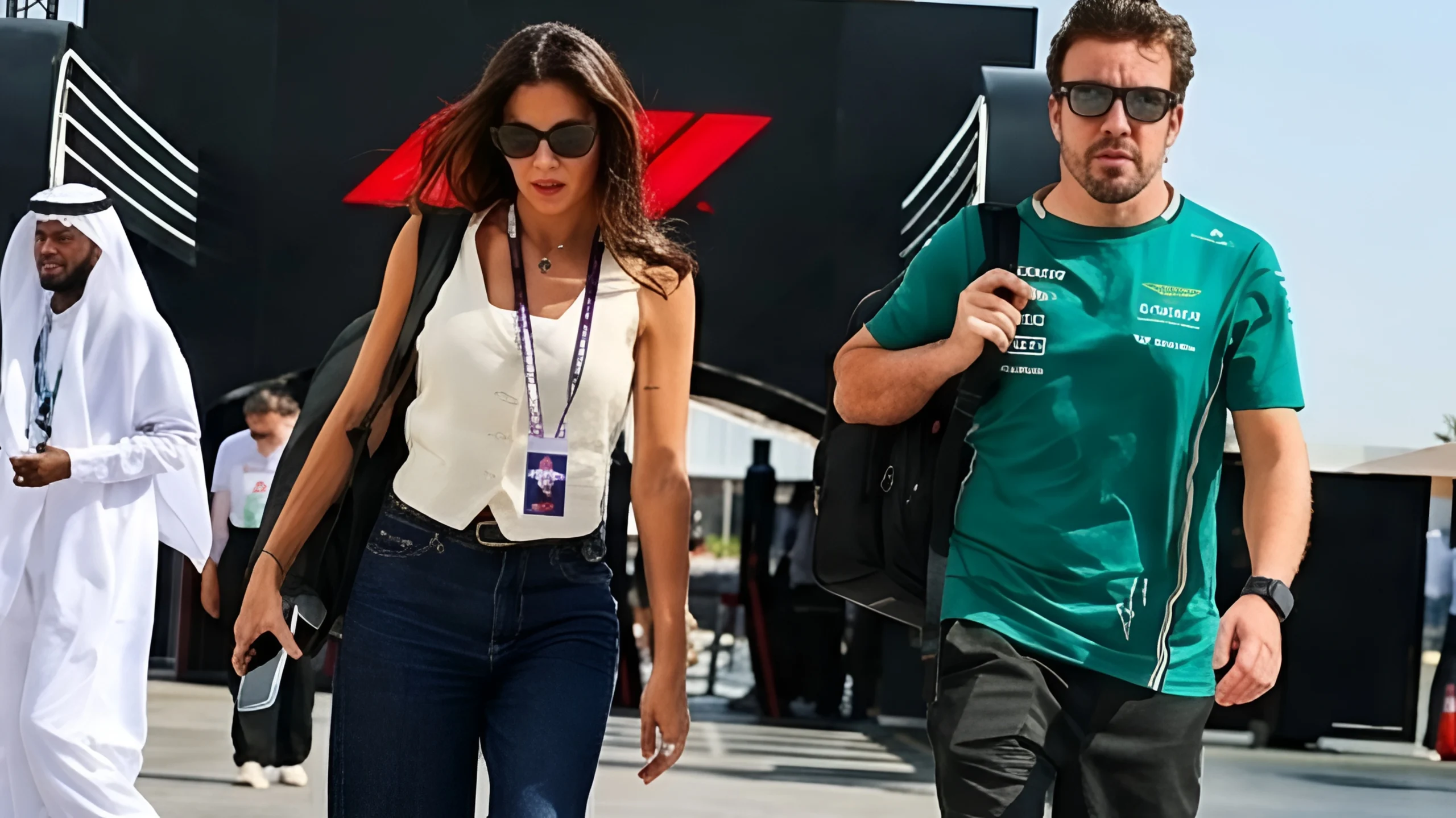
Fernando Alonso and partner Melissa Jiménez at the F1 paddock. The couple has announced the birth of their first child ahead of the 2026 Japanese Grand Prix.
Published by: AutodromeF1 Editorial Team
Fernando Alonso and Melissa Jiménez Welcome First Child: A Milestone of Legacy, Resilience, and Private Joy Amid the Demands of Elite Motorsport
London. 25 March – In the rarefied realm of Formula 1, where the pursuit of speed and supremacy often eclipses the quieter rhythms of personal existence, the announcement of a new life carries particular resonance. On or around March 24-25, 2026, two-time world champion Fernando Alonso and his partner, the accomplished Spanish journalist and DAZN presenter Melissa Jiménez, welcomed their first child together. The birth, which occurred precisely in alignment with earlier indications that Jiménez’s pregnancy would culminate in March, represents not merely a private celebration but a profound chapter in the life of one of motorsport’s most enduring and multifaceted figures.
This development arrives at a pivotal juncture in Alonso’s 2026 campaign with Aston Martin Aramco. The 44-year-old Spaniard, whose competitive fire remains undimmed after a quarter-century at the pinnacle of the sport, was notably absent from media obligations on Thursday at the Japanese Grand Prix in Suzuka. Team sources confirm that the decision was made to afford Alonso uninterrupted time with his growing family following the birth, while he remains fully committed to resuming competitive duties for Friday’s practice sessions. Such a measured approach underscores a maturity that has defined the latter phase of Alonso’s career—one that balances unyielding ambition on the track with an evolving appreciation for life beyond the cockpit.
The couple’s relationship, forged within the vibrant yet intensely scrutinized confines of the Formula 1 paddock, traces its origins to 2023. It was there, amid the global traveling circus of grand prix racing, that Alonso and Jiménez first connected professionally before their bond deepened into a committed partnership. Jiménez, a respected voice in sports broadcasting whose work with DAZN has brought incisive analysis and accessibility to millions of viewers, brought to the relationship not only professional poise but also a rich personal history. She enters this new chapter as a mother of four, having previously raised three children from her marriage to the former professional footballer Marc Bartra. For Alonso, by contrast, this marks the arrival of his first offspring, arriving at an age when many athletes contemplate the twilight of their careers. That he approaches fatherhood with the same deliberate intensity he has applied to every lap of his professional journey speaks volumes about the man who has repeatedly redefined the parameters of longevity in Formula 1.
Pregnancy rumors first circulated in December 2025, when observers noted that Jiménez appeared approximately six months along. At the time, the couple maintained a characteristically discreet stance, sharing the news selectively with an intimate circle of family, friends, and key members of Alonso’s Aston Martin team. This restraint is emblematic of their approach throughout the relationship. Unlike many high-profile pairings in the paddock, Alonso and Jiménez have cultivated a sphere of privacy that shields their personal milestones from the relentless glare of speculation. In an era when social media amplifies every gesture and paparazzi lenses probe every corner of celebrity life, their decision to reveal the pregnancy and subsequent birth primarily through controlled channels reflects a conscious prioritization of authenticity over spectacle.
The timing of the birth, coinciding with the early stages of the 2026 season, invites reflection on the intricate interplay between professional obligation and familial responsibility in elite sport. Formula 1 has long been a domain where drivers navigate not only the physical and mental rigors of competition but also the logistical complexities of a nomadic existence. Grands prix unfold across continents, demanding weeks away from home bases, exhaustive preparation, and an almost monastic focus on performance metrics. For Alonso, whose career trajectory has encompassed triumphs with Renault and Ferrari, a return to the grid with McLaren, and now a renaissance chapter at Aston Martin, the addition of fatherhood introduces a new variable. Yet those familiar with his ethos will recognize that this development is unlikely to diminish his competitive edge; rather, it may infuse it with renewed purpose.
Alonso’s journey to this moment has been anything but conventional. Debuting in Formula 1 at the dawn of the new millennium, he claimed his maiden world title in 2005 and defended it successfully the following year, becoming the youngest champion at the time—a record later eclipsed by subsequent talents. His subsequent career, marked by strategic moves, engineering collaborations, and a brief foray into other series including endurance racing where he secured victories at Le Mans, has cemented his status as one of the sport’s most adaptable and resilient competitors. At 44, he stands as one of the oldest active drivers on the grid, a distinction he wears not as a limitation but as testament to meticulous physical conditioning, intellectual acuity, and an unquenchable passion for the technical evolution of the machines he pilots. The 2026 regulations, which promise further aerodynamic and power-unit innovations, align seamlessly with Alonso’s lifelong fascination with the engineering dialogue between driver and car. His continued presence at Aston Martin, under the stewardship of Lawrence Stroll and the technical guidance of a forward-looking team, positions him to mentor younger talents while chasing podiums and victories that would further embellish an already storied legacy.
Jiménez, for her part, embodies a parallel narrative of professional excellence and personal evolution. Her transition from on-screen presenter to a figure whose life now intersects with one of motorsport’s icons has been navigated with grace and discretion. The paddock, historically a male-dominated enclave, has gradually embraced greater diversity, and Jiménez’s contributions as a broadcaster have played a subtle yet meaningful role in broadening the sport’s appeal. Her decision to balance motherhood—now expanded to four children—with her media career mirrors the challenges faced by many women in high-visibility professions. That she has done so while forging a partnership with Alonso highlights a complementary dynamic: two individuals whose respective worlds of speed and storytelling converge in mutual respect and shared discretion.
The couple’s low-key dissemination of news—confined largely to close associates and the Aston Martin inner circle—distinguishes this story from the more ostentatious announcements that occasionally punctuate the F1 calendar. There are no immediate plans for public statements or social-media fanfare, a choice that respects the sanctity of early parenthood while allowing the racing community to focus on the on-track narrative unfolding in Suzuka. This restraint also serves as a quiet rebuke to the culture of instant disclosure, affirming that some experiences transcend the demands of public consumption. In an industry where every driver’s move is parsed for competitive advantage, Alonso’s absence from media day carries no hint of controversy; instead, it elicits widespread understanding and support from rivals, teams, and fans alike.
Looking beyond the immediate celebration, the birth invites broader contemplation of the evolving demographics of Formula 1. Once perceived as a young man’s domain, the sport increasingly accommodates drivers who extend their careers into their forties, supported by advances in sports science, recovery protocols, and strategic team structures. Alonso’s impending fatherhood at this stage of life joins a select cadre of athletes who demonstrate that peak performance and parental milestones need not be mutually exclusive. It is a narrative that resonates with contemporary discussions around work-life integration in professional sport, where mental well-being, family support networks, and holistic personal development are recognized as enhancers rather than distractions from excellence.
For Aston Martin, the news arrives during a season of measured optimism. The team’s technical trajectory under new regulatory frameworks has shown promising signs, and Alonso’s experience remains a cornerstone of its ambitions. His decision to prioritize family while maintaining readiness for Friday practice exemplifies the professionalism that has long defined his tenure. Team principal Mike Krack and the broader organization have expressed quiet solidarity, reinforcing the ethos that the driver’s well-being extends beyond lap times to encompass life’s most significant transitions.
As the Japanese Grand Prix weekend progresses, the paddock will undoubtedly buzz with subdued congratulations, delivered in the understated manner befitting Alonso’s preference for privacy. Fans, meanwhile, will find inspiration in the knowledge that even the most driven competitors among us embrace the universal joys of parenthood. The child’s arrival heralds not an end to Alonso’s competitive chapter but a deepening of it—an additional layer of motivation as he continues to chase the checkered flag in a career already rich with achievement.
In the final analysis, this milestone transcends the binary of victory and defeat that governs Formula 1. It speaks to the enduring capacity of human endeavor to encompass both the extraordinary and the everyday. Fernando Alonso, whose name has become synonymous with resilience, adaptability, and unyielding pursuit of excellence, now embarks upon fatherhood with the same quiet determination that has carried him through two decades of elite competition. Melissa Jiménez, whose own path has been defined by professionalism and poise, enters this new phase supported by a partnership built on mutual understanding and respect. Together, they illustrate that the greatest legacies are not confined to podiums or championship trophies but extend into the private realms where life’s most meaningful victories unfold.
The motorsport world extends its warmest felicitations to the new family. As the 2026 season unfolds beneath the lights of Suzuka and beyond, Fernando Alonso’s story gains an enriching dimension—one that reminds us all that behind the helmets and the roar of engines lie individuals whose personal journeys enrich the tapestry of the sport itself. In welcoming their first child, Alonso and Jiménez have not only expanded their family but also offered the F1 community a moment of genuine, unscripted humanity amid the relentless pursuit of speed.


