Published by: AutodromeF1 Editorial Team
Ferrari Secures Path to 2026 Power-Unit Parity: ADUO Approval Sought to Address Mercedes Deficit and Reshape Mid-Season Championship Dynamics
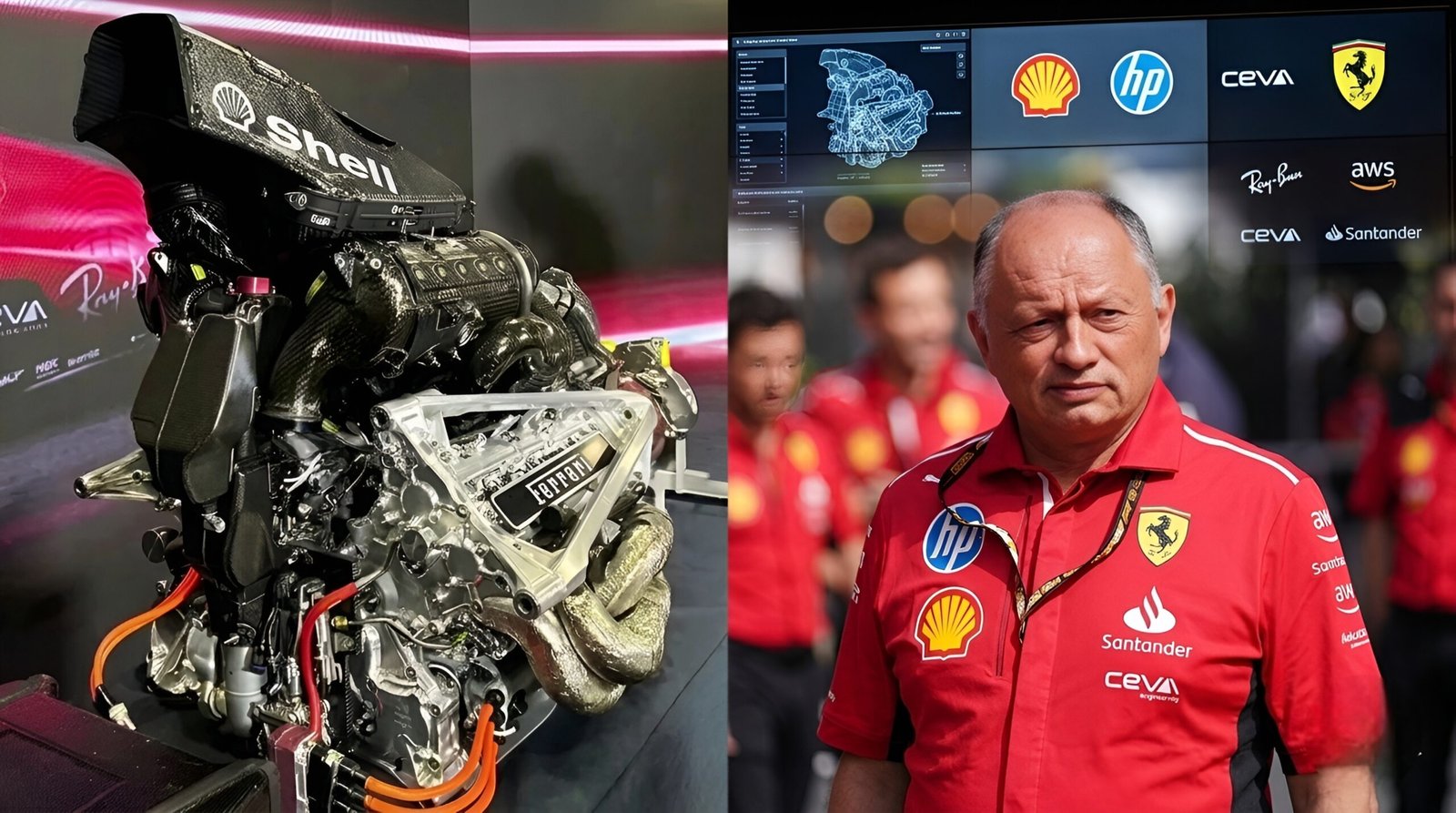
Maranello. Italy 31 March – In the high-stakes engineering corridors of Maranello, where every component of the 2026 Formula 1 power unit is scrutinized under the unforgiving lens of the new regulatory framework, Ferrari is poised to invoke a seldom-used mechanism designed precisely for moments like this. The Italian marque has formally requested approval from the Fédération Internationale de l’Automobile (FIA) under the Additional Development and Upgrade Opportunities (ADUO) regulation—often referenced in technical circles as Adjusted Development Under Opportunity in preliminary documentation—to introduce targeted enhancements to its internal combustion engine (ICE). This move, far from a routine administrative filing, represents a calculated strategic pivot aimed at neutralizing a measurable performance shortfall before the 2026 season reaches its critical inflection point.
The ADUO regulation, enshrined in Article 4 of Appendix 4 of the 2026 FIA Formula 1 Technical Regulations, exists as a deliberate safeguard against the kind of entrenched power-unit disparity that defined the early years of the hybrid era. It permits manufacturers demonstrating a sustained performance deficit—typically quantified at 2 percent or greater in isolated dynamometer testing—to pursue one additional homologation upgrade in the current season (with a follow-on provision extending into 2027). Unlike standard development tokens, which impose stringent penalties on subsequent iterations, ADUO approvals are calibrated to restore competitive equilibrium without destabilizing the regulatory ecosystem. Ferrari’s application centers on a sophisticated recalibration of variable compression-ratio technology, achieved through redesigned connecting rods. This hardware evolution is intended to optimize combustion efficiency under the demanding constraints of the 2026 sustainable-fuel mandate, thereby closing the gap that has become evident in early-season straight-line performance.
Ferrari’s power deficit, while not catastrophic in overall qualifying trim, manifests most acutely in raw ICE output. Independent analysis of telemetry from the Chinese and Japanese Grands Prix reveals that the Scuderia trails its primary rival, Mercedes, by approximately 25 horsepower in peak internal-combustion delivery. This shortfall is compounded by Mercedes’ superior energy-management protocols, which yield a more consistent deployment of the hybrid system across varying track conditions. The net result has been a documented 12 percent deficit in top speed on high-velocity straights—figures corroborated by sector-time comparisons at Shanghai and Suzuka. It is important to contextualize these numbers: the absolute peak-power gap sits closer to 15 horsepower when isolated from energy-recovery variables, yet the cumulative effect on lap-time potential is amplified by the 50/50 ICE-electric split mandated for 2026. Ferrari’s engineers have already identified the root causes—suboptimal compression-ratio stability under the new fuel chemistry and conservative mapping of the energy-recovery system (ERS)—and are addressing them on two parallel fronts.
Software optimizations for the ERS are scheduled for introduction at the Miami Grand Prix, offering an immediate, homologation-light pathway to incremental gains. However, the hardware component—the variable-compression upgrade via new connecting rods—falls squarely within the ADUO remit and requires explicit FIA sign-off. Team principal Frédéric Vasseur has been characteristically candid in private briefings, signaling that the team views ADUO as the most expeditious route compared to awaiting the broader compression-ratio rule amendments slated for review on June 1. Vasseur’s expectation, informed by extensive dialogue with the governing body, is that the FIA will initially lean toward preserving Mercedes’ early advantage while still granting Ferrari the targeted window necessary to remain within the performance envelope.
The timing of any approval carries profound strategic weight. Should the FIA green-light the upgrade in the coming weeks, Ferrari’s revised ICE specification could make its race debut around the Hungarian Grand Prix in late July, aligning with the traditional summer reset when teams traditionally introduce major aerodynamic and power-unit packages. Internal dyno validation at Maranello is already under way, with reliability cycles exceeding 1,500 kilometers completed on the latest iteration. This compressed development timeline underscores Ferrari’s commitment to an in-house power-unit philosophy amid the 2026 regulatory sea change: a complete departure from customer-engine arrangements of the past, emphasizing proprietary combustion and electrical architectures optimized for 100 percent sustainable aviation fuel and the mandated 50/50 power split.
Current championship standings provide the clearest illustration of why this technical intervention matters. Following the Japanese Grand Prix, Mercedes sits atop the constructors’ table with 135 points, while Ferrari occupies second place, 45 points adrift. In the drivers’ championship, Charles Leclerc holds third, trailing Mercedes’ precocious rookie Kimi Antonelli by 23 points. Mercedes has converted its power-unit advantage into three consecutive race victories, capitalizing on superior traction out of slow corners and sustained top-end speed on straights. Ferrari, by contrast, has demonstrated competitive one-lap pace—particularly in sectors requiring high downforce—but has been unable to sustain that advantage over race distance, where fuel-flow limits and thermal management expose the ICE disparity.
This is not merely a question of horsepower; it is a manifestation of deeper philosophical differences in power-unit design. Mercedes has prioritized a holistic energy-management strategy that leverages the electric motor’s instantaneous torque response to mask minor ICE inefficiencies. Ferrari, faithful to its tradition of high-revving, naturally aspirated-derived combustion DNA, has pursued outright thermal efficiency. The ADUO application, therefore, is not an admission of defeat but a recognition that the 2026 regulations—while promoting closer competition overall—still allow for transient imbalances that the governing body is duty-bound to address.
From a broader historical perspective, the current situation echoes the 2014 transition to hybrid power units, when Mercedes’ early mastery of the 1.6-liter V6 turbo-hybrid architecture created a multi-season advantage that only fractured after sustained regulatory intervention. Ferrari’s leadership, having learned from that era, is determined not to cede ground permanently. The in-house engine program, revitalized under the stewardship of technical director Enrico Cardile and power-unit chief Mattia Binotto’s successors, reflects a long-term vision: to position Ferrari as the benchmark manufacturer when the 2026-2030 regulatory cycle matures. Success here would not only bolster 2026 title aspirations but also enhance Ferrari’s commercial leverage in an era when power-unit supply agreements carry unprecedented financial and technological value.
Critically, the ADUO process itself is designed to be transparent and data-driven. The FIA’s independent benchmarking—conducted in controlled conditions at approved test facilities—will compare Ferrari’s ICE Performance Index against the field average. A deficit exceeding the 2 percent threshold triggers the upgrade window; anything below that threshold maintains the status quo. Insiders close to the process indicate that Ferrari’s submission includes comprehensive dyno logs, combustion-chamber pressure traces, and fuel-consumption maps, all of which have been prepared with the meticulousness expected of a championship contender. The governing body’s decision, expected within the next 10 to 14 days, will be communicated publicly to preserve the sport’s credibility.
Looking ahead, the implications extend beyond the immediate Hungarian Grand Prix horizon. Should Ferrari successfully deploy the upgraded connecting-rod assembly, the aerodynamic and chassis synergies already evident in the SF-26 could translate into a genuine challenge for race wins by the Belgian Grand Prix in late August. Conversely, any delay would force the team to rely on incremental software gains and circuit-specific setup compromises, potentially allowing Mercedes to extend its constructors’ lead into triple digits before the summer break. For Charles Leclerc, whose qualifying prowess remains a cornerstone of Ferrari’s challenge, the upgrade offers the prospect of converting pole positions into victories—a narrative arc the 29-year-old Monegasque has pursued since his maiden title contention in 2022.
In the wider ecosystem of Formula 1, Ferrari’s ADUO pursuit reinforces the regulatory philosophy that underpins the 2026 rules: sustainable innovation tempered by competitive fairness. The 50/50 power split and sustainable-fuel mandate were conceived to reduce environmental impact while preserving the visceral drama of grand-prix racing. Yet the regulations also acknowledge that perfect parity at the outset is improbable. Mechanisms such as ADUO exist precisely to prevent any single manufacturer from establishing a technological hegemony that could erode fan engagement or manufacturer participation.
Ferrari’s application, therefore, is not an anomaly but a feature of the system working as intended. It underscores the maturity of the sport’s governance, where technical disputes are resolved through evidence rather than rhetoric. As the paddock converges on Miami for the fourth round of the season, all eyes will remain fixed on the FIA’s technical department and the Maranello dyno. The outcome will not merely determine the winner of the 2026 drivers’ and constructors’ championships; it will shape the narrative of power-unit supremacy for the remainder of the decade.
In an era when Formula 1’s global audience demands both technological excellence and sporting equity, Ferrari’s measured pursuit of ADUO approval exemplifies the delicate balance between ambition and regulation. Whether the approval arrives in time for Hungary or necessitates a fallback to Monza, the Scuderia’s resolve remains unwavering. The 2026 season, still in its infancy, has already delivered a compelling subplot—one that promises to test the limits of engineering ingenuity and regulatory foresight in equal measure.


