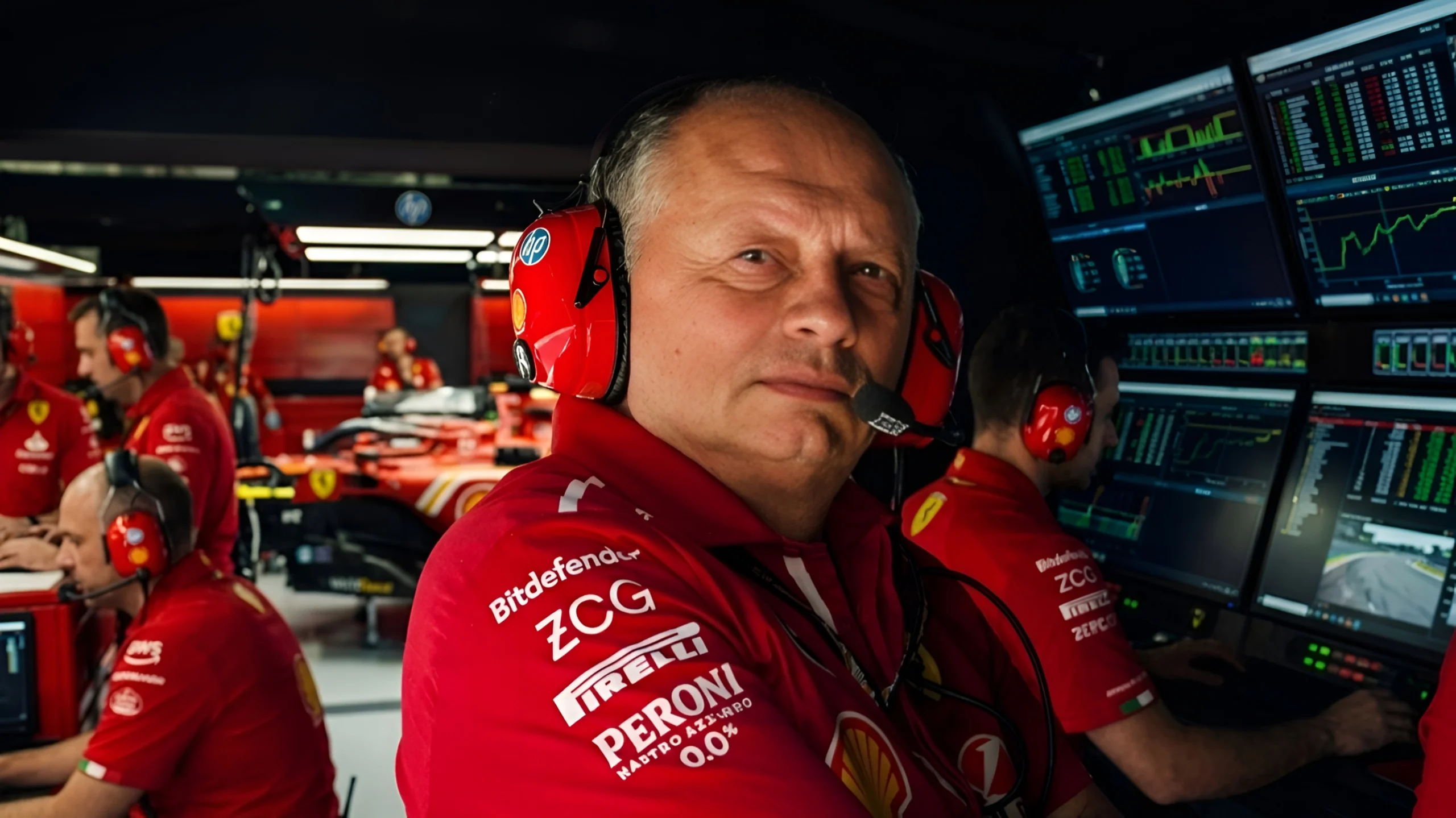
Ferrari Team Principal Fred Vasseur monitoring data from the pit wall during the 2026 Japanese Grand Prix weekend at Suzuka.
Published by: AutodromeF1 Editorial Team
The Ferrari Resurgence: Fred Vasseur’s Blueprint for the 2026 Technical Era
Suzuka, Japan — March 28, 2026
In the hallowed paddock of the Suzuka Circuit, where the scent of high-octane fuel mixes with the anticipation of the Japanese Grand Prix, Scuderia Ferrari stands at a critical crossroads. After a 2025 season that Fred Vasseur himself described as a “psychological test” for the Maranello faithful, the 2026 campaign has opened with a vastly different narrative. No longer are the Tifosi mourning a “scarlet disillusionment”; instead, they are witnessing the first fruits of a high-stakes gamble that saw Ferrari abandon 2025 development as early as last April to focus entirely on the current technical revolution.
The Context: A Strategic Sacrifice for 2026
To understand Ferrari’s performance today, one must look back at the tactical pivot executed by Team Principal Fred Vasseur during the 2025 season. While McLaren—led by the formidable duo of Lando Norris and Oscar Piastri—dominated the final year of the previous regulations, Vasseur made the executive decision to divert all wind tunnel time and R&D resources toward the SF-26.
This was a “masterclass in psychological positioning,” as Vasseur sought to shield his team from the immediate sting of P7 and P8 finishes in 2025 by pointing toward the 2026 horizon. Today, as the grid navigates the third round of the 2026 season in Japan, that decision is being vindicated. Ferrari is no longer a mid-field straggler; they are currently the primary challengers to a resurgent Mercedes squad.
The 2026 Reality: A Different Kind of Championship
As of the qualifying session at Suzuka today, the 2026 season has established a clear hierarchy. Mercedes, powered by the explosive debut of rookie sensation Kimi Antonelli and the consistency of George Russell, currently leads the Constructors’ standings. However, Ferrari is firmly in the hunt, occupying second place and showing a level of operational “pragmatism” that was often missing in years past.
The results from the opening rounds in Melbourne and Shanghai tell a story of consistent podium contention:
- Australia: Charles Leclerc secured a brilliant podium finish.
- China: Lewis Hamilton broke his 16-month podium drought, claiming P3.
- Japan (Qualifying): Leclerc and Hamilton have locked out the second and third rows (P4 and P6), ready to hunt down the Mercedes duo in tomorrow’s race.
Analyzing the SF-26: Technical Mastery under New Rules
The 2026 technical regulations represent the most significant shift in Formula 1 history, introducing active aerodynamics and a 50/50 power split between the internal combustion engine (ICE) and electric energy. Ferrari’s SF-26 has emerged as a car that finally aligns with the driving styles of its elite lineup.
- The Power Unit Parity
Ferrari’s 2026 power unit is rumored to be among the class of the field. With the removal of the MGU-H and the tripling of MGU-K electrical output to 350kW, the SF-26 has shown remarkable “battery management” during race stints. This was evident in China, where Hamilton was able to utilize the new “Manual Override Mode” to defend his podium spot against a hard-charging Lando Norris. - Active Aerodynamics and Efficiency
The 2026 cars feature movable front and rear wings that adjust for “Straight” and “Corner” modes. Ferrari’s implementation of this system has provided a stable platform, addressing the “snap oversteer” issues that plagued the 2025 car. While Mercedes currently holds a slight edge in pure qualifying trim, Ferrari’s race pace—or “sustained efficiency”—suggests they are kinder to the new, narrower Pirelli tires.
The Hamilton-Leclerc Dynamic: A Unified Front
One of the most striking changes in 2026 is the harmony within the Ferrari garage. Lewis Hamilton, now in his second year with the Scuderia, has been vocal about how the SF-26 fits his requirements far better than the previous year’s car. “The team listened to my feedback on suspension geometry and weight distribution,” Hamilton noted earlier this weekend.
The internal battle is razor-thin. Heading into the Japanese Grand Prix, Charles Leclerc (34 points) and Lewis Hamilton (33 points) are separated by a single point in the Drivers’ Championship. This “healthy friction” is exactly what Vasseur envisioned—a team where two world-class drivers push each other to maximize the “marginal gains” that define the current era. - Fred Vasseur’s leadership philosophy remains rooted in “incremental gains.” He has successfully steered Ferrari away from the “all-or-nothing” gambles of the past. Instead of promising immediate dominance, he speaks of a “development war” that will last through the European leg at Imola and Barcelona.
“We knew Mercedes would be strong at the start,” Vasseur stated in the Suzuka paddock. “But the 2026 championship is not a sprint; it is a marathon of correlation. Our focus is on ensuring every upgrade brought to the track matches our wind tunnel data 100%.”
This methodical approach is a stark contrast to the “scarlet disillusionment” of 2025. Ferrari is now a team that celebrates P3 and P4 finishes as building blocks rather than failures, provided they are accompanied by data that proves the car is evolving.
The Road Ahead: Can Ferrari Topple Mercedes?
While Mercedes currently holds the momentum—with Kimi Antonelli taking pole position today in Suzuka—the season is far from settled. The 2026 regulations have leveled the playing field significantly. Red Bull and Max Verstappen, for instance, are currently struggling in P8 in the standings, proving that no dynasty is permanent in the face of radical technical change.
Ferrari’s strategy for the upcoming races includes:
- Weight Reduction: Targeting the new 760kg minimum weight limit through chassis refinement.
- Software Optimization: Refining the ERS (Energy Recovery System) deployment to better exploit the “Overtake Mode.”
- Narrower Front Elements: Aero updates scheduled for the Miami Grand Prix in May to reduce drag in high-speed sections.
Conclusion: A Rebuilt Foundation
The Ferrari of 2026 is a team transformed. By sacrificing the 2025 campaign, Vasseur has given Maranello the “technical parity” it has craved for a decade. The sight of Oscar Piastri leading a McLaren dynasty has been replaced by a multi-front war involving Mercedes, Ferrari, and a resurgent McLaren.
For the Tifosi, the wait for a championship continues, but for the first time in years, the path forward is clear and logical. As the lights go out at Suzuka tomorrow, Ferrari isn’t just racing for points; they are validating a new philosophy of excellence. If 2025 was the year of the “strategic recalibration,” 2026 is proving to be the year of the “sustained assault.”


