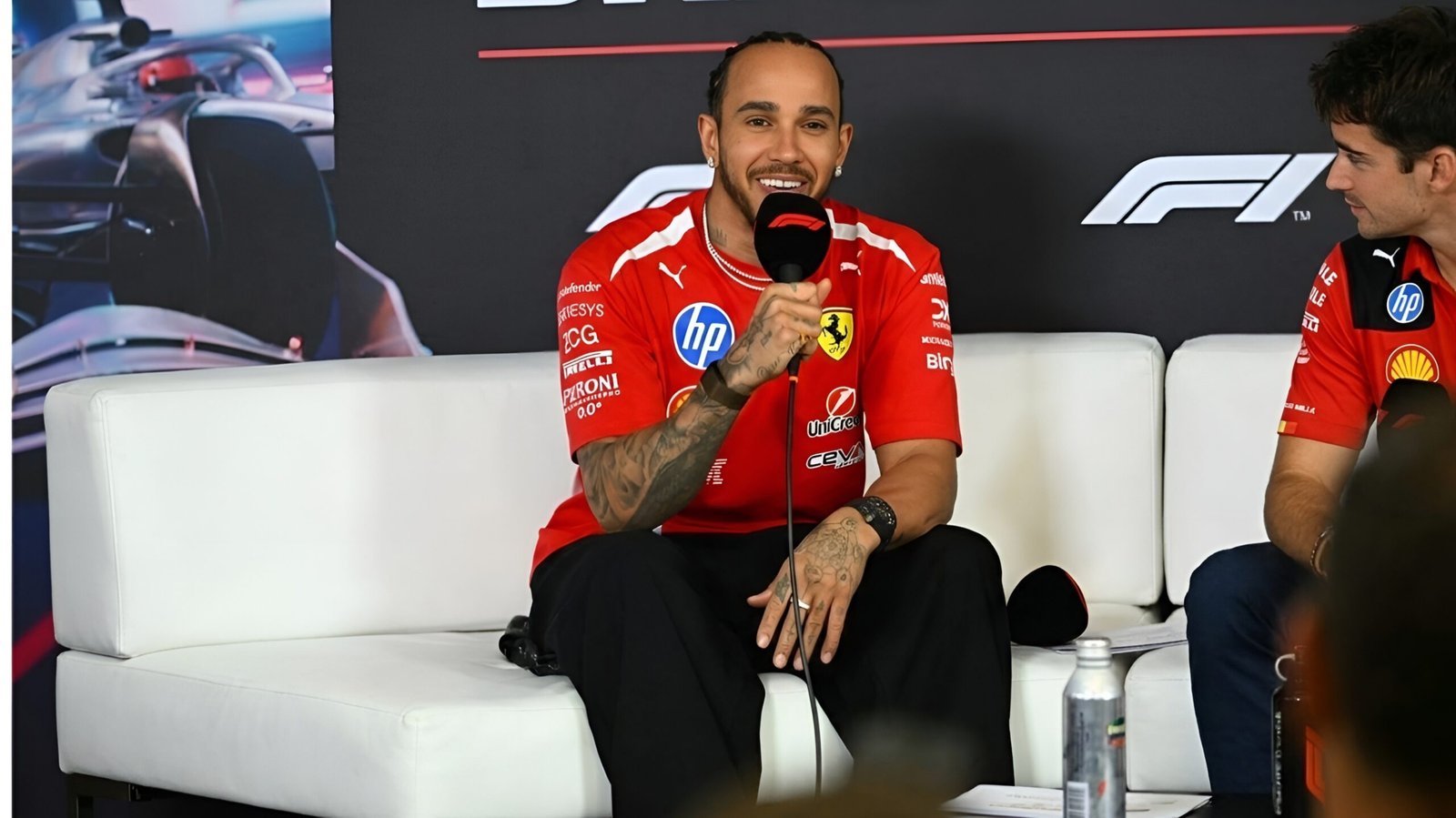
Lewis Hamilton discusses the SF-26 performance gap alongside teammate Charles Leclerc during the race press conference at the 2026 Japanese Grand Prix.
Published by: AutodromeF1 Editorial Team
Ferrari Power Unit Discrepancy Underscores Persistent Intra-Team Challenges as Lewis Hamilton Endures Frustrating Suzuka Defence
London, United Kingdom – 30 March 2026 – In the high-stakes crucible of Formula 1’s 2026 season, where regulatory overhauls have redefined power delivery and energy deployment strategies, Lewis Hamilton’s post-race remarks following the Japanese Grand Prix laid bare a rare but revealing vulnerability within Ferrari’s otherwise formidable SF-26 package. The seven-time world champion, now in his maiden campaign with the Scuderia, expressed measured yet unmistakable frustration after finishing sixth, citing a pronounced power deficit relative to teammate Charles Leclerc’s identical chassis. While Leclerc capitalised on superior straight-line performance to secure a hard-fought third place, Hamilton was left to mount a stoic rearguard action that ultimately yielded to the superior pace of rivals on the long straights of Suzuka.
The disparity was not lost on Hamilton, who has spent a career extracting the maximum from machinery that, on paper, should have been indistinguishable from his teammate’s. Speaking in the paddock immediately after the chequered flag, the 41-year-old Briton articulated a technical conundrum that has echoed through the opening rounds of this new-generation campaign. “We share the same car, the same specification, yet today there was a clear difference in power delivery,” Hamilton noted. “I was defending as hard as I could, but without the same deployment on the straights, it became a matter of survival rather than attack.” His observations were corroborated by onboard telemetry and radio transmissions that captured repeated queries regarding the four-tenths deficit he suffered into Turn 1 and along the 1.3-kilometre back straight—losses that proved decisive in the closing stages.
This was no isolated anomaly. The Japanese Grand Prix at Suzuka Circuit amplified concerns first flagged during the Chinese Grand Prix earlier in the season, where similar intra-team inconsistencies in power unit behaviour had already prompted discreet Ferrari investigations. The SF-26, powered by the latest iteration of Ferrari’s 2026-spec hybrid powertrain, has demonstrated blistering one-lap pace in qualifying but has occasionally struggled with consistent energy management across race stints. Under the stringent 2026 regulations—designed to emphasise sustainable fuels, reduced electrical output limits, and tighter integration between internal combustion engine and electric motor—such variances can stem from multiple variables: engine mapping calibration, battery state-of-charge deployment algorithms, software parameters governing ERS (Energy Recovery System) harvest and release, or even subtle chassis setup differences that influence thermal management and aerodynamic efficiency.
Hamilton, whose seamless integration into Maranello’s engineering ecosystem has otherwise drawn widespread acclaim, was unequivocal in highlighting the straight-line speed shortfall. “On the straights, particularly the long one after Turn 130R, I simply didn’t have the same punch as Charles,” he explained. “We’re talking about identical cars, yet the deployment window felt restricted. Was it mapping? Was it battery strategy? I don’t know yet, but we need answers.” These comments carry the weight of experience from a driver who has navigated seven world titles across Mercedes and now Ferrari, and they reflect a level of technical literacy that has long set Hamilton apart. His frustration was not theatrical; rather, it was the measured critique of a professional who understands that, in modern Formula 1, a tenth of a second per lap compounds into race-defining margins.
Leclerc, by contrast, executed a textbook display of adaptability that elevated his result to the upper echelons of the podium. Starting from fourth on the grid, the Monegasque driver capitalised on a virtual safety car period mid-race to optimise tyre strategy and battery deployment. His ability to maintain higher average speeds through the high-speed sectors—particularly the Esses and Spoon Curve—combined with a more aggressive ERS deployment profile, allowed him to pressure Hamilton’s position before ultimately pulling clear. Post-race, Leclerc acknowledged the team’s internal dynamics with characteristic diplomacy: “We both pushed the car to its limits today, but the data will show where the differences lay. The most important thing is that Ferrari extracts the maximum from both cars moving forward.” His podium finish not only bolstered his championship standing but also underscored the SF-26’s latent potential when power unit parameters align optimally.
Ferrari’s technical leadership has moved swiftly to address the issue. Team principal Frédéric Vasseur confirmed that a dedicated investigation is already underway, drawing on data from both drivers’ power units, telemetry logs, and wind-tunnel correlation models. “This is not acceptable in a team that prides itself on parity,” Vasseur stated during the post-race media briefing. “Charles and Lewis are driving identical specifications. Any discrepancy must be traced to its root cause—whether in software calibration, hardware tolerances, or operational procedures—and rectified before the next round.” Sources within the team indicate that the analysis will encompass a full audit of the power unit’s control electronics, focusing on the hybrid system’s energy deployment maps that were revised under 2026 regulations to cap electrical assistance at 350 kW while maintaining the 1.6-litre V6 turbocharged core.
The broader context of Hamilton’s transition to Ferrari adds layers of significance to the episode. After a decade of dominance with Mercedes, Hamilton’s 2025 move to Maranello was heralded as one of the most consequential driver transfers in modern Formula 1 history. Early-season flashes—most notably his podium in China—had ignited optimism that the partnership could challenge for the constructors’ and drivers’ titles in the first year of the new regulations. Yet weekends like Suzuka reveal the fine margins that separate contenders from frontrunners in an era where power unit reliability and consistency are paramount. The 2026 technical regulations, introduced to promote closer competition and environmental responsibility, have compressed performance envelopes across the grid. Straight-line speed, once the domain of raw horsepower, now hinges on sophisticated energy management strategies that demand flawless calibration between driver input, software algorithms, and hardware tolerances.
Analysts tracking the championship note that Ferrari’s intra-team performance gap, while frustrating for Hamilton, is not unprecedented in the sport’s history. Similar discrepancies plagued Mercedes during the hybrid era’s early phases and have surfaced at Red Bull in periods of rapid development. What distinguishes the current situation is the intensity of scrutiny under which Ferrari operates, particularly with a global icon like Hamilton at the wheel. The Scuderia’s historical reputation for passionate engineering—tempered occasionally by operational inconsistencies—will be tested in the coming weeks as the team prepares for the next leg of the Asian swing.
From a strategic standpoint, the race itself unfolded with the tactical nuance that defines Suzuka’s demanding 5.807-kilometre layout. Hamilton qualified strongly in third but found himself vulnerable after the first round of pit stops. Tyre degradation on the medium compound, exacerbated by the need to defend against faster cars behind, forced him into a conservative energy management regime that further limited his power unit’s output. By contrast, Leclerc’s proactive management of battery charge during the safety car window preserved his deployment advantage for the final 25 laps, enabling him to maintain pressure on the leaders while fending off McLaren and Mercedes challengers.
Looking ahead, the resolution of this power unit parity issue carries implications that extend beyond a single race weekend. With the championship still in its infancy, Ferrari sits within striking distance of the top three in the constructors’ standings. Hamilton’s experience and leadership within the team could prove instrumental in accelerating the diagnostic process, drawing on the collaborative culture he has cultivated since joining. Yet the episode also serves as a reminder that, even in an era of identical component specifications, the human and technical variables that separate drivers and cars remain as complex as ever.
As the paddock decamps from Suzuka and turns its attention to the forthcoming races, Ferrari’s engineering brain trust faces a clear mandate: eliminate the intra-team discrepancies that compromised Hamilton’s race and ensure both drivers can extract the full performance envelope of the SF-26. For Hamilton, the drive remains undiminished. His post-race demeanour—reflective, analytical, and forward-looking—spoke volumes about a champion who refuses to accept anything less than absolute parity from machinery that bears his name on the entry list.
In an age where Formula 1’s technological frontier evolves with each regulation cycle, moments like these illuminate the enduring truth of the sport: success is forged not merely in raw speed, but in the relentless pursuit of precision across every layer of the machine. Ferrari’s response in the days ahead will determine whether Suzuka represents a fleeting setback or the catalyst for a more harmonious and competitive campaign. The eyes of the motorsport world will be watching closely as the Scuderia seeks to restore the balance that both Hamilton and Leclerc deserve.


