Published by: AutodromeF1 Editorial Team
Intra-Team Emulation or Costly Indulgence? Ferrari’s Unfettered Duel in Shanghai Hands Mercedes a Decisive One-Two as George Russell Voices Measured Critique of Aggressive Tactics
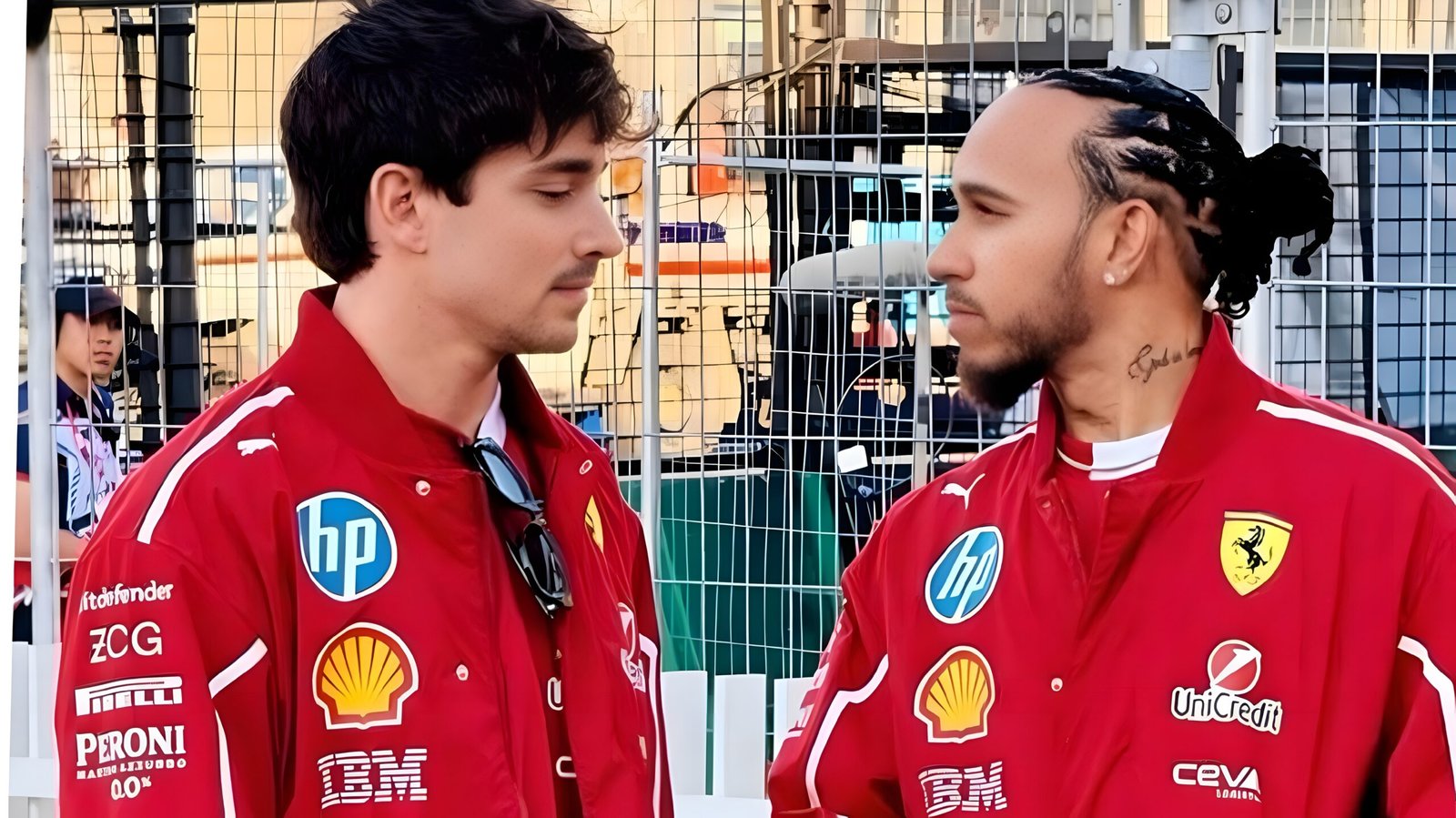
In the crucible of the 2026 Formula 1 season, where the recalibrated regulations have already begun to reshape the competitive landscape, the Chinese Grand Prix at the Shanghai International Circuit delivered a compelling case study in the tension between individual ambition and collective imperative. While Mercedes secured a commanding one-two finish, with 19-year-old Kimi Antonelli claiming a maiden victory and George Russell consolidating his championship position in second, the narrative of the afternoon centred not on the victors’ poise but on the spirited, and at times precarious, intra-team contest between Ferrari’s Lewis Hamilton and Charles Leclerc.
The duel, which unfolded over multiple laps and involved repeated position swaps, ultimately allowed Russell to advance unchallenged into second place. In its aftermath, the British Mercedes driver offered a pointed yet professional assessment of the Ferrari pair’s conduct, describing it as among the most aggressive intra-team racing he had witnessed in recent memory and admitting he had anticipated a collision. Ferrari team principal Frédéric Vasseur later defended the decision to permit such freedom, acknowledging the inherent risk of the team appearing “completely stupid” but emphasising its value in fostering long-term development. What emerged was not merely a race result but a nuanced examination of modern team management under the intensified demands of the 2026 machinery.
The race itself began with promise for Ferrari. Antonelli, who had secured pole position the previous day in a landmark achievement as the youngest polesitter in Formula 1 history, lost the lead almost immediately as Hamilton surged from third on the grid with a decisive opening-lap manoeuvre. The seven-time world champion, now in his second season with the Scuderia following his high-profile transition from Mercedes, appeared poised to convert early momentum into a landmark podium. Yet Antonelli reclaimed the advantage before the completion of lap two and thereafter established a rhythm that would prove unassailable. His sole pit stop coincided with the race’s only Safety Car deployment early in the proceedings, after which the young Italian maintained composure despite a late-race lock-up at Turn 14 that briefly threatened his advantage.
Behind the leading Mercedes, the race assumed a markedly different character. Hamilton and Leclerc, separated by mere fractions for extended periods, transformed the podium battle into a private arena of tactical audacity. On lap 24, Leclerc executed an assertive inside pass at the Turn 14 hairpin, only to delay his exit acceleration in a manner that visibly impeded Hamilton’s progress. The resulting compression in the train caught Russell, running directly astern, off guard; he was forced to jink his steering wheel to avoid contact and later queried over untelevised team radio, “What’s Leclerc doing?” His race engineer responded that Hamilton would receive the instruction to overtake, to which Russell replied pointedly, “Leclerc just backed up Lewis in the train.”
Such moments were not isolated. The pair exchanged positions repeatedly—through Turns 9 and 10 on one occasion, and again at Turn 14 on laps 35 and 39—each manoeuvre executed with the precision and intensity that the 2026 cars, with their refined aerodynamics and power-unit characteristics, both enable and amplify. Although no physical contact occurred, the proximity and defensive lines adopted rendered the contest visibly fraught. Leclerc, for his part, conveyed evident enjoyment on the radio, remarking that the battle was “actually quite fun.” Hamilton, ever the consummate professional, maintained focus and ultimately prevailed in the final exchange at Turn 1, securing third place and his first Grand Prix podium for Ferrari by a margin of more than three seconds over his teammate.
For Russell, stationed immediately behind the red cars during the critical mid-race phase, the spectacle carried a different resonance. Having initially demoted both Ferraris in the opening laps—passing Leclerc on lap three and Hamilton two laps thereafter—he found himself re-inserted behind them following the Safety Car restart. Tyre-temperature management proved challenging for the Mercedes driver in those moments, a phenomenon exacerbated by the new-generation rubber and the altered energy-recovery systems of 2026. The time lost while navigating the Ferrari duel proved decisive: Russell later estimated that the delay eliminated any realistic prospect of mounting a challenge to Antonelli, who had by then built an unassailable buffer.
In the post-race press conference, Russell articulated his perspective with characteristic clarity and restraint. “I was just waiting for the two of them to collide, and somehow they didn’t,” he stated. “It was some of the most aggressive racing I’ve seen for a while. If I wasn’t trying to win the race, I’d have been enjoying the battle, but obviously watching Kimi pull away during those points it was a little bit annoying.” He further observed that Ferrari demonstrated superior cornering pace, while Mercedes retained an edge on the straights, rendering the overtaking process “not straightforward” when attempting to clear both cars on identical tyre compounds. Nevertheless, Russell expressed satisfaction with second place, recognising that the outcome could have been considerably worse and affirming the solidity of Mercedes’ weekend overall.
Vasseur’s post-race reflections provided essential context to Ferrari’s strategic calculus. The French team principal acknowledged the deliberate choice to refrain from issuing team orders. “They are professional, and I think it makes sense in this situation to let them race,” he explained. “I know perfectly that we can also look completely stupid half an hour or later, but at the end of the day, it’s also the best way to build up a team. We need to have this kind of emulation in the team to improve, as long as it’s done like it was done today.” Vasseur noted that both drivers had indicated on the radio their enjoyment of the contest and emphasised that the substantial gap to the cars behind—Oliver Bearman in fifth and beyond—afforded the luxury of such an approach without immediate jeopardy to the team’s constructors’ standing.
This episode invites deeper consideration of the evolving dynamics within Formula 1’s 2026 regulatory framework. The new generation of cars, designed to promote closer racing through revised aerodynamics, sustainable power units, and modified energy deployment protocols, has already demonstrated an capacity to intensify wheel-to-wheel combat. Yet, as evidenced in Shanghai, this same proximity can transform internal rivalries into potential liabilities when not tempered by overarching strategy. Ferrari’s corner-speed advantage, while impressive, was rendered moot by the time lost in mutual defence, allowing Mercedes to capitalise on straight-line superiority and cleaner air. The result: a Mercedes one-two that extended the team’s early-season momentum, with Antonelli’s victory marking not only a personal milestone but a statement of the Brackley outfit’s readiness under the new rules.
For Hamilton, the podium carried symbolic weight. Competing at the circuit where he had secured his sole sprint victory the previous season, the 41-year-old delivered a performance that underscored his seamless integration into the Ferrari environment. His ability to emerge victorious from the intra-team fray without compromising team harmony reflects a maturity honed over two decades at the pinnacle of the sport. Leclerc, meanwhile, exits the weekend with valuable data on defensive resilience and the limits of aggressive line-holding under 2026 conditions. The Monegasque’s fourth-place finish, though disappointing in isolation, contributes to a constructors’ tally that keeps Ferrari firmly in the title conversation.
Antonelli’s triumph, achieved at the tender age of 19 years and 202 days, places him second only to Max Verstappen in the annals of youngest Grand Prix winners. The Italian prodigy’s composure—recovering the lead within two laps, managing tyre degradation across 56 laps, and overcoming a heart-stopping moment four laps from the flag—signals a precocious talent capable of anchoring Mercedes’ ambitions for years to come. His emotional radio message and subsequent podium demeanour conveyed the profound significance of the achievement, not merely for himself but for a nation eager to celebrate homegrown success at the highest level.
In the broader championship context, Russell maintains a slender advantage at the head of the drivers’ standings, with Antonelli now positioned as his closest rival. The four-point separation after three rounds underscores the tightness of the 2026 title fight, particularly given the impending technical updates and adjustments to power-unit measurement protocols flagged by Russell himself. Ferrari, despite the tactical indulgence in Shanghai, trails in the constructors’ classification but possesses the raw pace to challenge when internal cohesion is prioritised.
The events of 15 March compel reflection on the delicate art of team leadership in an era of heightened mechanical interdependence. Vasseur’s willingness to countenance risk in pursuit of “emulation” aligns with a philosophy that values driver development and psychological resilience. Yet, as Russell’s commentary subtly highlights, such latitude carries tangible costs when deployed against rivals operating with greater strategic discipline. In the 2026 landscape—where margins are compressed by regulation and overtaking windows are both expanded and perilous—the distinction between healthy competition and counterproductive friction may prove decisive.
As the paddock departs Shanghai for the forthcoming Japanese Grand Prix, the discourse will inevitably pivot toward the lessons absorbed. Will Ferrari refine its approach to intra-team management, introducing earlier guidance when podium positions are at stake? Or will the Scuderia continue to prioritise unbridled racing as a crucible for improvement, accepting occasional short-term setbacks in exchange for long-term competitive edge? Mercedes, for its part, will seek to sustain the operational precision that converted Ferrari’s discord into its own advantage.
What remains indisputable is the spectacle’s contribution to the sport’s enduring appeal. The 2026 cars, for all their technical sophistication, have restored an element of raw, unscripted drama to the grand prix weekend. Yet drama, when unchecked, can border on the hazardous—a reality George Russell articulated not with sensationalism but with the measured insight of a driver who has witnessed the consequences of excess from mere metres behind. In an age increasingly defined by data and simulation, Shanghai reminded observers that human factors—ambition, pride, and the instinct to race—remain the most unpredictable variables of all.
The 2026 season, still in its infancy, has already furnished a narrative rich in strategic nuance and human complexity. Ferrari’s duel in China may ultimately be remembered less as a misstep than as a necessary chapter in the team’s evolution under new regulations and new personnel. For Russell and Mercedes, it represented an opportunistic masterclass in capitalising on circumstance while maintaining professional decorum. As the championship unfolds, the true measure of these decisions will emerge not in isolated race reports but in the cumulative standings when the chequered flag falls in Abu Dhabi months hence. For now, Shanghai stands as a vivid illustration that in Formula 1, even the most sophisticated machinery cannot entirely suppress the primal imperatives of competition—nor the calculated restraint required to harness them effectively.


