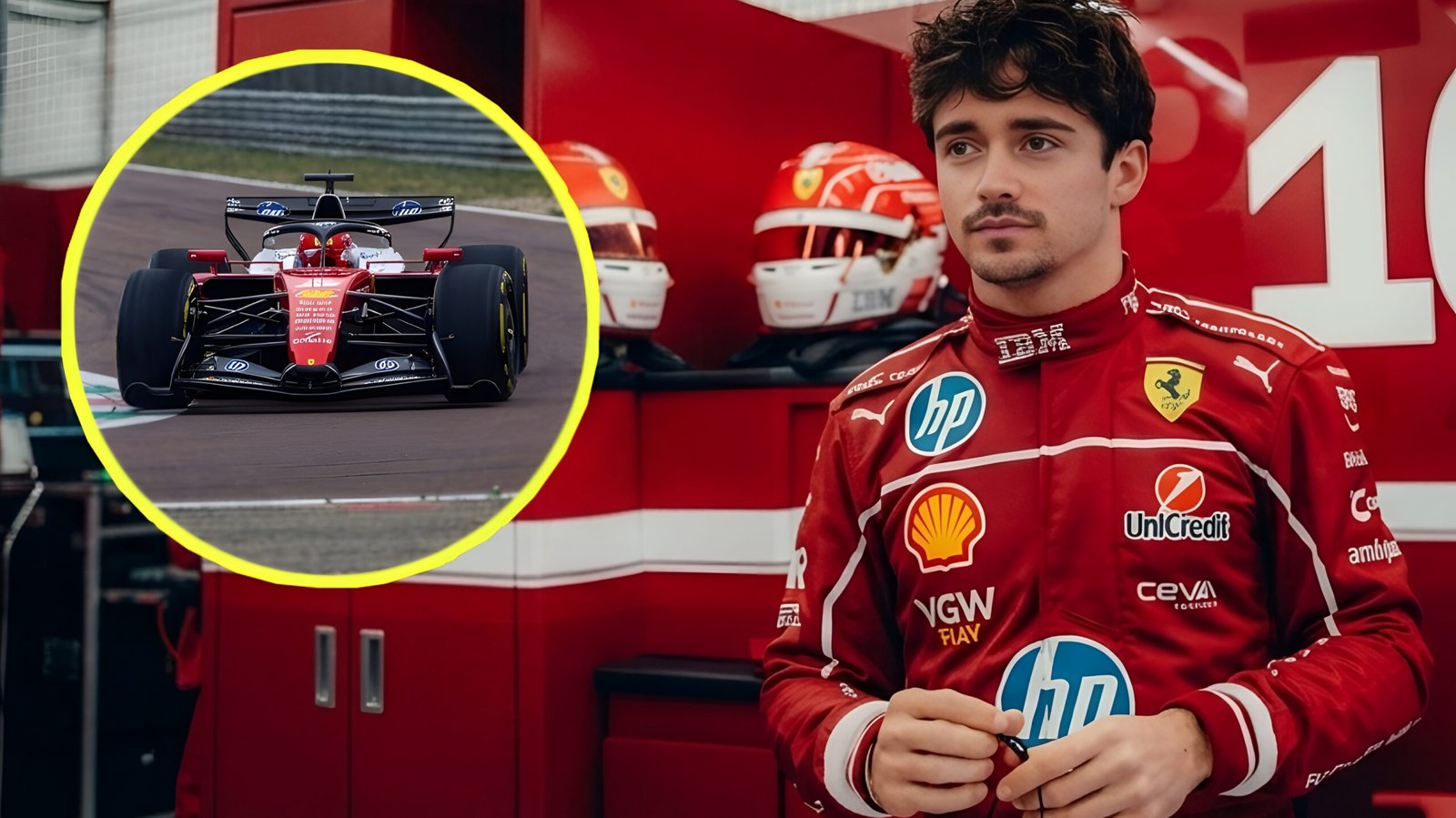
Charles Leclerc at the 2026 Chinese Grand Prix: The Ferrari driver faces a significant pace deficit as Mercedes dominates the straight-line speed traps in Shanghai.
Published by: AutodromeF1 Editorial Team
Mercedes’ Straight-Line Supremacy Exposes Ferrari’s Enduring Deficits: Leclerc Confronts 0.6-Second Race Gap in Shanghai as Upgrades Remain the Sole Beacon of Hope
Maranello, 23 March 2026 — In the crisp, floodlit expanse of the Shanghai International Circuit, Mercedes-AMG Petronas delivered a masterclass in aerodynamic efficiency and power-unit integration that left rivals, most notably Ferrari, grappling with a performance disparity more pronounced than any witnessed in the preceding season. Kimi Antonelli, the 19-year-old prodigy making only his seventh Formula 1 start, claimed a historic maiden victory, leading home teammate George Russell by 5.5 seconds. Lewis Hamilton, now in his second campaign with the Scuderia Ferrari, secured third place—his first podium in rosso corsa—while Charles Leclerc crossed the line a distant fourth, 28.9 seconds adrift of the winner. The result was not merely a race victory; it was a stark empirical confirmation of the technical chasm that Ferrari’s leadership had privately feared since pre-season testing.
Leclerc, whose qualifying position of fourth already signalled vulnerability, emerged from the cockpit visibly subdued. Speaking in the media pen with the measured restraint that has become his hallmark under pressure, the Monegasque driver articulated a sentiment that resonated far beyond the confines of the Ferrari garage. “I’m not going to say I was waiting for that,” he began, choosing his words with surgical precision, “because I was hoping that this pace, we would never see.” The reference was unambiguous: Mercedes’ race pace, sustained over 56 laps on a circuit that rewards both mechanical grip and outright top speed, had laid bare a deficit Ferrari had hoped would remain confined to simulation data.
The narrative arc of the weekend had begun with deceptive promise. In Australia, the season opener, and during the China Sprint on Saturday, Ferrari’s SF-26 appeared competitive enough to suggest that the winter’s development programme had narrowed the gap to the front. Those results, however, failed to correlate with the comprehensive telemetry gathered during February’s Bahrain tests. Only when the cars lined up for the full Grand Prix distance on Sunday did the true picture crystallise. “After testing there were things that were just not stacking up,” Leclerc continued. “In the race I didn’t understand why we were so close in Australia or the sprint.” Post-race analysis, corroborated by both teams’ internal data streams, quantified the deficit at approximately 0.6 seconds per lap in race trim—larger, by a meaningful margin, than the gaps observed throughout the 2025 campaign.
The root of Mercedes’ advantage lay not in a single revolutionary component but in a harmonious integration of chassis, suspension geometry and power-unit calibration. On the long, sweeping straight that dominates Sector 3—nearly 1.2 kilometres of uninterrupted acceleration—both Mercedes W17 entries consistently registered terminal velocities exceeding those of the Ferraris by more than 12 km/h. This straight-line supremacy translated into decisive time gains: approximately 0.35 seconds alone in Sector 3 on a typical lap. Ferrari, by contrast, demonstrated credible performance through the technical, medium-speed corners of Sectors 1 and 2, where the SF-26’s balance and tyre management shone. Yet the cumulative effect of that straight-line shortfall rendered any sector advantage moot. Once DRS zones opened and the race settled into its rhythm, the Mercedes drivers simply pulled away, their cars exhibiting superior traction out of the final hairpin and cleaner aero behaviour at 330 km/h-plus.
Such disparities are rarely accidental. The 2026 regulatory framework, with its emphasis on sustainable fuels and revised aerodynamic regulations, has rewarded teams that prioritised efficiency over peak power in their winter programmes. Mercedes’ power unit, rumoured to operate at an exceptional thermal efficiency window, combined with a floor design that generates consistent downforce without excessive drag, created a package ideally suited to Shanghai’s layout. Ferrari’s engineers, while lauded internally for their work on the hybrid system’s energy-recovery deployment, have evidently sacrificed top-end performance in pursuit of cornering stability—a compromise that proved costly on a track where overtaking opportunities are concentrated on the straights.
The intra-team dynamic within Ferrari added another layer of complexity. Hamilton’s third-place finish, achieved through a blend of strategic patience and clinical tyre management, marked a personal milestone. For the 41-year-old seven-time champion, standing on the podium in Ferrari overalls represented both vindication and a subtle reminder of the team’s potential. Leclerc, starting alongside his teammate on the second row, found himself unable to mount a sustained challenge. The 28.9-second margin at the flag spoke volumes: even with identical strategy calls and comparable fuel loads, the underlying car performance dictated the outcome. In the post-race debrief, team principal Frédéric Vasseur acknowledged the deficit without equivocation, describing the weekend as “a data point we must absorb rather than deny.”
Yet denial has never been part of Ferrari’s institutional character. Leclerc, ever the realist tempered by guarded optimism, refused to surrender to despondency. “We have upgrades in the pipeline,” he stated, his tone shifting from reflection to resolve. “We know the direction we need to take, and we will push to put Mercedes under pressure as soon as possible.” Those upgrades—expected to include revisions to the front wing, floor edges and power-unit mapping—are scheduled for phased introduction beginning at the European leg of the championship. Insiders within Maranello suggest the package could reclaim as much as 0.3 seconds per lap, provided the correlation between wind-tunnel data and track reality holds.
The broader championship implications are already being recalibrated. With only two races completed, Mercedes sits atop the constructors’ standings with a commanding 68-point lead. Antonelli’s victory, achieved with the poise of a driver far beyond his years, has electrified the paddock. At 19 years and 47 days, he becomes the second-youngest winner in Formula 1 history, eclipsed only by Max Verstappen’s 2016 triumph. Russell, meanwhile, continues to embody consistency, his second-place finish extending a personal streak of podiums that now spans five consecutive races. For Ferrari, the priority remains clear: close the straight-line deficit before the championship’s momentum becomes irreversible.
Technical observers note that the 0.6-second gap observed in China exceeds the historical average for competitive disparity in the hybrid era. In 2025, Ferrari’s maximum race-pace deficit rarely surpassed 0.4 seconds; the escalation this weekend suggests either a step-change in Mercedes’ development curve or a misjudgement in Ferrari’s 2026 concept. Telemetry traces released under FIA protocols reveal that Ferrari’s tyre degradation, while controlled, was marginally higher in the medium-speed sections—another factor that compounded the straight-line weakness. When asked whether the team had considered altering its aerodynamic philosophy mid-season, Vasseur demurred, emphasising that “fundamental changes at this stage would risk destabilising the entire programme.”
Beyond the numbers lies the human dimension. Leclerc’s disappointment was palpable yet never petulant. In an era where social-media scrutiny amplifies every grimace, his composure in the face of clear adversity underscored the maturity that has defined his tenure at Maranello. Hamilton, by contrast, radiated quiet satisfaction. His podium interview, delivered with the measured eloquence that has become his trademark, focused less on personal achievement and more on the collective task ahead: “We know where we are. We know what we need to do. And we will do it.” The contrast between the two Ferrari drivers—Leclerc’s analytical frustration and Hamilton’s seasoned pragmatism—may yet prove the team’s greatest asset as development intensifies.
Looking forward, the calendar offers both opportunity and peril. The upcoming races in Europe—Bahrain’s high-speed layout followed by the technical demands of Imola and Monaco—will test whether Ferrari’s upgrades can indeed bridge the gap. Should the package deliver even partial recovery, the intra-team battle between Hamilton and Leclerc could evolve into one of the most compelling narratives of the season. Conversely, if Mercedes maintains its current trajectory, the championship battle may tilt decisively toward Brackley earlier than anticipated.
In the final analysis, Sunday’s Chinese Grand Prix served as more than a single-race result; it functioned as a diagnostic examination of Formula 1’s 2026 hierarchy. Mercedes emerged with clinical dominance, its drivers executing a flawless one-two that showcased both youth and experience in perfect harmony. Ferrari, while competitive in isolated sectors, confronted the uncomfortable reality of a systemic shortfall. Leclerc’s candid assessment—“I was hoping we would never see these days”—captured the sentiment of an entire team. Yet his subsequent insistence on forthcoming upgrades injected a note of strategic realism into an otherwise sobering weekend.
The Scuderia’s history is replete with chapters of adversity followed by resurgence. Whether the 2026 campaign will add another such chapter depends on the speed with which those “upgrades in the pipeline” translate from CAD drawings to race-ready components. For now, Mercedes holds the initiative, its straight-line supremacy a reminder that in modern Formula 1, marginal gains at 330 km/h can translate into decisive victories. Ferrari’s response, when it arrives, will determine whether this weekend in Shanghai marks the beginning of a Mercedes hegemony or merely the first stanza in a fiercely contested season.


