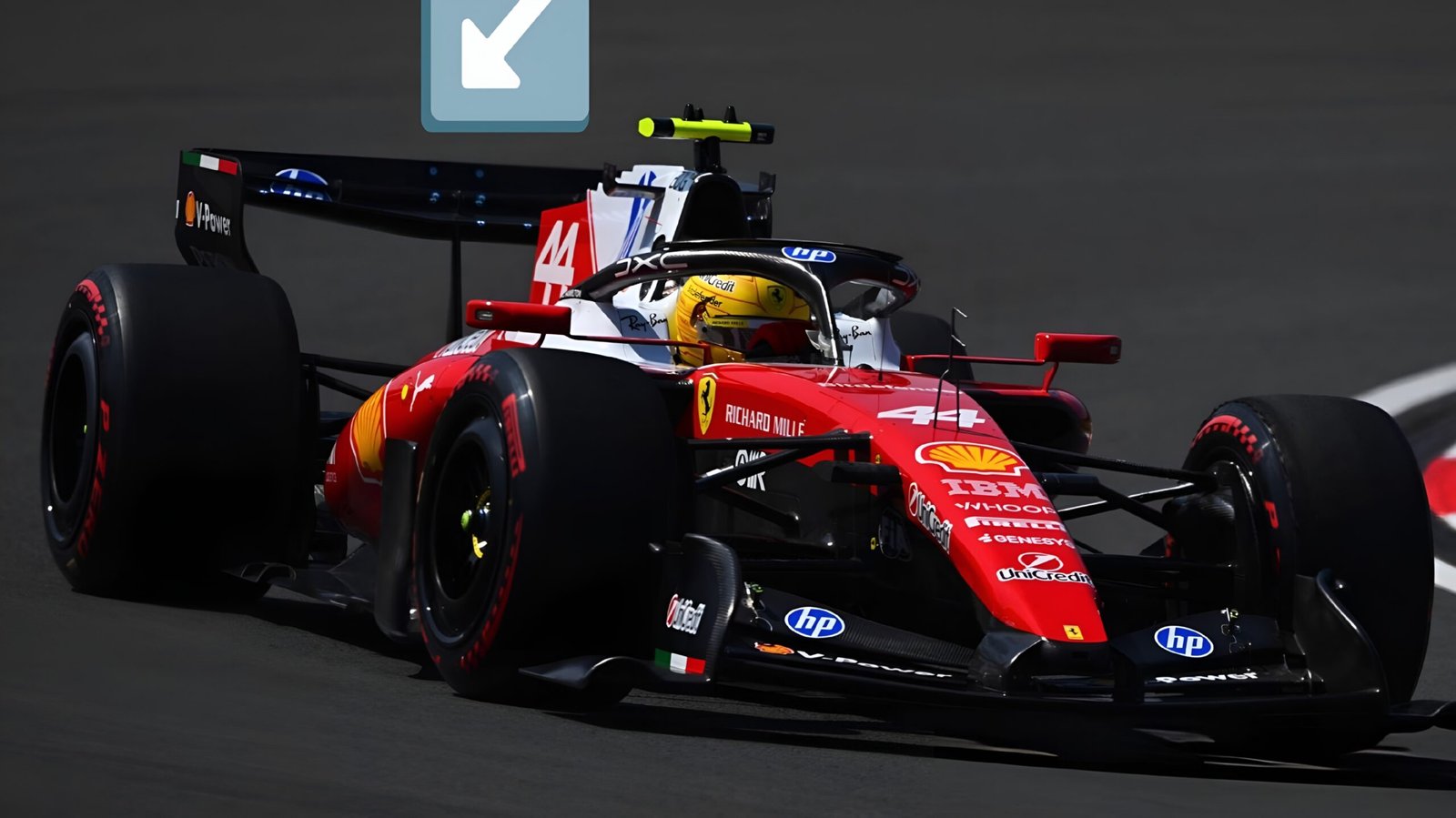
The Ferrari SF-26 on track, highlighting the sophisticated front-wing architecture and the “Macarena” active rear wing designed for the 2026 technical regulations.
Published by: AutodromeF1 Editorial Team
The Prancing Horse Paradox: Deconstructing the Ferrari SF-26’s Enigmatic Performance Profile
Maranello, Italy – In the hyper-competitive crucible of the 2026 Formula 1 World Championship, a compelling and deeply technical narrative is unfolding around the Scuderia Ferrari SF-26. It is a story of profound contrasts: a machine demonstrating sublime mastery through the most demanding cornering sequences on the calendar, yet simultaneously revealing a conspicuous vulnerability on the long straights where raw power reigns supreme. This performance dichotomy has become the central strategic challenge for the Maranello-based team, a complex engineering puzzle rooted in a series of critical pre-season decisions, unforeseen technical hurdles, and a fascinating mismatch between aerodynamic philosophy and realized power unit output. While rivals like Mercedes have presented a more balanced package, the SF-26 stands as a case study in specialized excellence, a chassis of immense potential tethered by a compromised heart.
A Masterclass in Mechanical and Aerodynamic Grip
To witness the SF-26 in its element is to observe a masterclass in modern chassis design. Through high-g sweepers, complex chicanes, and low-speed hairpins, the car exhibits a level of downforce and mechanical balance that is arguably the benchmark of the current grid. Trackside analysis and telemetry data confirm that in cornering phases, the SF-26 frequently matches and, in certain sequences, demonstrably exceeds the performance of its primary competitors. This superiority is not born from a single innovation but from an integrated design philosophy focused on generating consistent, manageable downforce across a wide range of yaw angles and ride heights.
The car’s floor and diffuser assembly appear to be exceptionally effective at creating a powerful, stable ground effect, allowing the drivers to carry remarkable entry speed with confidence. The suspension kinematics, a closely guarded secret, seem to provide a robust platform that maintains aerodynamic stability during the crucial phases of braking, turn-in, and initial acceleration. This allows the car to “rotate” with an immediacy that other teams are struggling to replicate, giving its drivers the ability to attack the apex with precision. It is this cornering prowess that keeps the SF-26 in contention, a testament to the chassis department’s profound understanding of fluid dynamics and vehicle mechanics. They have, by all accounts, delivered a chassis worthy of a championship fight.
The Straight-Line Deficit: Unpacking the Power Unit Conundrum
However, the moment the track straightens, this advantage begins to evaporate. The SF-26’s struggle on the straights is not a simple matter of being “draggy”; it is a multi-faceted issue with the 2026-spec Ferrari power unit at its core. While the chassis provides a formidable exit from corners, the car’s acceleration profile through the mid-to-high-speed range appears blunted. This deficit becomes more pronounced as the car approaches its terminal velocity, a clear indicator that the limitation stems from the power unit’s overall efficiency and deployment strategy.
Industry insiders point to two primary areas of concern. The first is the efficiency of the hybrid energy management system. The complex interplay between the Motor Generator Unit-Kinetic (MGU-K) and the Motor Generator Unit-Heat (MGU-H) is the cornerstone of modern F1 power. It appears the Ferrari system, in its current homologated state, may not be deploying its harvested electrical energy with the same sustained potency as its rivals. This could manifest as a shorter duration of peak electrical deployment down a straight or a less efficient energy recovery process under braking, leaving the car with a net energy deficit to deploy on the subsequent straight.
The second, and perhaps more critical, factor is the internal combustion engine (ICE) itself. Reports from Maranello suggest that the engine which was ultimately homologated for the 2026 season is a more conservative evolution of the 2025 unit, not the revolutionary design originally planned. This decision was not made out of a lack of ambition but was forced upon the team by significant reliability concerns that emerged during late-stage dyno testing. These problems were reportedly exacerbated by the introduction of the new generation of fully sustainable fuels. The variability in fuel composition and combustion characteristics, supplied by partner Shell, introduced unforeseen challenges and stressed components to their breaking point. Coupled with setbacks from prior projects that had a cascading effect on the 2026 development timeline, the team faced a stark choice: risk catastrophic on-track failures with an unproven, higher-power design, or homologate a known, reliable, but less potent unit. They prudently chose the latter.
The Aero-Engine Mismatch and a Tale of Two Ferraris
This decision has created a fundamental imbalance in the SF-26’s overall concept. The car’s aerodynamic package—its wings, bodywork, and cooling inlets—was conceived and optimized around the projected power and cooling requirements of the more aggressive, un-homologated engine. With a more conservative power unit installed, the aero package is now sub-optimal. It is, in essence, an airframe designed for a more powerful engine, resulting in a relative straight-line weakness that was not part of the original design brief.
This is thrown into sharp relief when comparing the SF-26 to its customer team counterpart, the Haas VF-26. Sharing the same Ferrari power unit, the Haas provides a fascinating control variable. While the VF-26 exhibits comparable traction out of slow corners—a trait likely inherited from the shared power unit’s torque characteristics and rear-end componentry—it demonstrates markedly better efficiency at higher speeds. The reason lies in design philosophy. The Haas team, perhaps anticipating a different operational window for the power unit or simply pursuing an alternative aerodynamic path, adopted design elements such as radical front wing dive planes and intricate exhaust flaps. These features appear to manage the car’s aerodynamic wake and reduce drag more effectively as speeds climb.
Consequently, the Ferrari SF-26 experiences a faster rate of drag increase, hitting an aerodynamic “wall” that limits its mid-range acceleration and top-end speed earlier than the Haas. This subtle but critical difference underscores that while the power unit is the primary limiting factor, Maranello’s own aerodynamic choices, made for an engine that never arrived, are compounding the issue.
The Path Forward: Innovation Under Constraint
The predicament leaves Ferrari’s engineers engaged in a campaign of aggressive in-season development, fighting to claw back performance within the tight confines of the sport’s regulations. Since the power unit hardware is homologated and effectively frozen, the focus has shifted entirely to aerodynamic adaptation. The team is working to “re-optimize” the car for its actual power output, seeking to shed drag without critically compromising its extraordinary cornering strength.
Recent developments, such as the curiously nicknamed “Macarena” rear wing, are direct evidence of this effort. These new aero components are designed to create more efficient airflow and reduce the car’s overall drag coefficient, even at the cost of some peak downforce. The goal is to find a new equilibrium, a more harmonious balance between the car’s brilliant chassis and its constrained power unit.
Beyond these aerodynamic tweaks, the team’s hopes rest on the possibility of future homologation updates. While major performance-driven changes are forbidden, manufacturers can apply to the FIA to make modifications for the sole purpose of improving reliability. Ferrari’s engineering team is undoubtedly working to build a case that the reliability issues which forced their conservative homologation choice can be addressed, potentially allowing them to unlock some of the engine’s latent, originally-intended performance.
Until then, the Scuderia Ferrari SF-26 will remain an enigma—a car of two distinct personalities, a world-beater in the corners, and a vulnerable contender on the straights. The 2026 season for Ferrari is no longer just a race against its competitors; it is a race against its own design decisions and a relentless technical pursuit to unleash the full potential of a thoroughbred machine.


