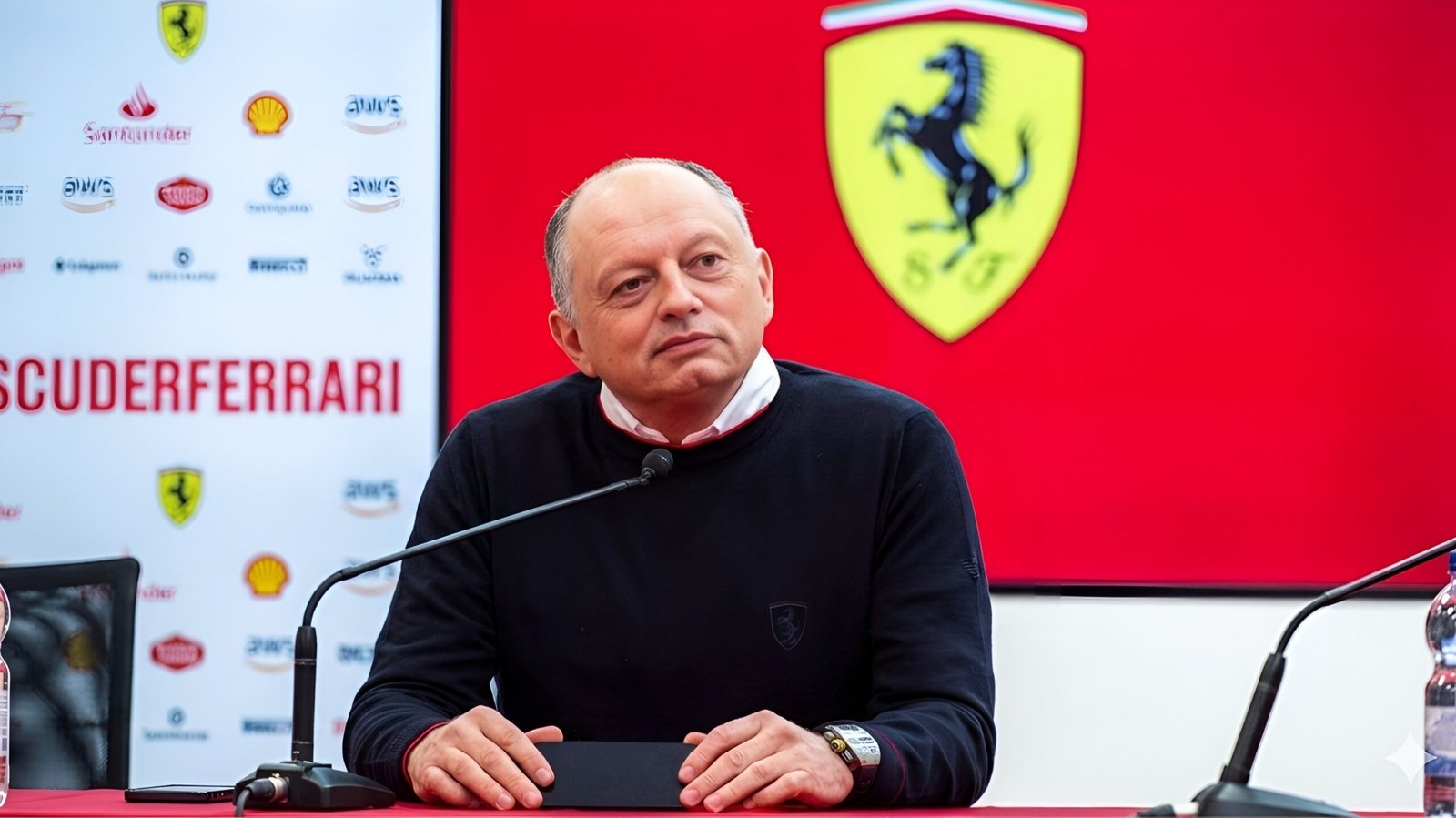
Scuderia Ferrari Team Principal Frédéric Vasseur defends the team’s engineering foresight regarding the 2026 Formula 1 power unit start procedures.
Published by: AutodromeF1 Editorial Team
The Prancing Horse Holds Firm: Ferrari, Vasseur, and the Strategic Impasse Over Formula 1’s 2026 Starting Procedures
Maranello, 23 March – In the high-stakes, hyper-competitive world of Formula 1, an advantage measured in milliseconds can be the difference between victory and defeat. It is a sport where engineering foresight is as crucial as driver skill, and where political maneuvering in the paddock can be as intense as the battles on track. A new and significant flashpoint has emerged, centered on the forthcoming 2026 technical regulations, with Scuderia Ferrari and its Team Principal, Frédéric Vasseur, positioned at the heart of a strategic blockade that has drawn both criticism and grudging respect from their rivals. At issue is a complex but critical detail concerning battery energy management during the race start sequence—a detail Ferrari claims to have anticipated and engineered for, giving them a crucial performance edge they are now staunchly refusing to relinquish.
The dispute is rooted in the fundamental overhaul of the power unit regulations for the 2026 season. As Formula 1 pivots towards a more sustainable future, the new rules mandate a near 50/50 split between internal combustion engine (ICE) power and electrical power, alongside a commitment to 100% sustainable fuels. A key component of this electrical system’s operation is a strict new limit on the amount of energy the battery can recuperate, or “recharge,” per lap. This has been set at approximately 8 megajoules (8MJ). Crucially, the regulation stipulates that the calculation of this energy recovery begins the moment a car crosses the official timing line to start a lap.
This seemingly minor provision has created a significant unintended consequence during the most critical phase of pre-race preparation: the formation lap. On this slow, preparatory lap, drivers perform a series of vital procedures. They aggressively weave to bring their tyres up to optimal operating temperature, conduct practice starts, and perform burnouts to clean the rear tyres and lay down rubber for a better launch. These actions are throttle-intensive and demand significant energy deployment from the hybrid system. However, because the formation lap does not involve the high-speed braking zones of a racing lap, the opportunities for the MGU-K (Motor Generator Unit – Kinetic) to harvest energy are virtually non-existent. Under the new 2026 rules, with the 8MJ recharge cycle not yet initiated in a meaningful way, the cars are forced to expend precious battery energy without any means of replenishing it.
The result is a precarious situation. Cars, particularly those at the front of the grid who complete the formation lap first, are arriving at their starting boxes for the all-important “lights out” moment with their batteries almost completely drained. When the five red lights extinguish, and the drivers demand maximum power, the electrical system is unable to deliver. This leads to a cascade of problems: significantly reduced initial acceleration, pronounced turbo lag as the MGU-H (Motor Generator Unit – Heat, which is being removed in 2026, making turbo response even more critical) can’t be spooled up effectively by electrical power, and consequently, chaotic and potentially dangerous race starts. Front-row starters, who should have the advantage, find themselves vulnerable, as exemplified by incidents in the opening races of the season, where drivers like George Russell highlighted the dramatic loss of performance off the line.
In response to initial complaints, the FIA, Formula 1’s governing body, implemented a minor concession: a five-second hold period before the start sequence is initiated, allowing a brief window for some minimal energy recovery. However, for many of Ferrari’s rivals, this is seen as a wholly inadequate solution. They have been lobbying for more substantial changes, such as making the formation lap exempt from the energy usage calculation, which would allow teams to arrive at the grid with a full state of charge.
This is where Frédéric Vasseur and Ferrari have drawn a line in the sand.
Vasseur, a veteran of the F1 paddock known for his direct and pragmatic leadership, has made Ferrari’s position unequivocally clear. He asserts that Ferrari’s engineering team identified this potential regulatory pitfall more than a year ago during the development of their 2026 challenger, the SF-26. Foreseeing the formation lap energy deficit, they dedicated significant resources to designing a power unit and an energy management strategy that could mitigate the issue more effectively than their competitors. This foresight has gifted them a tangible advantage in the opening moments of a Grand Prix, where their cars have demonstrated consistently stronger launches.
Vasseur stated that Ferrari formally raised their concerns with the FIA a year prior, but with no changes made, they proceeded to engineer a solution within the existing framework. From his perspective, the matter was debated and is now closed. He views the calls for further rule tweaks not as a collective effort to solve a problem, but as a thinly veiled attempt by rival teams to legislate away a competitive advantage they failed to anticipate themselves. To acquiesce would be to penalize Ferrari’s proactive engineering and reward the reactive complaints of others. This strategic stance is deeply rooted in the sport’s competitive DNA, where exploiting the nuances of the regulations is a celebrated art form.
The frustration from rival camps is palpable. George Russell, a director of the Grand Prix Drivers’ Association (GPDA) and a prominent voice in the paddock, publicly labelled Ferrari’s position as “selfish.” He pointed out that any mid-season adjustments to the technical regulations require a “supermajority” vote from the teams, a threshold Ferrari’s opposition effectively prevents them from reaching. Russell’s argument is that Ferrari’s superior starts are a direct consequence of this regulatory anomaly, and their refusal to entertain a fix is hindering the sporting spectacle and potentially compromising fairness.
The initial races of the 2026 season bore out these concerns, with starts characterized by a level of unpredictability bordering on chaos. Cars bogged down, acceleration was inconsistent, and the grid order was often scrambled by the first corner simply due to who managed their depleted energy reserves the best. However, as is typical in Formula 1, teams have been on a steep learning curve. Engineers have been working tirelessly on software maps and drivers have been adapting their formation lap procedures to be more conservative with energy usage, even at the expense of ideal tyre preparation. The situation, while still challenging, has seen some degree of adaptation since the early-season drama.
Looking ahead, the nature of upcoming circuits may also play a role. A track like the one in China, for instance, with a different layout and potentially different ambient conditions, might present fewer challenges or alter the strategic calculus of energy management. Yet, the fundamental issue remains.
Vasseur’s position, while seen as obstinate by his rivals, is being hailed as a masterstroke of strategic leadership by others. He is not merely defending a technical advantage; he is defending a core tenet of Formula 1: the principle that innovation and foresight should be rewarded. By rejecting calls for a mid-stream rule change, he is sending a clear message that Ferrari will not be strong-armed into surrendering a hard-won edge. It is a calculated gamble that reinforces the team’s renewed confidence and ruthless competitive focus under his stewardship, drawing parallels to the unyielding strategic acumen of past Ferrari titans like Jean Todt.
This entire episode serves as a fascinating microcosm of modern Formula 1. It is a confluence of cutting-edge technology, driver advocacy, political gamesmanship, and the relentless pursuit of competitive advantage. While rivals cry foul, Ferrari stands firm, believing that the race for the 2026 championship began not on the starting grid, but on the drawing boards and in the simulation suites of Maranello more than a year ago. The battle over battery recharge limits is more than just a technical squabble; it is the first major strategic conflict of Formula 1’s new era, and Ferrari has no intention of backing down.


