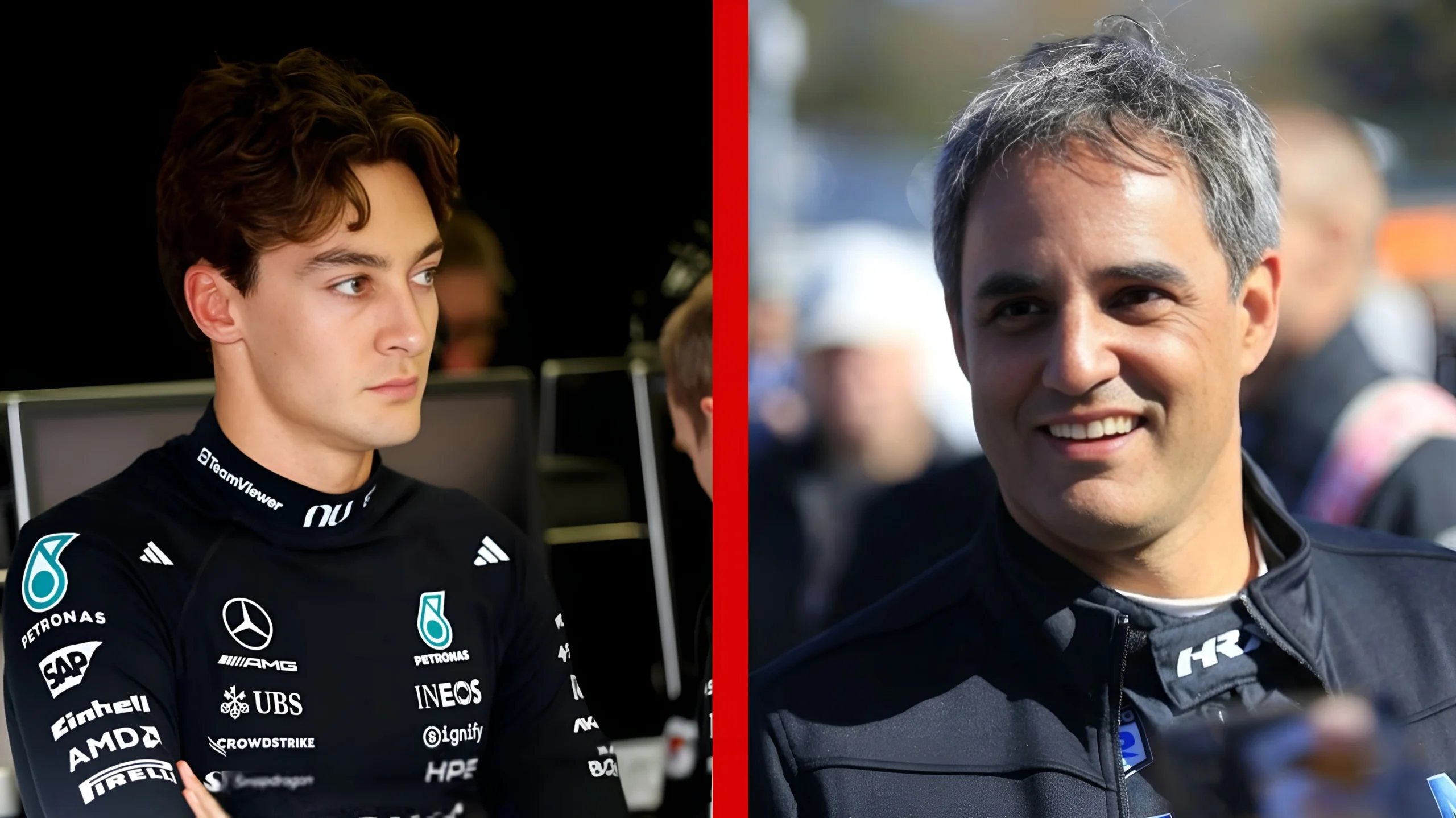
Mercedes driver George Russell and former F1 race winner Juan Pablo Montoya, who has sparked controversy with his psychological advice for the 2026 season.
Published by: AutodromeF1 Editorial Team
London, 25 March – In the high-octane theatre of Formula 1, where the psychological game is as crucial as the engineering prowess, a fascinating and potentially explosive dynamic is unfolding at Mercedes-AMG Petronas. The 2026 season, marked by a radical overhaul of technical regulations, has seen the Brackley-based squad emerge from the pack with a clear and decisive car advantage, reminiscent of their early turbo-hybrid era dominance. However, this newfound supremacy has not brought tranquility. Instead, it has ignited a fierce internal battle for the Drivers’ World Championship between their two pilots: the established team leader, George Russell, and the sensational rookie prodigy, Andrea Kimi Antonelli. With the season’s head-to-head scorecard currently tied at one victory apiece, former Formula 1 race winner Juan Pablo Montoya has issued a stark and unequivocal piece of advice to Russell, urging him to psychologically “destroy” his young teammate to assert his authority and secure his claim to the throne.
The Crucible of a New Era: Mercedes’ Resurgence and the Emergence of a Rivalry
The dawn of the 2026 regulations was anticipated to reset the competitive order, and it has delivered in spectacular fashion. Mercedes, having navigated a comparatively fallow period in the preceding years, invested immense resources and intellectual capital into mastering the new power unit and aerodynamic formulas. The fruit of their labor, the W17 E PERFORMANCE, has proven to be a class apart, leaving rivals scrambling in its wake. This technical superiority has created a unique pressure cooker within the team, transforming the season from an inter-team battle into an intra-team civil war for the ultimate prize in motorsport.
The season-opening Australian Grand Prix in Melbourne set the initial tone. George Russell, now in his role as the de facto senior driver, delivered a masterful performance. Harnessing his experience, he converted a strong qualifying position into a commanding victory, signaling his intent to lead the team’s championship charge. It was a statement drive, one that underlined his development into a polished and formidable competitor, ready to seize the opportunity of a championship-contending machine.
However, the narrative of Russell’s imperious march was dramatically rewritten at the Chinese Grand Prix. It was here that Andrea Kimi Antonelli, the most hyped rookie to enter the sport in a generation, announced his arrival in the most emphatic way possible. After securing a breathtaking pole position, the young Italian prodigy managed the race with the composure of a seasoned veteran. Aided by a fortuitously timed safety car that neutralized Russell’s recovery drive from a compromised qualifying session, Antonelli stormed to his maiden Formula 1 victory. The win sent shockwaves through the paddock, not merely for the result itself, but for the manner in which it was achieved. The rookie had not just won; he had demonstrated raw pace, race craft, and an unflappable temperament under pressure, leveling the score and igniting the championship fight.
Montoya’s Stark Counsel: The Psychology of Dominance
It is against this backdrop of escalating tension that Juan Pablo Montoya’s recent comments have resonated so profoundly. The Colombian, himself a veteran of intense intra-team rivalries and known for his aggressive, uncompromising style, provided a candid and brutal assessment of the situation from the senior driver’s perspective.
“For George, this is a must-win situation, not just on the track, but in the garage, in the debriefs, in his own mind,” Montoya articulated. “When you are the established guy, the one who has weathered the difficult years and is supposed to be the team leader, and a rookie comes in and wins in the first few races, the pressure multiplies exponentially. George has everything to lose, whereas for Kimi, every success is a bonus. That’s a dangerous psychological imbalance.”
Montoya’s advice was pointed and devoid of pleasantries, urging Russell to adopt a posture of absolute psychological dominance. He stressed that Russell must not only be faster but must also control the internal team dynamic decisively.
“He needs to go to the next race at Suzuka and not just beat him, but destroy him,” Montoya stated. “He needs to be half a second clear in qualifying. He needs to dominate every practice session. He needs to make it clear that what happened in China was a fortunate anomaly for the kid, not the new normal. He has to get into Kimi’s head and establish that ‘I am the number one, and you are here to learn.’ If he gives him an inch, Kimi, who is clearly a massive talent, will take a mile. George has to shut the door on that possibility, firmly and immediately.”
This counsel taps into a long history of Formula 1’s greatest rivalries, where the psychological battle was often the decisive factor. From Senna vs. Prost to Hamilton vs. Rosberg, the ability to impose one’s will upon a teammate has been a hallmark of a World Champion. Montoya suggests that Russell must now embrace this more ruthless aspect of his competitive nature.
The Wolff Conundrum and the Echoes of History
The escalating rivalry presents a complex challenge for Mercedes Team Principal and CEO, Toto Wolff. While having the two best drivers in the best car is a “problem” any team principal would desire, it is a scenario fraught with peril. Wolff is no stranger to managing such dynamics, having presided over the often-incendiary Hamilton-Rosberg rivalry that defined the 2014-2016 seasons. That period, while delivering immense success, was also marked by on-track collisions, acrimony, and a team divided.
Esteemed figures in the paddock, such as 1978 World Champion Mario Andretti, have already begun to speculate on how Wolff will manage his two chargers. “Toto’s main job right now is to keep a lid on it,” Andretti commented. “But if this continues, if they are this far ahead of everyone else, he knows a moment will come when he may have to choose. You can’t risk your two drivers taking each other out and throwing away a guaranteed 1-2 finish. At some point, the needs of the team for the Constructors’ title will force his hand, or one driver will prove to be the stronger contender, and the team will have to get behind him.”
For now, Wolff is likely to preach the mantra of free and fair competition. However, every race weekend will be a test of that philosophy. The team will be scrutinizing the data, not just for performance, but for signs of one driver gaining a consistent edge. The upcoming Japanese Grand Prix at the legendary Suzuka circuit—a true driver’s track—will serve as a critical barometer. It is a circuit that rewards bravery, precision, and commitment, and it will provide the perfect arena for both Russell and Antonelli to stake their claim.
For George Russell, the challenge is clear. He must heed Montoya’s advice and re-establish his authority, proving that he is not just a top-tier driver, but a true champion in waiting. For Kimi Antonelli, the path is one of fearless ambition, continuing to challenge the established order and prove that his maiden victory was not a fluke but the first of many. As the Silver Arrows charge towards what seems an inevitable championship, the real battle is just beginning. It is a war fought not just on the asphalt, but in the minds of two brilliant drivers, and the outcome will define the 2026 Formula 1 season.


