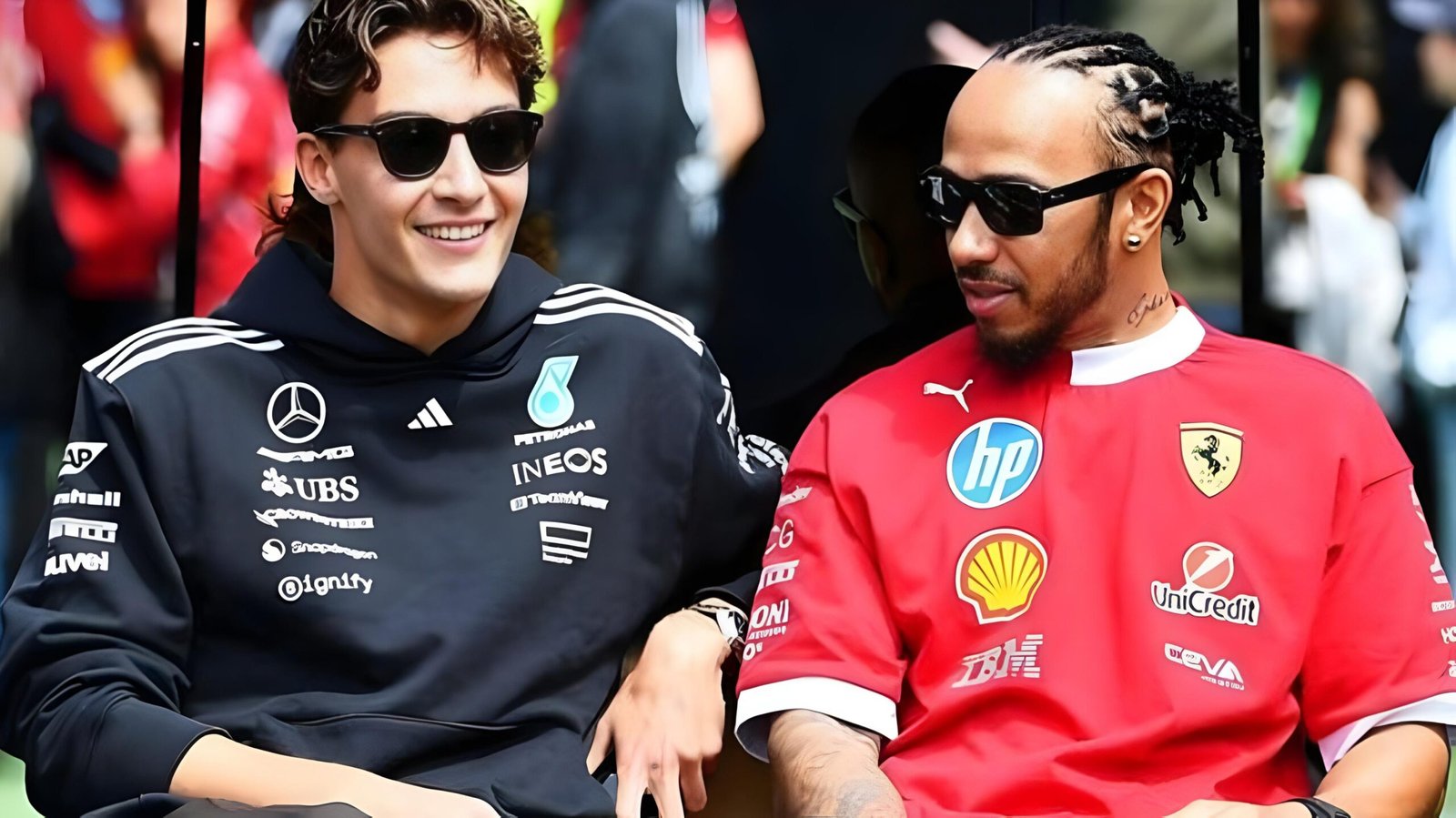
Published by: AutodromeF1 Editorial Team
George Russell’s Enduring Reverence for Lewis Hamilton: A Masterclass in Sportsmanship and the Pursuit of Greatness in Formula One
In the unforgiving arena of Formula One, where rivalries are forged in milliseconds and legacies are etched across decades, few relationships embody the sport’s highest ideals as profoundly as that between George Russell and Lewis Hamilton. As the 2026 season unfolds, with its promise of regulatory evolution and renewed competitive balance, Russell’s consistent public affirmation of Hamilton as the greatest driver of all time (GOAT) stands not merely as a personal tribute but as a beacon of professional integrity. Far from the transient drama that often dominates paddock discourse, these declarations—rooted in shared history at Mercedes and undiminished by Hamilton’s transition to Ferrari—illuminate a deeper truth: true excellence in motorsport transcends team colours, contractual obligations, and even on-track adversity.
Russell’s admiration, articulated across multiple platforms and years, reached a poignant crescendo in 2025 amid Hamilton’s well-documented challenges at Maranello. When the seven-time world champion, grappling with the intricacies of a new car and team culture, publicly expressed frustration after a difficult qualifying session at the Hungarian Grand Prix—describing himself as “useless” and suggesting Ferrari might need to “change driver”—it was Russell, now leading Mercedes into a new era, who offered the most measured and emphatic rebuttal. “Of course he’s talking nonsense when he says something like that,” Russell stated with characteristic composure, “because he’s the greatest driver of all time, I think.” He continued, underscoring Hamilton’s enduring capability: “He’s still an exceptional driver. He obviously won the sprint straight away at the start of the year in China. He’s clearly still got it.”
These words, delivered ahead of the Dutch Grand Prix weekend, were not the product of fleeting sentiment or media obligation. They represented the culmination of a mentorship forged over three intense seasons as teammates, where Russell witnessed firsthand the meticulous preparation, unyielding mental fortitude, and insatiable hunger that propelled Hamilton to unparalleled statistical dominance. By framing Hamilton’s self-criticism as an emotional outlier rather than a reflection of diminished talent, Russell elevated the conversation beyond the immediate narrative of Ferrari’s early-season teething problems. In doing so, he reminded the entire Formula One fraternity—and aspiring drivers worldwide—that greatness is not defined by a single weekend’s performance but by a career’s cumulative mastery.
To fully appreciate the weight of Russell’s endorsements, one must revisit their origins in the relative tranquillity of 2023. Appearing on the F1 Beyond the Grid podcast, Russell offered an unfiltered glimpse into the psychological demands of competing alongside a living legend. “He is the greatest driver of all time,” he declared without hesitation, “and every single weekend—practice, quali, race—you are directly compared to the greatest driver of all time.” This admission was no mere platitude; it was a candid acknowledgement of how Hamilton’s presence had catalysed Russell’s own evolution. From his promotion from Williams to a full-time Mercedes seat in 2022, Russell had navigated the dual pressures of proving his worth and learning from the most decorated driver in history. The intra-team battles, often separated by fractions of a second, honed Russell’s racecraft, strategic acumen, and resilience in ways that no simulator or junior formula could replicate.
That podcast exchange, now viewed retrospectively as a foundational chapter in their shared narrative, revealed much about the symbiotic dynamic at Mercedes. Hamilton, already a global icon with seven world titles and over 100 Grand Prix victories to his name, did not merely occupy the adjacent garage; he redefined the benchmark for professional excellence. Russell credited his teammate with instilling a philosophy that prioritised victory above all else—a mindset that, as he later reflected in a deeply introspective piece for The Players’ Tribune, reshaped his approach to both racing and leadership. “The biggest thing I learned from Lewis, I guess, is that winning comes first. Then everything else,” Russell wrote, encapsulating how Hamilton’s unrelenting focus permeated the team’s culture. This lesson proved instrumental as Russell assumed greater responsibility following Hamilton’s departure, guiding Mercedes through the transitional challenges of 2025 while securing multiple race victories, including standout triumphs in Canada and Singapore.
Hamilton’s move to Ferrari, announced with considerable fanfare in early 2024 and realised at the dawn of 2025, marked a seismic shift not only for the drivers but for the sport’s competitive landscape. The Scuderia, eager to recapture its historic glory under the stewardship of Fred Vasseur, paired the British veteran with the precocious Charles Leclerc in what many anticipated would be a formidable alliance. Early signs were promising: Hamilton’s sprint victory in China demonstrated that his instinctive brilliance and adaptability remained intact, silencing initial sceptics who questioned whether a driver approaching his 41st birthday could seamlessly integrate into the Prancing Horse’s storied environment.
Yet, as the season progressed, the complexities of the Ferrari SF-25 became apparent. Handling characteristics that suited Leclerc’s aggressive style occasionally clashed with Hamilton’s preference for a more neutral balance, compounded by the inevitable cultural and technical adjustments inherent in any team switch. The Hungarian Grand Prix weekend epitomised these struggles. Hamilton’s Q2 elimination and subsequent self-deprecating remarks laid bare the emotional toll of adaptation, prompting widespread speculation about the partnership’s viability. It was against this backdrop that Russell’s intervention assumed particular significance. By invoking Hamilton’s sprint success and reaffirming his status as the GOAT, Russell reframed the narrative from one of potential decline to one of temporary recalibration—a perspective grounded in empathy rather than rivalry.
What distinguishes Russell’s commentary from the superficial analyses that frequently populate motorsport media is its philosophical depth. In an era where social media amplifies every setback into a crisis, his refusal to indulge in schadenfreude or sensationalism exemplifies the maturity that has defined his ascent. At just 28 years old in 2026, Russell has already amassed four Grand Prix wins and established himself as Mercedes’ undisputed leader, yet he consistently positions his achievements within the context of Hamilton’s towering shadow. This humility is not performative; it stems from genuine recognition that competing against—and occasionally outperforming—Hamilton in qualifying and race trim during their Mercedes tenure represented the ultimate validation of his talent.
Consider the broader implications for Formula One. In a sport historically marred by acrimonious rivalries—think Senna and Prost, or the occasionally fractious dynamics between teammates across eras—Russell and Hamilton have modelled a paradigm of mutual respect that transcends the chequered flag. Their relationship underscores a vital lesson for emerging talents: greatness is not a solitary pursuit but a collective elevation. Young drivers entering the paddock today, from the likes of Kimi Antonelli at Mercedes to those navigating the junior ladder, can draw inspiration from Russell’s example. By publicly crediting Hamilton with elevating his performance, Russell illustrates how proximity to excellence fosters growth rather than insecurity. As he noted in various interviews, the “GOAT sitting right next to me” instilled a winning-first mentality that has since become the cornerstone of his leadership at Brackley.
Moreover, Russell’s affirmations carry resonance beyond the cockpit. Hamilton’s off-track advocacy—for diversity, sustainability, and social justice—has expanded the sport’s global footprint in ways that statistical records alone cannot capture. Russell, in his Players’ Tribune reflections, alluded to this multifaceted legacy, pondering whether Hamilton fully appreciated the breadth of his impact. “I’ve sometimes wondered if within himself he could ever fully appreciate what he’s achieved in F1 because his vision is so much greater, further, and higher,” Russell observed. This insight humanises the icon, portraying Hamilton not as an infallible deity but as a relentlessly aspirational figure whose definition of success evolves beyond podiums and championships. In an age when Formula One grapples with its relevance amid technological disruption and shifting audience demographics, such perspectives enrich the sport’s cultural narrative.
As the 2026 campaign gathers momentum, with new power-unit regulations promising closer competition, the echoes of Russell’s 2025 defence continue to reverberate. Hamilton, now fully acclimatised to Ferrari’s operations, has demonstrated flashes of his vintage form, while Russell spearheads Mercedes’ charge with a blend of youthful vigour and hard-earned wisdom. Their on-track encounters, once intra-team duels, have evolved into respectful inter-team contests that captivate audiences. Yet the off-track bond remains unbroken—a testament to the enduring power of shared experience.
In reflecting upon this dynamic, one discerns a timeless principle: in Formula One, as in life, the measure of a champion lies not only in victories accumulated but in the inspiration imparted to peers and successors. George Russell’s unwavering praise for Lewis Hamilton as the greatest of all time transcends mere courtesy; it is a profound acknowledgement of legacy, a call to aspire higher, and a reminder that sportsmanship, when practised with sincerity, elevates the entire discipline. As the grid prepares for the next chapter in this storied rivalry, the paddock—and indeed the wider world of motorsport—would do well to heed the lessons embedded in Russell’s words. For in celebrating Hamilton’s unparalleled achievements, Russell has not only honoured his former teammate but also defined the standard by which future generations of drivers will be judged.
The narrative of George Russell and Lewis Hamilton is far from concluded. It serves, rather, as a living testament to the idea that true greatness inspires rather than intimidates, unites rather than divides, and endures long after the engines fall silent. In an industry perpetually chasing the next headline, their story offers something rarer: a masterclass in grace under pressure and the quiet power of genuine respect. Formula One, at its finest, is defined by such moments—and through his eloquent advocacy, George Russell has ensured that Lewis Hamilton’s legacy remains not merely statistical but profoundly human.


