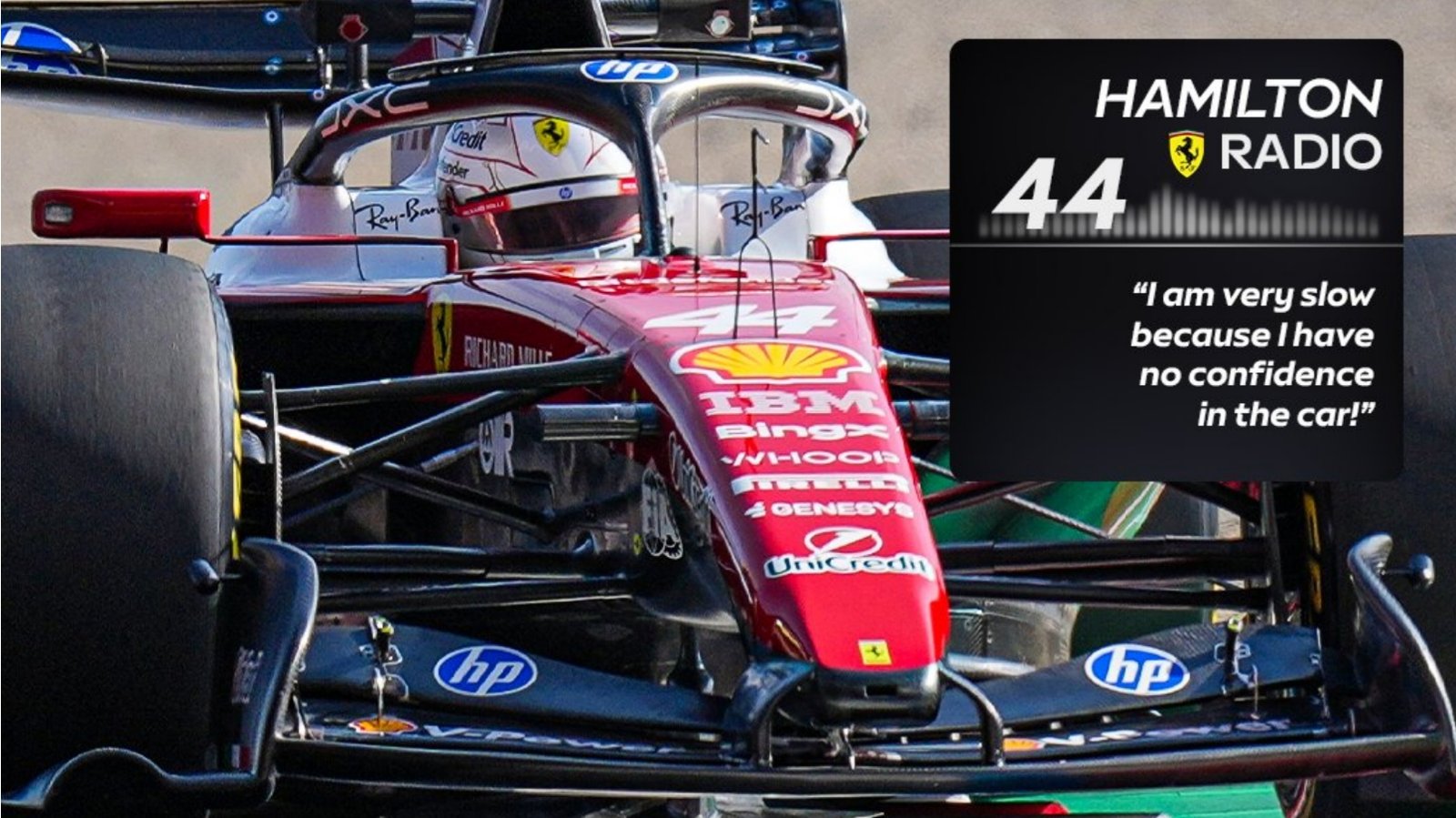
Lewis Hamilton at the 2026 Japanese Grand Prix expresses a lack of confidence in the Ferrari SF-26 during Free Practice at Suzuka.
Published by: AutodromeF1 Editorial Team
Hamilton’s Stark Radio Message Exposes Ferrari’s Suzuka Struggles: A Defining Moment for the 2026 Title Contenders
Suzuka, Japan – Friday, 27 March 2026
In the crisp spring air of Suzuka Circuit, where the demanding 5.807-kilometre layout has tested Formula 1’s finest for decades, Lewis Hamilton delivered a moment of raw candour that cut through the polished veneer of a modern grand prix weekend. “I am very slow because I have no confidence in the car,” the seven-time world champion radioed to his Ferrari engineers during Free Practice 2 for the 2026 Japanese Grand Prix. The message, captured live and broadcast across global feeds, was not the frustrated outburst of a driver having an off day. It was the measured assessment of a 41-year-old master who has spent a career translating mechanical nuance into tenths of a second, now confronting a machine that refuses to answer his inputs.
The session statistics told a clinical story. McLaren’s Oscar Piastri set the benchmark at 1:30.133 on soft tyres, a lap that carried the unmistakable signature of a car in perfect harmony with its driver. Mercedes followed in close formation, with rookie Kimi Antonelli posting the second-fastest time just 0.092 seconds adrift and George Russell third. Charles Leclerc, Ferrari’s most consistent performer this season, could manage only fifth place, 0.713 seconds off the pace. Hamilton, running the sister SF-26, finished sixth at +0.847 seconds. On paper, the gaps appear modest. On the asphalt of Suzuka—where high-speed direction changes through the Esses, the deceptive crest of Turn 13, and the long, sweeping Spoon Curve punish any imbalance—the deficit felt seismic.
This was not the Friday Ferrari had scripted after Hamilton’s podium in China two weeks earlier. That result had offered genuine encouragement: the SF-26 finally delivering the race pace its aerodynamic package had promised in pre-season testing. Yet here, on one of the calendar’s most technically unforgiving circuits, the car’s limitations resurfaced with clinical precision. Hamilton’s feedback throughout the 90-minute session was consistent and unsparing: persistent understeer into high-speed corners, a rear axle that refused to rotate cleanly, and a front end that lacked the immediate bite he demands to commit through sector one’s sweeping left-right flick. Setup adjustments—wing angles, ride height, differential maps—yielded little progress. The radio transcript later released by the team confirmed the depth of his concern: repeated references to “snaps” on direction changes and a fundamental lack of trust that prevented him from extracting the car’s theoretical potential.
To understand why this matters beyond a single practice session, one must appreciate the broader context of Hamilton’s move to Ferrari and the regulatory landscape of 2026. The new power-unit regulations—lighter, more efficient hybrid systems with restricted energy deployment—have introduced subtleties that few predicted would bite so early. At Suzuka, the limited “straight mode” availability (reportedly only around 20 percent of previous deployment levels) robbed drivers of the predictable shove out of slow corners that had masked aerodynamic shortcomings elsewhere. For a driver of Hamilton’s calibre, whose style relies on precise front-end grip to carry speed through complex sequences, the result is not merely slower lap times but a visceral erosion of confidence. When the car feels “alive” yet unpredictable, the margin for error on a track like Suzuka shrinks to zero.
Ferrari’s technical director, Loïc Bigois, and his aerodynamics team have spent the winter refining the SF-26’s underfloor and suspension geometry to address exactly these traits. Early-season data from Bahrain and China suggested progress: the car exhibited strong tyre management and respectable one-lap pace when the balance was right. Yet Suzuka’s unique demands—low kerb aggression combined with sustained lateral loads—have exposed residual weaknesses in the front axle’s mechanical grip. Hamilton’s driving style, honed over 400-plus grands prix, is unforgiving of such traits. Where Leclerc can adapt through sheer commitment, Hamilton’s feedback loop demands a car that responds intuitively. The radio message was not a complaint; it was diagnostic data delivered in real time.
McLaren’s dominance, by contrast, reinforced the narrative that the Woking squad has nailed the 2026 transition. Piastri’s lap was not a one-off; the MCL40 displayed the kind of planted stability and responsive front end that allowed both drivers to push the limits without hesitation. Mercedes, too, appears to have found an early-season sweet spot, with Antonelli’s performance particularly noteworthy. The 18-year-old Italian, thrust into the spotlight after replacing the retiring Lewis Hamilton at the Silver Arrows, has shown maturity beyond his years. His P2 time suggests the Brackley engineers have extracted the maximum from the new hybrid architecture, particularly in energy recovery through the high-speed sections.
For Ferrari, the overnight debrief will be exhaustive. Telemetry from both cars will be scrutinised alongside tyre-pressure and track-temperature data. The medium-compound runs earlier in FP2 offered some insight into long-run potential, but the soft-tyre qualifying simulation exposed the true deficit. Engineers will examine whether the issue stems from aerodynamic ride-height sensitivity, a suspension geometry compromise, or a power-unit calibration that limits torque delivery in the critical 80-120 km/h window. Hamilton himself has requested a full review of the differential settings and front-bar stiffness—small adjustments that can transform driver feel without altering the fundamental package.
The wider implications for the 2026 championship are significant. After just three races, the title fight already appears a three-way battle between McLaren, Mercedes, and Ferrari, with Red Bull showing uncharacteristic early-season vulnerability. Hamilton’s arrival at Maranello was billed as the catalyst for Ferrari’s first drivers’ title since 2008. A single difficult Friday does not derail that ambition, but repeated weekends where the SF-26 fails to deliver front-end confidence could erode the psychological edge that championship challenges require. Hamilton has never been one to suffer in silence; his openness on the radio serves as both a pressure valve and a clear directive to the factory in Maranello. The team has responded positively in the past—witness the rapid developments that propelled him to the China podium—but Suzuka’s unforgiving nature leaves little room for incremental fixes.
Historically, Suzuka has been kind to Ferrari only when the car possesses inherent balance. Michael Schumacher’s dominant years in the early 2000s were built on a chassis that inspired total trust through the Esses. Hamilton, who has won here multiple times for Mercedes, knows the difference between a workable compromise and a fundamental mismatch. His post-session comments, delivered with the measured tone of a veteran statesman, emphasised the need for “a step forward” rather than wholesale redesign. “We know where the car is strong and where it isn’t,” he noted. “Tonight is about understanding why the balance window is so narrow.”
Looking ahead, FP3 on Saturday morning offers the final opportunity to refine the setup before qualifying. The weather forecast remains dry, with track temperatures expected to rise slightly—an advantage for teams that struggled with tyre warm-up on Friday. Ferrari will likely run a more aggressive wing configuration to generate additional front downforce, though this risks compromising straight-line speed on the long back straight. Hamilton’s experience will be crucial; his ability to read a car’s behaviour after minimal running has been a hallmark of his career.
Beyond the immediate weekend, this session highlights the maturation of the 2026 regulations. The reduced reliance on hybrid “push-to-pass” modes and the tighter energy-management windows have shifted the performance delta back toward pure mechanical and aerodynamic efficiency. Teams that invested heavily in simulation tools during the winter have reaped rewards; those still calibrating their models are paying the price. Ferrari’s long-term project under Fred Vasseur remains on track, but the short-term pressure is real. A strong qualifying performance—ideally both cars inside the top four—would restore momentum. Anything less would intensify scrutiny on the Hamilton-Ferrari partnership just three races into its maiden season.
As the sun set over the Japanese hills, the Ferrari garage buzzed with focused activity. Data engineers pored over graphs, mechanics prepared the cars for the evening’s running, and Hamilton sat quietly with his performance engineer, reviewing corner-by-corner traces. The frustration of the afternoon had given way to the quiet determination that has defined his career. For a driver who has achieved everything and still hungers for more, days like this are not defeats but diagnostics—opportunities to sharpen the weapon before the real battle begins on Sunday afternoon.
The 2026 Japanese Grand Prix is far from decided. Yet in a single radio message, Lewis Hamilton reminded the paddock—and his new team—that true performance begins with trust. At Suzuka, where precision has always been paramount, Ferrari now faces its clearest test of the young season. The response overnight will speak volumes about the Scuderia’s readiness to challenge for the championship that has eluded them for nearly two decades.


