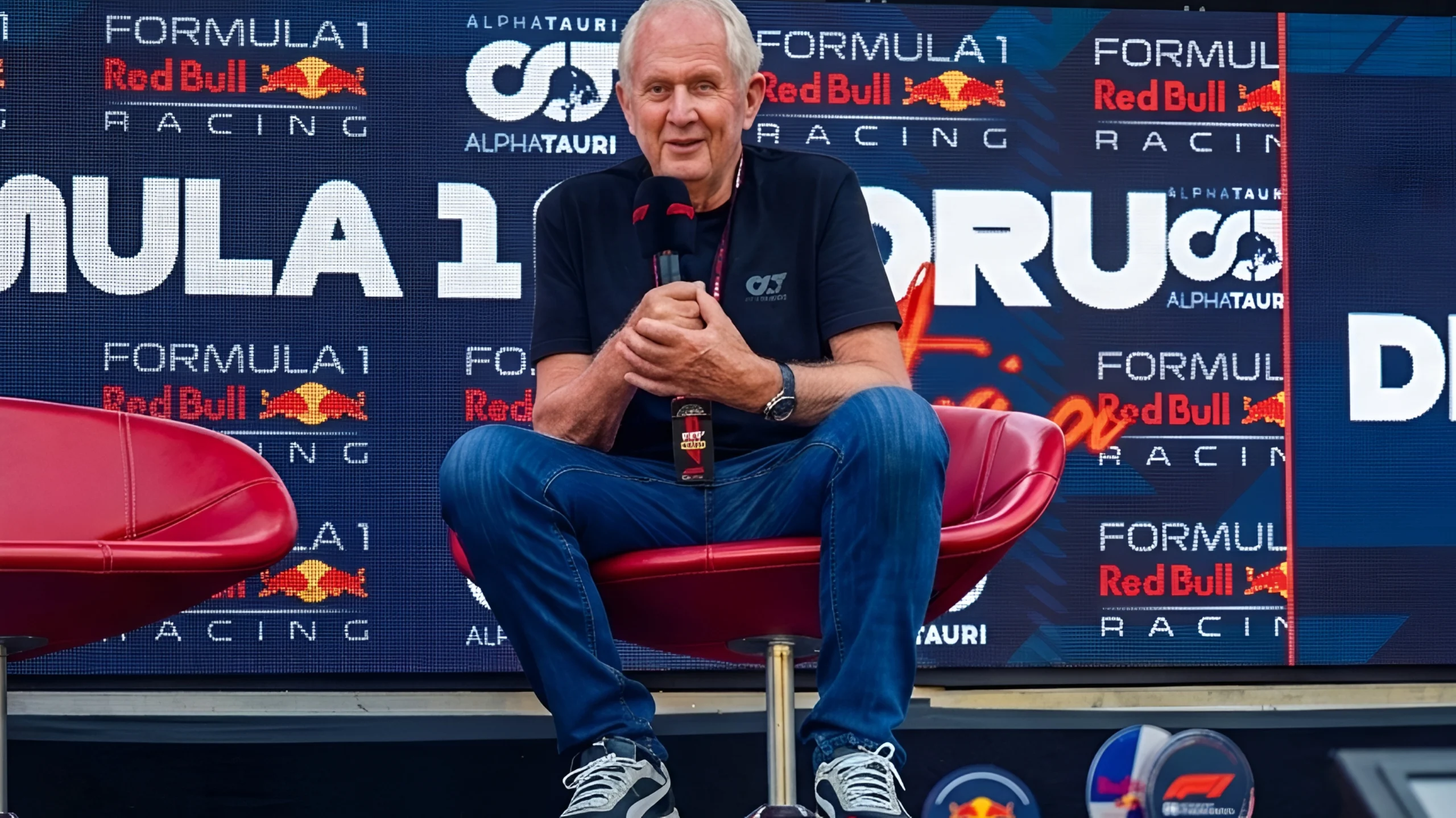
Helmut Marko discusses Red Bull Racing’s strategic development and the RB22’s evolution during the 2026 Formula 1 season.
Published by: AutodromeF1 Editorial Team
Helmut Marko’s Calculated Optimism: Red Bull’s April Respite as a Catalyst for 2026 Redemption in Formula 1
London, 25 March – In the high-stakes crucible of Formula 1, where technological precision collides with the unforgiving demands of competition, few voices carry the weight of institutional memory quite like that of Helmut Marko. Though he formally concluded his two-decade tenure as Red Bull Racing’s motorsport advisor at the close of 2025, the 82-year-old Austrian luminary remains a perceptive observer of the team he helped sculpt into a dynasty. In the wake of a disconcerting opening to the 2026 campaign, Marko has articulated a message of resolute confidence, one that underscores the organisation’s proven capacity for rapid evolution. Speaking with characteristic directness to OE24, he emphasised that Red Bull “is known for being able to catch up quickly and effectively,” adding that “anything is still possible” thanks to the unforeseen gift of an extended development window created by the cancellation of the Bahrain and Saudi Arabian Grands Prix.
This pronouncement arrives at a pivotal juncture. After only two races—the Australian Grand Prix in Melbourne and the Chinese Grand Prix in Shanghai—Red Bull sits fifth in the constructors’ standings with a mere 12 points. The RB22, the team’s latest creation conceived under the transformative 2026 regulatory framework, has manifested a constellation of challenges: persistent aerodynamic deficiencies, compromised mechanical balance, accelerated tyre degradation, and intermittent reliability concerns linked to the integration of the all-new in-house power unit developed in partnership with Ford. Rivals such as Alpine and Haas have, in certain sessions, exposed vulnerabilities that once seemed inconceivable for a squad long accustomed to front-running supremacy. Yet Marko’s assessment is neither naive nor dismissive of these realities; rather, it reflects a profound understanding of the team’s intrinsic strengths and the strategic leverage afforded by the calendar’s reconfiguration.
The 2026 regulations represent one of the most ambitious overhauls in the sport’s modern era. Power units have been re-engineered with a heightened emphasis on electrical deployment, active aerodynamics have introduced variable wing configurations, and chassis dimensions have been recalibrated to promote closer racing while imposing stricter efficiency mandates. For Red Bull, the transition has been particularly exacting. The RB22’s aerodynamic package has struggled to generate consistent downforce across varying track surfaces, resulting in a rear-end instability that exacerbates tyre wear and undermines driver confidence. Reliability issues, including coolant-system anomalies and mapping complexities within the new powertrain, have compounded the difficulties, manifesting in suboptimal energy recovery and occasional component failures. Team principal Laurent Mekies has candidly acknowledged a “substantial gap” to the leading Mercedes and Ferrari entries, estimating the deficit as roughly evenly divided between straight-line performance and cornering prowess.
Against this backdrop, the cancellation of the Bahrain and Saudi Arabian rounds—originally slated for early April and postponed indefinitely following careful evaluations tied to regional considerations—assumes outsized significance. What might have been a compressed sequence of back-to-back races has instead yielded a month-long hiatus following the upcoming Japanese Grand Prix at Suzuka. For a team renowned for its agile in-season development ethos, this interlude is not merely a pause but a strategic inflection point. Engineers in Milton Keynes will gain uninterrupted access to simulation tools, wind-tunnel facilities, and computational fluid dynamics resources. Upgrades targeting the RB22’s balance, suspension geometry, and power-unit software can be iterated with greater deliberation, free from the logistical exigencies of race-weekend preparations. Marko’s reference to this “extra time” is thus both pragmatic and prescient: it aligns precisely with Red Bull’s historical modus operandi of identifying deficiencies early and addressing them with surgical precision.
One need only recall previous campaigns to appreciate the foundation of Marko’s conviction. Red Bull has repeatedly demonstrated an aptitude for mid-season metamorphosis. Whether surmounting regulatory setbacks in the hybrid era or refining aerodynamic concepts under pressure, the squad’s engineering cadre—bolstered by a depth of talent that extends across aerodynamics, vehicle dynamics, and powertrain specialists—has consistently translated data into performance gains. The current cohort, including those who contributed to the dominant 2022–2025 architecture, possesses institutional knowledge that transcends individual personnel changes. Even as the team navigates the complexities of its first fully independent power unit, the foundational philosophy remains intact: adaptability through rigorous analysis and iterative innovation.
Pre-season expectations had been notably buoyant. Red Bull entered 2026 buoyed by the promise of its in-house engine project, which had undergone extensive validation in partnership with Ford. The organisation’s pre-season communications projected a competitive debut, predicated on seamless integration of chassis and powertrain elements. Reality, however, has tempered that optimism. The RB22’s early performances have highlighted the intricate interplay between aerodynamic efficiency and electrical deployment under the new rules. Tyre management, in particular, has emerged as a critical bottleneck; the car’s inherent instability accelerates wear rates, forcing conservative strategies that forfeit competitive edge. Drivers Max Verstappen and Isack Hadjar have articulated frustrations born of an undriveable balance, yet their feedback has been instrumental in guiding development priorities. Verstappen’s vast experience provides a benchmark of excellence, while Hadjar’s emerging talent injects fresh perspective into the cockpit.
The broader championship landscape further contextualises Red Bull’s predicament. Mercedes and Ferrari have capitalised on their respective power-unit evolutions to establish early benchmarks, with the former displaying superior driveability and the latter excelling in high-speed sectors. Alpine and Haas, meanwhile, have leveraged targeted aerodynamic solutions to punch above their traditional weight, underscoring the democratising potential of the 2026 regulations even as they expose transitional vulnerabilities. Yet the season remains in its infancy. With 22 races still on the provisional calendar—subject to further adjustments—the margin for recovery is substantial. Marko’s assertion that “anything is still possible” resonates not as hyperbole but as a recognition of Formula 1’s inherent volatility. Historical precedents abound: teams have overturned deficits of similar magnitude through focused development sprints.
Central to Red Bull’s prospective resurgence is its organisational culture, one that prizes empirical rigour over complacency. The April break will facilitate not only hardware revisions but also software optimisations and simulation refinements that could yield compounding benefits. Potential upgrades may encompass revised front-wing geometries to mitigate understeer, enhanced rear diffuser profiles for improved traction, and recalibrated energy-management algorithms to maximise the MGU-K’s output. Such interventions, when synchronised with the power unit’s maturation, could restore the RB22’s competitiveness by the European leg of the season, commencing in earnest at Imola. The team’s supply chain resilience and collaborative ethos with key partners will be tested, yet these attributes have historically proven robust.
Beyond the immediate technical horizon, Marko’s comments invite reflection on the psychological dimension of elite motorsport. In an era of unprecedented regulatory flux, confidence derived from past triumphs serves as a stabilising force. Red Bull’s leadership, from Christian Horner’s strategic oversight to the engineering brain trust in Milton Keynes, has cultivated an environment where challenges are reframed as opportunities. This mindset permeates the driver line-up, where Verstappen’s resilience and Hadjar’s adaptability form a potent partnership. The extended development window also mitigates the risk of reactive decision-making under race-weekend constraints, allowing for holistic validation that could prevent subsequent setbacks.
Critics may counter that optimism alone cannot bridge performance chasms, and indeed, the RB22’s weight penalty—estimated in some analyses at 15–20 kilograms—presents a non-trivial handicap that demands structural revisions. Nevertheless, Red Bull’s track record suggests that such obstacles are surmountable. The team’s ability to extract marginal gains through data-driven refinement has been a hallmark of its success. Moreover, the 2026 regulations’ emphasis on sustainability and electrification aligns with long-term strategic investments that may yield dividends as the season progresses.
Looking ahead, the Japanese Grand Prix offers a critical litmus test. Suzuka’s demanding layout will accentuate the RB22’s current limitations while providing granular data for post-race analysis. Should the team register incremental improvements, Marko’s narrative will gain empirical credence. Conversely, persistent struggles would intensify scrutiny, yet the April interlude remains a buffer against premature conclusions. The championship battle, already characterised by tight margins at the front, could yet witness a recalibration as development curves converge.
In summation, Helmut Marko’s endorsement of Red Bull’s capacity to rebound is grounded in empirical precedent, strategic foresight, and an unyielding belief in the team’s engineering prowess. The cancellation of two early-season fixtures has transformed a potential liability into a tangible advantage, affording the Milton Keynes operation the temporal latitude essential for substantive progress. As the 2026 season unfolds amid the most profound regulatory shift in decades, Red Bull’s trajectory will hinge not merely on the resolution of immediate deficiencies but on the realisation of its latent potential. Anything, as Marko astutely observes, remains possible—and in Formula 1, possibility frequently yields to probability through the alchemy of innovation and resolve.
This extended development phase may well prove the crucible in which the RB22 is refined into a championship contender. For a team that has redefined excellence across multiple eras, the current adversity serves not as an indictment but as a prelude to resurgence. The paddock, the fans, and the sport itself stand poised to witness whether Red Bull’s historical resilience will once again assert itself on the global stage. In the intricate ballet of aerodynamics, power delivery, and human ingenuity, the April hiatus may emerge as the defining intermission of the 2026 narrative.


