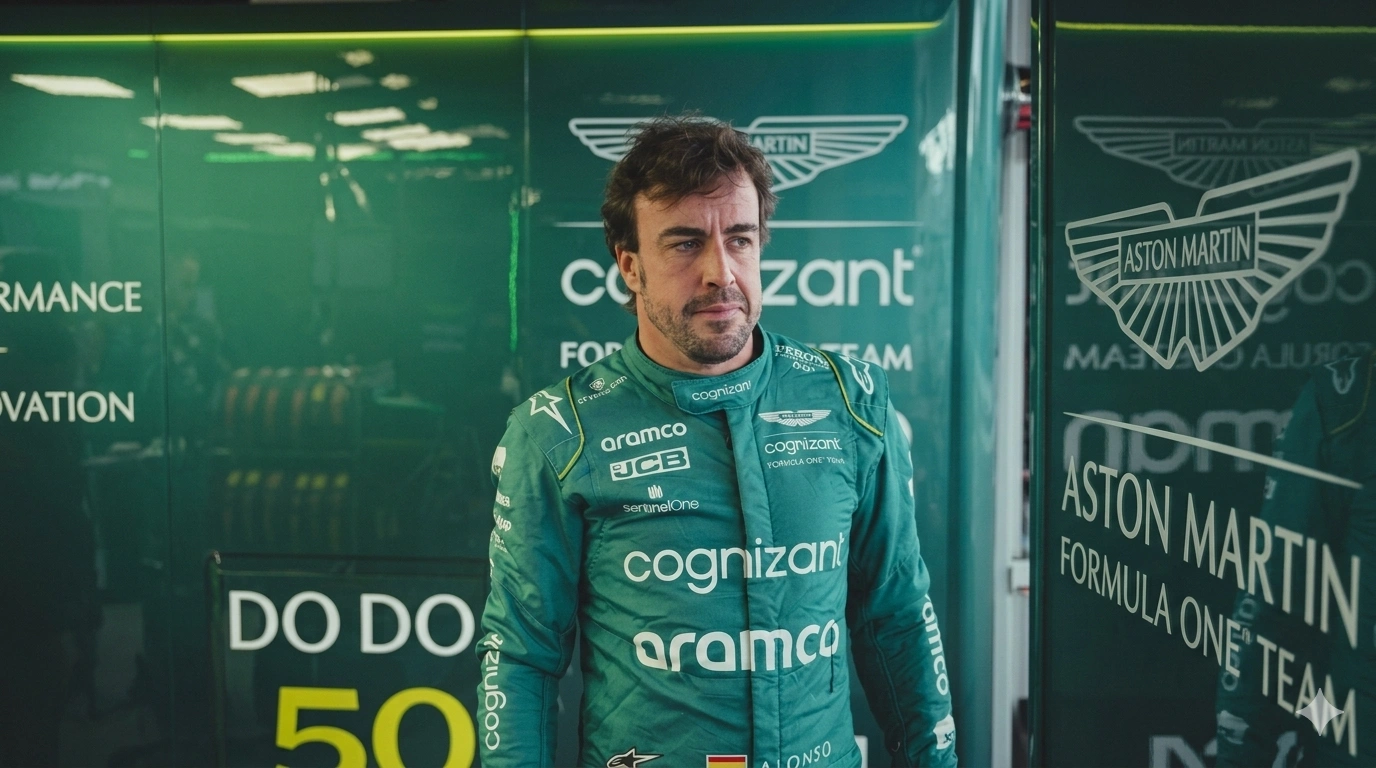
Fernando Alonso in the Aston Martin garage ahead of the Japanese Grand Prix, where Honda’s new RA626H power unit faces its toughest energy management test yet.
Published by: AutodromeF1 Editorial Team
Suzuka’s Crucible: Honda Grapples with Energy Conundrum in Aston Martin’s 2026 Power Unit
London, 24 March – As the Formula 1 paddock descends upon the iconic Suzuka International Racing Course for the Japanese Grand Prix, a narrative of immense technical challenge and high-stakes engineering prowess is unfolding within the nascent partnership of Honda Racing Corporation (HRC) and the Aston Martin Aramco F1 team. The focal point of this intense scrutiny is the RA626H, the all-new power unit meticulously developed at Honda’s Sakura facility. Designed to meet the radical 2026 regulations, this power unit represents not only Honda’s full-fledged return as a works manufacturer but also the technical keystone for Aston Martin’s championship aspirations. However, early assessments have revealed significant hurdles, particularly concerning the intricate science of energy management and the physical resilience of its battery systems, casting a shadow of uncertainty over their immediate competitive prospects.
The 2026 season heralds one of the most profound regulatory shifts in Formula 1’s modern history. The regulations are a departure from the complex and thermally efficient MGU-H (Motor Generator Unit – Heat) era, mandating a simpler, yet more powerful, electrical system paired with an engine fueled by 100% sustainable, carbon-neutral synthetics. Power units will now feature a near 50/50 split between internal combustion engine (ICE) power and electrical energy, with the MGU-K (Motor Generator Unit – Kinetic) component’s output tripling to a formidable 350kW. This tectonic shift fundamentally rewrites the rules of energy harvesting, storage, and deployment. The removal of the MGU-H—the ingenious device that converted exhaust gas heat into electrical energy—eliminates a vital source of continuous regeneration, placing an unprecedented emphasis on the efficiency of the MGU-K and the strategic deployment of a limited 8.5 megajoule per lap electrical allowance.
It is within this demanding new paradigm that Honda’s RA626H has encountered its most formidable difficulties. Shintaro Orihara, a top engineer at the heart of the project, offered a candid and professionally sober assessment of their current standing. “The performance is not where we want it to be,” Orihara conceded, a statement that resonates with the quiet intensity of an organization that measures success by world championships. His admission points to a multi-faceted engineering challenge that began to manifest during the harsh environment of pre-season testing in Bahrain.
During those crucial initial shakedown runs, the RA626H was beset by severe and unanticipated vibration harmonics originating from the ICE. These oscillations propagated through the chassis and into the Energy Store (ES), the sophisticated battery array, causing internal structural damage. This issue represented a critical setback, as a compromised battery not only curtails performance but also poses a significant safety and reliability risk. In Formula 1, where components are engineered to the very edge of material science, unexpected vibrational loads can be catastrophic. The initial data from Bahrain forced Honda’s engineers into a reactive mode, shifting focus from performance optimization to fundamental problem-solving.
Encouragingly, the engineering response from Sakura has been both rapid and effective. Through a rigorous process of data analysis, simulation, and component redesign, Honda implemented a series of countermeasures to dampen and isolate the destructive frequencies. These modifications were put to the test in the subsequent Grands Prix in Australia and China, where the RA626H demonstrated markedly improved reliability. The team was finally able to operate the power unit within its intended parameters for sustained periods, allowing them to gather crucial data and move beyond mere survival to the initial stages of performance evaluation. The progress at the Shanghai International Circuit, in particular, was seen as a validation of the team’s diagnostic and corrective strategy.
However, the resolution of the vibration issue has peeled back a layer to reveal a deeper, more complex challenge: mastering the art of energy management under the new regulations. With the MGU-H absent, the entire burden of electrical regeneration falls upon the MGU-K during braking phases. This creates a strategic dilemma for drivers and engineers. Aggressive energy harvesting can upset vehicle balance under braking, yet insufficient regeneration leaves the battery depleted and the car vulnerable on the straights. Furthermore, deploying the powerful 350kW burst from the MGU-K must be timed to perfection for both offensive and defensive maneuvers, all while ensuring enough energy remains to complete a lap without a dramatic drop-off in pace—a phenomenon known as “derating.”
This weekend’s Japanese Grand Prix at Suzuka, therefore, transforms from a celebratory homecoming for Honda into a critical, high-pressure litmus test. There is perhaps no circuit on the Formula 1 calendar that interrogates a power unit’s energy cycle more relentlessly. Suzuka is a track of legendary sequences: the high-speed “Esses” of sector one demand a stable and responsive chassis, while the long, sweeping curves like the Degners and the iconic 130R require sustained, peak power output. The crucial phase for the RA626H will be the run from the tight Hairpin (Turn 11) up through the sweeping Spoon Curve (Turns 13 and 14) and onto the long back straight leading to the infamous 130R. This section combines a heavy braking zone perfect for MGU-K harvesting (into the Hairpin) followed by a long period of full-throttle deployment.
Any deficiency in Honda’s energy recovery and deployment software will be ruthlessly exposed here. If the RA626H cannot regenerate sufficient energy under braking at the Hairpin and the chicane, the Aston Martin will be left exposed and underpowered on the main straight and the back straight. The data gathered at this demanding circuit will be invaluable, providing Honda’s engineers with a clear, unfiltered benchmark of their standing relative to competitors like Mercedes-AMG, Ferrari, and Red Bull-Ford. It will highlight the remaining performance gaps and dictate the development trajectory for the remainder of the season.
The implications of these early challenges are profound. For Aston Martin, a team that has invested hundreds of millions in state-of-the-art facilities and top-tier talent, the 2026 season is the target for its ascent to championship contention. The success of this ambition rests almost entirely on the competitiveness of the Honda power unit. For Honda, its legacy is on the line. After a dominant period with Red Bull Racing, its decision to leave and then promptly return to the sport was a bold declaration of its commitment to pioneering automotive technology. A faltering power unit would be a significant blow to its brand and engineering prestige.
As the green lights illuminate to signal the start of practice at Suzuka, the on-track action will be about more than just lap times. It will be a public demonstration of a complex engineering battle being waged against the clock. The performance of the Honda-powered Aston Martin on this hallowed home turf will provide the clearest indication yet of whether the RA626H’s early struggles are merely teething problems or the symptoms of a more fundamental design challenge. The world will be watching to see if the roar of the new Honda engine signals a resurgence or a long road ahead.


