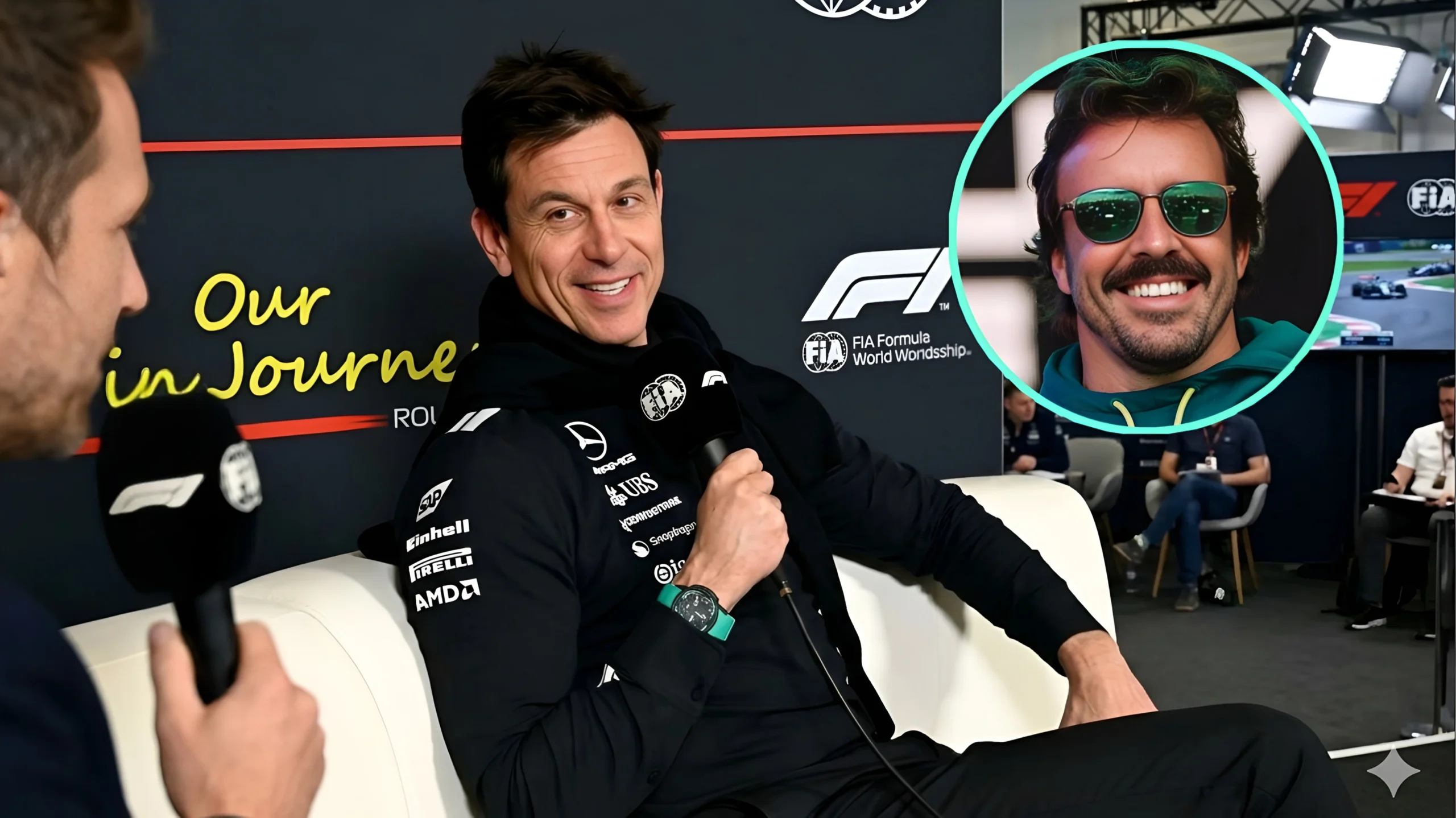
A surprising choice: Fernando Alonso is named the favorite driver of Jack Wolff, despite his father Toto Wolff leading the rival Mercedes F1 team.
Published by: AutodromeF1 Editorial Team
Toto Wolff’s Young Son Names Fernando Alonso as His Favourite Formula 1 Driver in Candid Father’s Day Exchange
London, 23 March – In a moment that effortlessly bridged the intensely competitive world of Formula 1 with the uncomplicated candour of childhood, Jack Wolff, the son of Mercedes team principal Toto Wolff, has publicly declared Fernando Alonso as his favourite driver. The revelation emerged during a relaxed Father’s Day interview conducted at a karting event in Italy, captured on video and subsequently shared across social media platforms. At a time when the sport is preparing for the significant regulatory and personnel shifts of the 2026 season, this innocent preference has offered a refreshing counterpoint to the high-stakes strategic manoeuvrings that typically dominate paddock discourse.
Jack, who accompanied his father to the Italian karting gathering, was asked straightforwardly about his preferred Formula 1 competitor while seated beside Toto Wolff. Without hesitation, the youngster bypassed the Mercedes drivers with whom his family is most closely associated—Lewis Hamilton, George Russell, and rising prospect Kimi Antonelli—and instead selected the two-time world champion Fernando Alonso. His reasoning, delivered with the directness only a child can muster, was both concise and telling: “Because he’s a two-time world champion, and I just like him a lot.”
The exchange, though brief, carried a disarming sincerity that immediately resonated beyond the immediate family setting. Toto Wolff, whose expression remained one of quiet amusement and paternal pride throughout the conversation, offered no corrective intervention or redirection toward his own team’s roster. The video clip, which has circulated widely since its release, captures not only Jack’s unfiltered enthusiasm but also the subtle dynamics of a household deeply immersed in the sport yet unbound by corporate allegiance in private moments.
This episode arrives at a pivotal juncture for Formula 1. As the sport transitions into a new technical era in 2026—characterised by revised power-unit regulations, sustainable fuels, and an intensified emphasis on aerodynamic efficiency—the narrative surrounding driver line-ups and team identities has grown particularly charged. Mercedes, under Toto Wolff’s stewardship since 2013, has engineered one of the most successful dynasties in modern motorsport history. Yet even within this environment of institutional loyalty, the Wolff family has demonstrated that personal admiration can transcend team colours.
Fernando Alonso’s appeal to the younger generation is hardly surprising when viewed through the prism of his enduring career. The Spaniard’s two world championships, secured in 2005 and 2006 with Renault, represent milestones of precocious brilliance. His subsequent decades in the sport have been defined by resilience, tactical acumen, and an unwavering competitive spirit that has seen him compete for multiple constructors, including Ferrari, McLaren, and most recently Aston Martin. At an age when many drivers contemplate retirement, Alonso continues to extract maximum performance from machinery that is not always the class of the field, earning him respect that spans demographic boundaries.
Toto Wolff’s own professional history with Alonso adds an intriguing layer of context to Jack’s choice. During the mid-2010s, when Mercedes was consolidating its dominance, Wolff openly explored the possibility of bringing the Spaniard into the Silver Arrows fold. Those discussions, though ultimately unsuccessful, underscored Alonso’s status as a perennial target for top-tier teams. That the Mercedes principal’s son now gravitates toward the very driver once considered for the team seat creates a narrative symmetry that few scripted storylines could match.
The setting of the revelation—a Father’s Day karting event in Italy—further amplifies its charm. Karting remains the foundational discipline for aspiring racers, and events of this nature frequently serve as informal forums where family bonds intersect with the sport’s grassroots future. Italy, a nation steeped in motorsport heritage and home to storied circuits such as Monza, provided an appropriately evocative backdrop. Jack’s participation alongside his father reflects the Wolff family’s commitment to nurturing the next generation’s interest in racing, even as Toto balances the demands of leading a championship-contending outfit.
Social media reaction to the clip has been overwhelmingly positive, with enthusiasts describing the exchange as a “personal highlight in the 2026 paddock.” Commentators have praised the unscripted nature of the moment, noting that in an era of carefully managed public relations, such genuine glimpses into the private lives of key figures are rare. One recurring theme in online discourse has been the amusement evident in Toto Wolff’s demeanour; far from appearing displeased by his son’s allegiance to a rival driver, the team principal seemed to relish the independence of thought on display. This parental response has itself become a focal point, with observers suggesting it exemplifies the healthy separation between professional obligation and personal affection that sustains long-term involvement in elite sport.
Beyond the immediate warmth of the father-son interaction, the episode invites broader reflection on the role of family within Formula 1’s ecosystem. The sport has long been shaped by dynastic legacies—think of the Andrettis, the Schumachers, or the Verstappens—yet these lineages are rarely insulated from external influences. Jack Wolff’s preference for Alonso illustrates how young fans, even those raised in the epicentre of a rival team, form attachments based on charisma, achievement, and narrative rather than institutional loyalty. In an increasingly data-driven and corporate landscape, such organic connections serve as a reminder of the sport’s emotional core.
Moreover, the timing of the interview holds symbolic weight as Formula 1 braces for 2026. The forthcoming season promises to recalibrate competitive hierarchies, with new power-unit manufacturers entering the fray and established teams recalibrating their driver strategies. Alonso’s continued presence at Aston Martin, where he has forged a productive partnership in recent years, positions him as a veteran mentor amid younger talents. His ability to inspire admiration from the offspring of a direct competitor may subtly influence how teams approach talent retention and fan engagement in the years ahead.
Industry analysts have already begun contextualising the moment within wider discussions about driver market dynamics. While Mercedes retains a formidable driver pairing in Hamilton and Russell—with Antonelli waiting in the wings—the sport’s appeal rests partly on transcending team affiliations. Alonso’s career trajectory, marked by periods of adversity followed by resurgence, offers a compelling template for younger enthusiasts. His two world titles, achieved at a remarkably young age, remain benchmarks against which contemporary achievements are measured. Jack’s reference to those championships, articulated with such simplicity, underscores the lasting imprint of sporting excellence on impressionable minds.
The video’s dissemination has also prompted commentary from within the paddock. While no official statements have emerged from Mercedes or Aston Martin, the absence of tension speaks volumes. Toto Wolff has consistently cultivated an image of measured leadership, one that accommodates both intense ambition and personal equilibrium. His visible enjoyment during the interview aligns with this persona, suggesting that the Mercedes principal recognises the value of allowing his son to develop independent perspectives—an approach that may, in time, foster greater resilience in the next generation of motorsport participants.
From a sociological standpoint, the episode highlights the democratising effect of modern media within Formula 1. A brief, unpolished conversation between father and son has reached millions, humanising figures who are otherwise perceived through the lens of multi-million-dollar contracts and technological sophistication. In doing so, it reinforces the sport’s capacity to generate universal appeal, extending far beyond telemetry graphs and aerodynamic debates.
As the countdown to the 2026 season intensifies, moments like this serve as essential counterbalances to the relentless pursuit of performance. They remind stakeholders—teams, sponsors, fans, and regulators alike—that Formula 1 remains, at its essence, a human endeavour. Jack Wolff’s straightforward endorsement of Fernando Alonso does not alter championship standings or technical specifications, yet it enriches the narrative tapestry of the sport in ways that data alone cannot capture.
In the final analysis, the Father’s Day exchange in Italy transcends its apparent simplicity. It encapsulates the enduring allure of sporting icons, the delicate interplay between family and profession, and the quiet independence that can flourish even within the most scrutinised environments. For Toto Wolff, it may represent nothing more than a heartwarming anecdote to be cherished privately. For the wider Formula 1 community, however, it stands as a gentle affirmation that greatness—whether measured in world titles or in the ability to captivate a child’s imagination—continues to resonate across generational and competitive divides.
As the new season approaches, observers will no doubt watch with heightened interest for any future interactions between the Wolff family and Alonso. Whether Jack maintains his allegiance or eventually shifts toward the Mercedes stable remains to be seen. What is certain, however, is that this single, unvarnished declaration has already added a memorable chapter to the rich chronicle of Formula 1’s human stories—one that prioritises authenticity over allegiance and warmth over rivalry.


