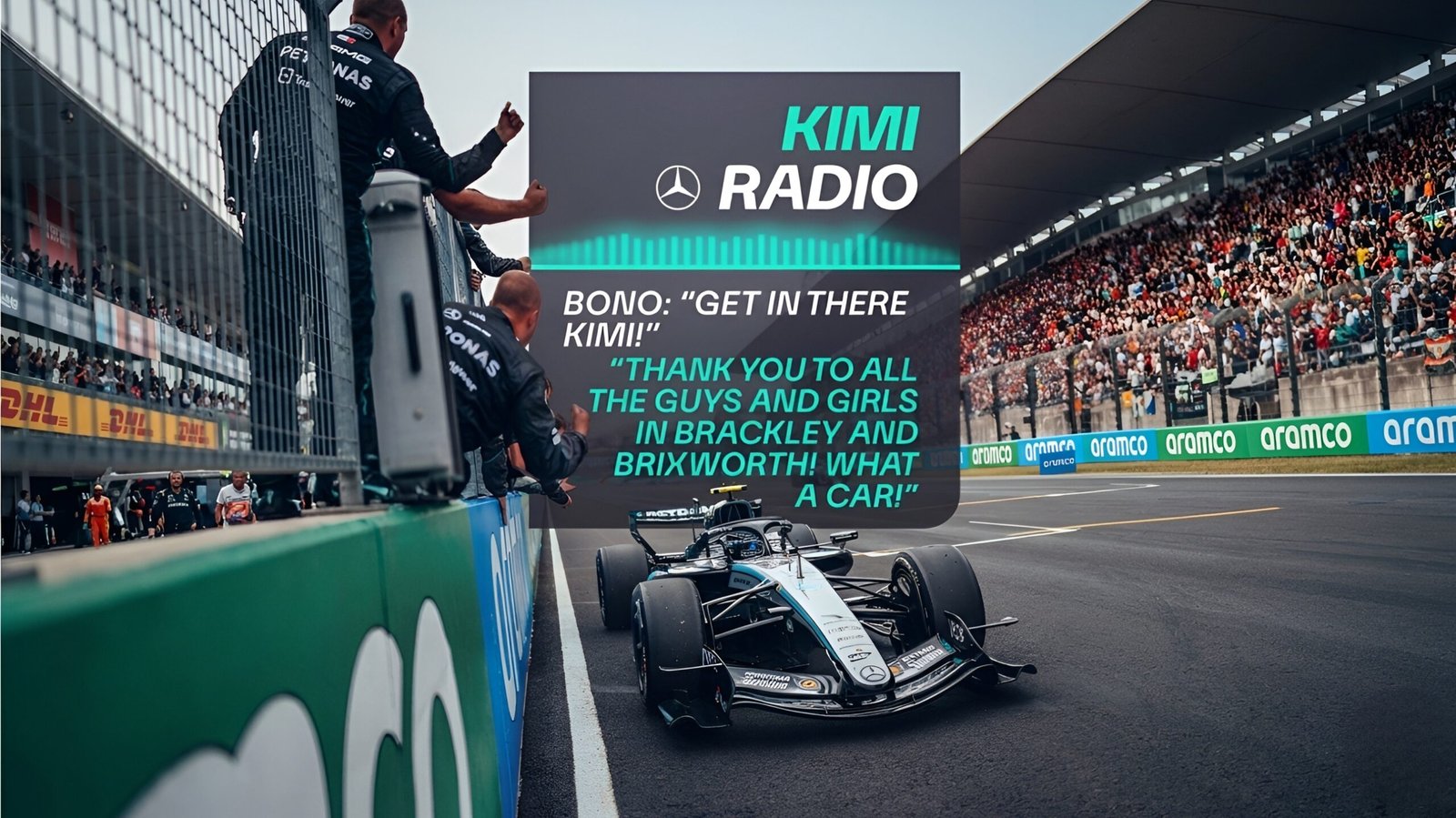
Mercedes sensation Kimi Antonelli celebrates his second consecutive victory at the 2026 Japanese Grand Prix, becoming the youngest driver in Formula 1 history to lead the World Championship standings.
Published by: AutodromeF1 Editorial Team
Mercedes’ Commanding Start to the 2026 Formula 1 Season: Engineering Precision Meets Regulatory Revolution
London, United Kingdom 30 March – In the high-stakes arena of Formula 1, where technological innovation and human endeavour converge under the relentless scrutiny of global competition, Mercedes-AMG Petronas has reasserted its supremacy with clinical authority. As the 2026 campaign unfolds under a transformative regulatory framework, the Silver Arrows have secured victory in every one of the opening three Grands Prix, establishing an unassailable early lead in both the constructors’ and drivers’ championships. With 135 constructors’ points already banked, the Brackley-based outfit finds itself not merely competitive but demonstrably superior, a position that echoes its golden hybrid era while adapting seamlessly to the sport’s most radical overhaul in over a decade.
At the forefront of this resurgence stands Kimi Antonelli, the precocious 19-year-old Italian who has assumed pole position in the drivers’ standings with 72 points. His teammate, the seasoned George Russell, trails by a slender nine-point margin on 63, setting the stage for what promises to be one of the most compelling intra-team title contests in recent memory. This is no fleeting advantage born of circumstance; it is the product of meticulous preparation, profound technical insight, and an organisational culture that has long prioritised sustainable performance over short-term spectacle.
The 2026 regulations represent a paradigm shift engineered by the Fédération Internationale de l’Automobile (FIA) to align Formula 1 with broader objectives of environmental responsibility and competitive equilibrium. Central to the overhaul is a near-equal division of power delivery: the internal combustion engine (ICE) is capped at 400 kilowatts, precisely matched by an enhanced electric contribution from the MGU-K unit, now boosted to 350 kilowatts. The elimination of the MGU-H—previously a cornerstone of energy recovery from exhaust gases—has compelled teams to rethink hybrid architecture entirely, placing unprecedented emphasis on battery efficiency, regenerative braking, and instantaneous power deployment. Sustainable fuels, derived from advanced synthetic processes, further underscore the championship’s commitment to carbon neutrality without compromising the visceral thrill of 1,000-horsepower machines.
Compounding these powertrain demands are significant chassis and aerodynamic revisions. Cars are markedly smaller and lighter, with wheelbase reductions and a simplified bodywork philosophy designed to promote closer racing. Active aerodynamics—deployable front and rear elements that adjust in real time—introduce a new layer of strategic complexity, demanding split-second calibration between mechanical grip, aerodynamic efficiency, and energy management. In this environment, where marginal gains in one domain can cascade into decisive advantages across an entire lap, Mercedes has demonstrated an unparalleled capacity for integration.
The Australian Grand Prix in Melbourne on 8 March provided the first unequivocal statement of intent. On a circuit renowned for its high-speed sweeps and demanding traction zones, Russell converted pole position into a commanding victory, with Antonelli securing a seamless one-two finish. The result was not merely a triumph of speed but of superior energy deployment: telemetry indicated that Mercedes’ hybrid system recovered and redeployed electrical energy with an efficiency margin estimated at 3-5 per cent above the field, translating into measurable advantages through the long straights of Albert Park. Ferrari’s Charles Leclerc claimed third, yet post-race analysis revealed a deficit of approximately 0.6 seconds per lap in qualifying trim—a gap that would prove emblematic of the season’s nascent narrative.
Two weeks later in Shanghai, the narrative evolved into a coronation of youth. Antonelli, already the youngest pole-sitter in Formula 1 history, delivered a flawless Grand Prix performance to claim his maiden victory, while Russell’s Sprint triumph on Saturday ensured another Mercedes double. The Chinese venue, with its blend of tight hairpins and extended straights, tested the new regulations’ emphasis on brake energy recovery. Here, the W16 chassis—Mercedes’ 2026 evolution—exhibited exceptional balance, allowing both drivers to maintain higher corner-exit speeds without compromising tyre management. Lewis Hamilton, now competing for Ferrari, secured a hard-fought podium in third, offering a poignant reminder of the team’s enduring legacy even as rivals sought to bridge the divide.
The most recent instalment, the Japanese Grand Prix at Suzuka on 29 March, tested resilience under variable conditions. Antonelli once again prevailed, navigating the circuit’s legendary esses and chicanes with a maturity that belied his tender years. Russell, however, encountered a rare off-day, finishing fourth behind McLaren’s Oscar Piastri and Ferrari’s Leclerc. The result handed Antonelli the championship lead, yet it also illuminated the depth of Mercedes’ resources: even on a circuit where straight-line speed is paramount, the team’s aerodynamic package and active aero calibration preserved a competitive edge sufficient to mitigate Russell’s qualifying shortfall.
What underpins this early dominance is a confluence of factors that extend far beyond raw power output. Mercedes’ decades-long investment in hybrid technology—honed through eight consecutive constructors’ titles between 2014 and 2021—has proven prescient. The absence of the MGU-H has elevated the importance of MGU-K optimisation and battery thermal management, domains in which the Stuttgart-based powertrain division has evidently excelled. Insiders familiar with the programme describe a power unit that achieves near-perfect energy harvesting from regenerative sources, enabling sustained deployment of the full 350-kilowatt electric quota without degradation—a capability that rivals have openly acknowledged as a “decisive differentiator.”
Chassis dynamics provide the complementary pillar. The smaller 2026 silhouette has allowed Mercedes’ aerodynamicists to prioritise a low-drag, high-downforce configuration that translates into superior traction and braking stability. Straight-line efficiency, enhanced by active aero elements that minimise drag on demand, has yielded consistent 0.5- to 0.8-second advantages in qualifying simulations, according to data corroborated across multiple independent analyses. This is not serendipity; it reflects a holistic design philosophy that integrates powertrain, chassis, and software into a singular, coherent entity. As Toto Wolff, Mercedes’ team principal, observed in a recent technical briefing, “The 2026 rules reward those who understood that hybridisation is not an addendum but the core DNA of modern Formula 1. Our heritage has become our greatest asset.”
Rivals, to their credit, have been forthcoming in their assessments. Ferrari team principal Frédéric Vasseur has noted the “formidable efficiency” of Mercedes’ energy management, while McLaren’s Andrea Stella has highlighted the challengers’ “catch-up” in aerodynamic correlation between wind-tunnel models and track performance. Both organisations, along with Red Bull Racing, have cited the regulatory emphasis on sustainable fuels as an area of ongoing development, where Mercedes’ early adoption of advanced synthetic blends appears to have conferred an additional thermal efficiency benefit.
The intra-team dynamic between Antonelli and Russell adds a compelling human dimension to the technical narrative. Antonelli’s meteoric rise—from Formula 2 graduate to championship leader in three races—exemplifies the meritocratic ethos that F1 aspires to uphold. His instinctive feel for the car’s balance, particularly in high-speed direction changes, has drawn comparisons to past prodigies, yet his post-race demeanour remains one of measured professionalism. Russell, the elder statesman at 28, brings tactical acumen and race-craft refined over years at the sharp end. Their nine-point separation after Suzuka underscores a healthy rivalry that, far from fracturing team cohesion, appears to elevate collective performance. Mercedes’ engineering briefings confirm that data-sharing protocols remain uncompromised, ensuring both drivers benefit from identical machinery and strategic insight.
Viewed through a broader historical lens, Mercedes’ 2026 ascendancy reaffirms the enduring value of institutional knowledge in a sport often characterised by disruptive reinvention. The transition from the 1.6-litre turbo-hybrid era to the current 50/50 architecture has not diminished the team’s competitive edge; rather, it has amplified it. Where others grapple with the complexities of active aero calibration and battery state-of-charge optimisation, Mercedes leverages proprietary simulation tools and real-time telemetry analytics honed across multiple regulatory cycles. This expertise extends to sustainability metrics: the adoption of fully sustainable fuels has been executed with minimal performance trade-offs, aligning commercial imperatives with regulatory compliance in a manner that positions the manufacturer as a leader in motorsport’s green transition.
Yet the season remains in its infancy. Four weeks of development time separate Suzuka from the European leg, offering rivals a window to interrogate their own shortcomings. Aerodynamic upgrades, power-unit software revisions, and refined energy deployment strategies are anticipated across the paddock. The constructors’ championship, while currently favouring Mercedes by a substantial margin, will hinge on consistency across 24 races and the inevitable variables of weather, reliability, and strategic opportunism. For Antonelli and Russell, the psychological dimension of their duel will test not only driving prowess but also emotional resilience—a factor no telemetry graph can quantify.
In an era where Formula 1 seeks to balance spectacle with sustainability, Mercedes’ early 2026 form serves as a compelling case study in excellence through adaptation. The team’s performance transcends mere victory tallies; it embodies the fusion of cutting-edge engineering, strategic foresight, and human talent. As the championship progresses, the question remains whether this dominance will endure or whether the regulatory intent to foster parity will eventually assert itself. For now, however, the Silver Arrows glide with the confidence of an organisation that has once again deciphered the code of a new technical landscape.
The 2026 season, already etched with records and rivalries, promises to reward those who master not only the physics of speed but the art of sustained innovation. Mercedes stands, for the moment, as the exemplar of that mastery—a reminder that in Formula 1, as in any domain of human endeavour, true authority arises from preparation, precision, and an unyielding commitment to excellence.


