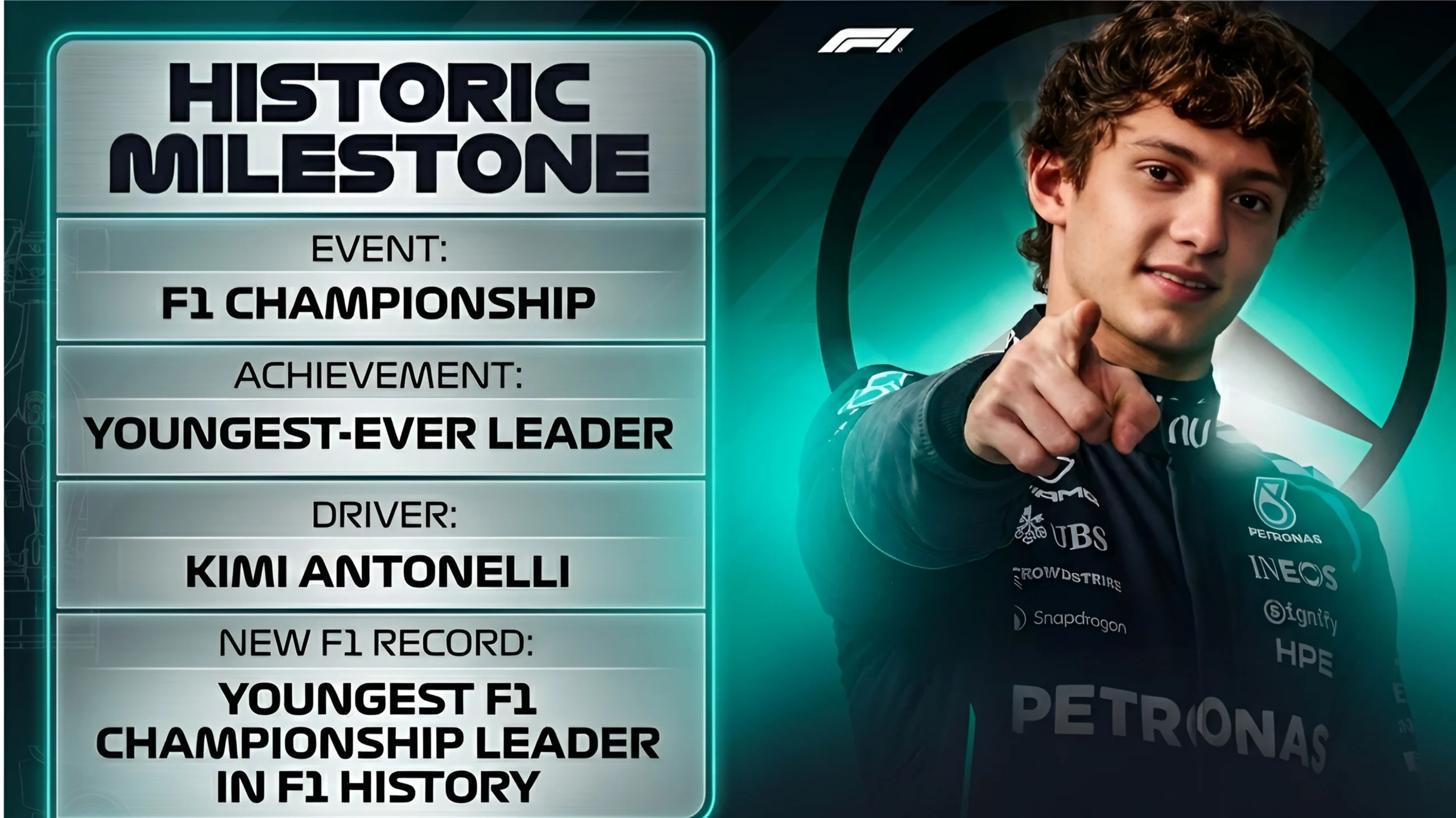
Kimi Antonelli celebrates a historic milestone after winning the 2026 Japanese Grand Prix at Suzuka, becoming the youngest driver to lead the F1 Drivers’ Championship.
Published by: AutodromeF1 Editorial Team
Kimi Antonelli Claims Historic Victory at the 2026 Japanese Grand Prix, Emerging as the Youngest-Ever Leader of the Formula 1 Drivers’ Championship
Suzuka, Japan 29 March – In a performance that blended raw talent, tactical precision, and unyielding resilience, 19-year-old Kimi Antonelli delivered a commanding masterclass at the Suzuka International Racing Course to secure victory in the 2026 Formula 1 Japanese Grand Prix. Driving for Mercedes, the Italian prodigy overcame an uncharacteristically hesitant launch from pole position to capitalise on a mid-race Safety Car deployment, ultimately crossing the line ahead of McLaren’s Oscar Piastri and Ferrari’s Charles Leclerc. The result marks Antonelli’s second consecutive Grand Prix win—following his sensational debut triumph in China—and catapults him to the summit of the Drivers’ Championship with 72 points after just three races of the season.
This achievement is not merely a statistical footnote; it represents a seismic shift in Formula 1’s long and storied narrative. At precisely 19 years, six months, and 28 days old, Antonelli has eclipsed the previous benchmark set by Lewis Hamilton in 2007, when the British driver became the youngest to lead the championship at 22 years and five months. In doing so, Antonelli has etched his name alongside motorsport legends while simultaneously reviving Italy’s proud legacy in the pinnacle of single-seater racing. He becomes the first Italian driver to record back-to-back victories since Alberto Ascari’s dominant run in 1953, a period when the two-time world champion’s Ferrari successes defined an era of national pride on the global stage.
The race itself unfolded against the dramatic backdrop of Suzuka’s iconic 5.807-kilometre figure-of-eight layout—one of the most technically demanding and driver-favourite circuits on the calendar. Designed originally as a Honda test facility and renowned for its high-speed sweeps, elevation changes, and the unique crossover section that tests both nerve and precision, Suzuka has historically rewarded the complete package: speed, strategy, and adaptability. Antonelli’s pole position on Saturday had signalled Mercedes’ early-season competitive edge under the evolving 2026 regulations, yet the race began inauspiciously. A poor getaway—marked by wheelspin and a momentary loss of traction—saw the young Italian drop positions in the opening corners, a rare lapse that could have derailed lesser talents on such a punishing track.
What followed, however, was a demonstration of maturity far beyond his tender years. As the field settled into the opening stint, Antonelli methodically rebuilt his momentum, managing tyre wear with clinical efficiency on the medium-compound Pirelli rubber while maintaining pressure on those ahead. The pivotal moment arrived midway through the 53-lap contest when the Safety Car was deployed following an incident further down the order. In a calculated strategic masterstroke orchestrated by the Mercedes pit wall, Antonelli and his team elected to pit under the neutralised conditions, rejoining the race with fresh rubber and an optimal position to attack on the restart. The decision proved decisive. Surging with renewed vigour, Antonelli dispatched rival after rival in a display of overtaking prowess and racecraft that belied his rookie status. By the time the field returned to green-flag racing, the Italian had seized the lead and never relinquished it, building a buffer that ultimately proved unassailable.
Finishing 3.2 seconds clear of Piastri in second, Antonelli crossed the line to the roar of an international crowd that recognised the historic weight of the occasion. Leclerc, driving a competitive but ultimately outpaced Ferrari, completed the podium in third, while Antonelli’s Mercedes team-mate George Russell recovered to fourth—securing valuable points but underscoring the intra-team hierarchy that now favours the newcomer. The result leaves Antonelli with a nine-point advantage over Russell in the standings, with Piastri a further three points adrift in third. Mercedes, meanwhile, consolidated its constructors’ lead, a testament to the W16 chassis’s balance and aerodynamic efficiency around Suzuka’s demanding 18 corners.
This back-to-back success—China followed by Japan—places Antonelli in exalted company. Alberto Ascari’s consecutive triumphs in the early 1950s not only secured back-to-back world titles for Ferrari but also cemented Italy’s place in Formula 1 folklore. For decades, the nation has awaited a successor capable of matching that pedigree; Antonelli, hailing from Bologna and nurtured through Mercedes’ junior programme, now carries that mantle with quiet authority. His post-race comments reflected the poise that has become his hallmark. “It’s still early days,” he noted in the press conference, downplaying any premature championship speculation despite the commanding nature of his drive. “We have a long season ahead, and the competition is fierce. My focus remains on extracting the maximum from the car and the team week in, week out.”
Such humility is rare in a driver so young, yet it echoes the mindset of champions past. Hamilton’s 2007 campaign, which saw him lead the championship as a rookie before narrowly missing the title, set a precedent for what sustained excellence looks like. Antonelli’s record-breaking ascent, however, arrives even earlier and amid a regulatory landscape transformed for 2026—one that emphasises sustainable power units, active aerodynamics, and closer racing. Early indications suggest Mercedes has interpreted these rules with particular acuity, granting Antonelli a platform that rewards his instinctive feel for the car’s limits.
The championship picture after three races paints an intriguing portrait of the season to come. Antonelli’s 72 points reflect not only two victories but consistent scoring across the opening rounds, a foundation built on reliability and adaptability. Russell’s fourth-place finish in Japan ensured Mercedes claimed maximum haul from the front row, yet the Briton now trails his junior colleague by nine points—a margin that will test team dynamics as the campaign unfolds. Piastri’s consistent podium challenge for McLaren signals the papaya squad’s resurgence, while Leclerc’s efforts for Ferrari highlight the Scuderia’s competitive but not yet decisive pace. With the Middle East segment of the calendar cancelled, the field now faces an extended hiatus before reconvening at the Miami Grand Prix on 3 May, offering teams time to analyse data, refine setups, and prepare for the high-downforce demands of the street circuit.
From a broader perspective, Antonelli’s rise underscores deeper trends within Formula 1. The sport has long celebrated prodigious talent—Max Verstappen’s teenage breakthroughs, Lando Norris’s measured progression—but rarely has a driver assumed championship leadership at such an embryonic stage of his career. Suzuka, with its legacy of title-deciding drama and technical rigour, proved the perfect arena for this statement. The circuit’s figure-of-eight configuration demands total commitment through sectors one and two, where precision under braking and commitment through the esses separate the elite from the merely quick. Antonelli’s ability to maintain composure through these challenges, even after his suboptimal start, speaks volumes about the depth of his preparation and the confidence instilled by Toto Wolff’s Mercedes outfit.
Veteran observers, drawing on decades of race analysis, note that such early dominance often foreshadows sustained contention rather than a fleeting phenomenon. Ascari’s 1953 campaign, for instance, was characterised by unrelenting consistency and strategic nous; Antonelli’s early form mirrors that archetype. Yet the 2026 grid is deeper and more competitive than ever, with regulatory parity fostering multi-team battles. McLaren’s aerodynamic package appears potent in high-speed corners, while Ferrari’s power delivery offers straight-line threats. Mercedes’ advantage at Suzuka may not translate universally, rendering the upcoming Miami round a critical litmus test.
Beyond the numbers lies the intangible impact on the sport’s global audience. Italian motorsport enthusiasts, still cherishing the echoes of Ascari, Fangio-era Ferrari glory, and more recent flashes from drivers such as Michele Alboreto, have found renewed vigour in Antonelli’s story. Social media platforms buzzed with tributes, while the grandstands at Suzuka—traditionally a bastion of disciplined Japanese fandom—erupted in applause for the young victor. The narrative of a teenager leading the world championship injects fresh vitality into a series sometimes criticised for predictability, reminding stakeholders of Formula 1’s enduring capacity to surprise and inspire.
As the paddock disperses from Japan, attention turns to the strategic interlude ahead. Teams will pore over telemetry, simulate Suzuka’s lessons, and calibrate for Miami’s variable conditions. For Antonelli, the priority remains process over podiums: refining qualifying execution to avoid future poor starts, honing tyre management across varying track temperatures, and fostering seamless radio communication with his engineers. His downplaying of title talk is not false modesty but a calculated recognition that three races represent a mere snapshot in a 24-race marathon.
In an era defined by data analytics, hybrid power, and commercial pressures, Antonelli’s emergence reaffirms the primacy of human instinct. Suzuka has crowned many legends—Prost and Senna’s duels, Schumacher’s mastery, Hamilton’s own triumphs—but few moments have carried the weight of youthful audacity quite like this. The 2026 season, already enriched by drama and unpredictability, now revolves around a 19-year-old Italian who has reminded the world why Formula 1 remains the ultimate theatre of speed and skill.
Mercedes enters the break with momentum and a clear internal leader. Rivals will regroup, recalibrate, and return hungrier. Yet for one Sunday afternoon in Suzuka, the spotlight belonged unequivocally to Kimi Antonelli—a driver whose name now stands alongside the sport’s youngest trailblazers, and whose potential appears boundless. The championship lead is his to defend; the history books have already begun to rewrite themselves in his favour.


