Published by: AutodromeF1 Editorial Team
Kimi Antonelli’s Measured Ascent: A 19-Year-Old’s Blueprint for Formula 1 Championship Contention in 2026
London, United Kingdom 3 April – In the rarefied world of Formula 1, where precocity is both celebrated and scrutinised with forensic intensity, Kimi Antonelli stands as a compelling study in disciplined ambition. The Italian teenager, now in his second season with Mercedes, has publicly reaffirmed his conviction that he can contend for the Drivers’ World Championship before the 2026 season concludes—and ultimately claim the title. His remarks, delivered with the poise of a driver far beyond his years, blend unapologetic confidence with a granular emphasis on consistency, technical mastery, and mental resilience. Far from the brash declarations that have occasionally defined young talents in the sport’s history, Antonelli’s statements reflect a maturity forged through the crucible of a challenging rookie campaign and the unrelenting demands of top-tier competition.
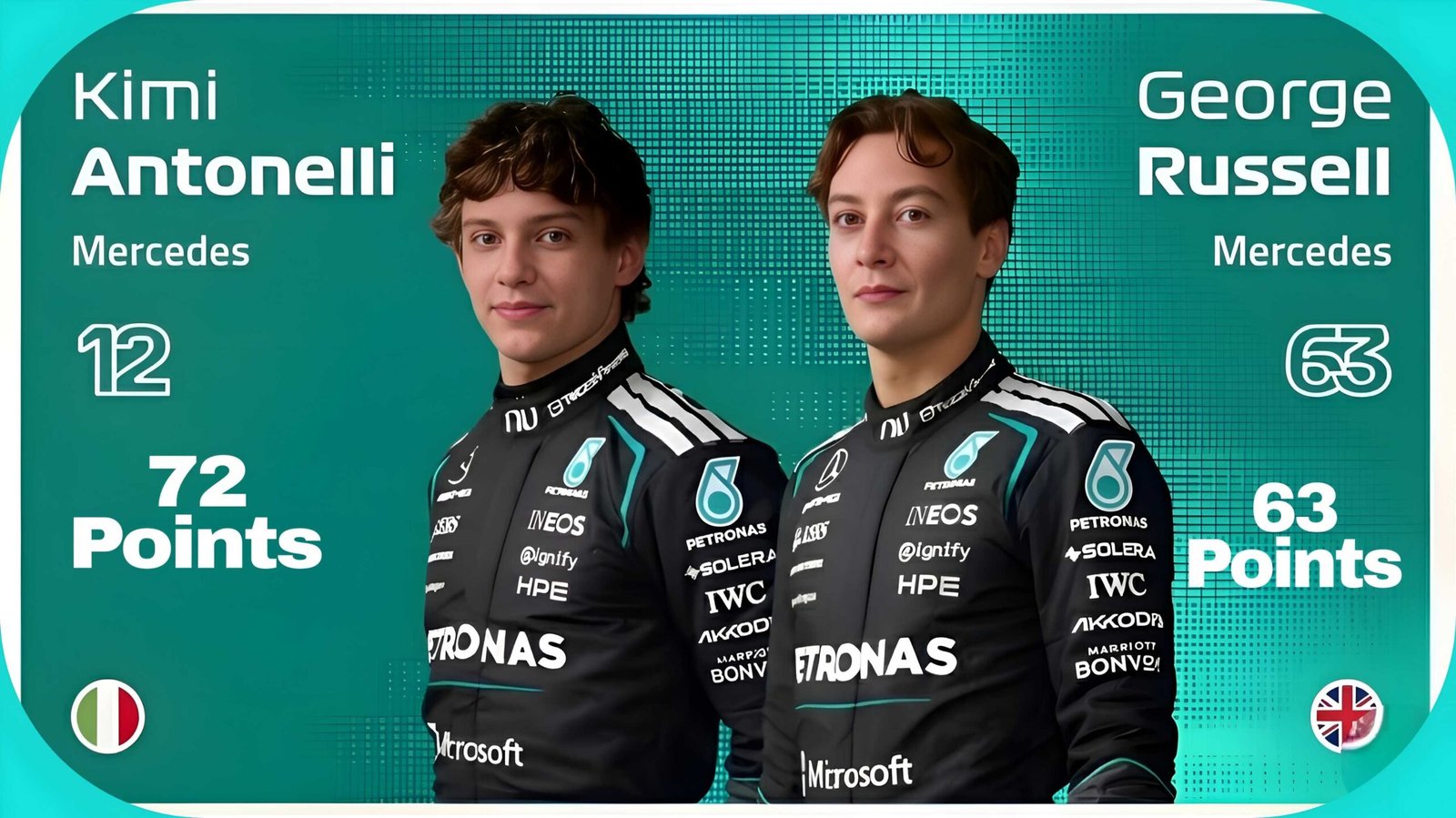
As the 2026 season enters its early phase, Antonelli occupies a position of genuine contention. With 72 points to his name, he trails the championship leader by a slender nine-point margin. His Mercedes team-mate, George Russell, sits on 63 points, underscoring the intra-team rivalry that has already produced compelling on-track theatre. The numerical proximity to the summit is not merely statistical; it serves as tangible validation of the progress Antonelli has made since his debut. Yet the young driver refuses to allow early-season momentum to distort perspective. In post-race reflections following his victory at the Japanese Grand Prix—his maiden triumph at the highest level—he underscored the necessity of remaining grounded. “The target is clear,” he noted, “but losing sight of it through over-celebration would be the quickest way to fall short.” Such restraint is rare in an era of instant social-media amplification and is a hallmark of drivers who ultimately endure.
The Japanese success, secured after a commanding performance that saw him defeat Russell in a straight fight, arrived at a pivotal juncture. It was not an isolated flash of brilliance but the culmination of incremental improvements that began to crystallise earlier in the campaign. Antonelli’s ability to convert potential into results has been evident since his breakthrough win in China, where he demonstrated unequivocally that, when operating at the upper limit of his capability, he can dispatch even the most seasoned competitors. That victory provided empirical proof: the raw speed and racecraft long anticipated by Mercedes’ talent scouts were no longer theoretical. They were quantifiable, repeatable, and, crucially, scalable.
What distinguishes Antonelli’s current outlook from the optimism of other young drivers is the forensic self-analysis that underpins it. He has been candid about the lessons extracted from his 2025 rookie season, a year marked by the inevitable turbulence that accompanies adaptation to Formula 1’s unique pressures. Mechanical sympathy, tyre management, and the nuanced art of providing consistent, actionable feedback to engineers on car setup were areas where growth was required. Mental resets—those deliberate, almost clinical processes of compartmentalising errors and refocusing between sessions—emerged as non-negotiable disciplines. Antonelli now speaks of these elements not as abstract ideals but as operational imperatives. “Nailing the basics,” he insists, “is what separates sustainable contenders from one-off performers.” This philosophy is informed by hard-won experience rather than inherited wisdom, lending it an authenticity that resonates within the paddock.

Central to Antonelli’s development narrative is the evolution of his mentorship relationships. Last season, both Lewis Hamilton and Max Verstappen were notably generous with guidance, offering the kind of unfiltered insight that only multiple world champions can provide. Hamilton, in particular, maintained a supportive public posture, delivering heartfelt messages after Antonelli’s record-breaking youngest pole position and other landmark moments. Verstappen, never one to suffer fools, nevertheless recognised the Italian’s potential and contributed practical advice on race management and defensive lines. Antonelli credits both men openly for accelerating his learning curve during the most demanding phase of his induction into Formula 1.
Yet those channels have now closed—a development the young driver interprets not as rejection but as affirmation of his progress. “They have stopped,” he observed recently, “and that tells me I am no longer the kid they need to carry. I am a competitor.” The transition from protégé to peer is rarely articulated with such clarity. It signals a psychological shift that is as significant as any technical refinement. Hamilton’s public endorsements, once a source of external validation, have been internalised; Antonelli now draws confidence from within while retaining profound respect for his predecessors. This independence is essential. History demonstrates that drivers who remain overly reliant on senior counsel often plateau once the novelty of their arrival fades. Antonelli’s self-awareness in recognising the moment to stand alone suggests a strategic intelligence that could prove decisive over a 22-race campaign.
The broader context of Mercedes’ 2026 campaign adds layers of complexity to Antonelli’s story. The team’s car, while competitive, has not exhibited the outright dominance seen in previous regulatory cycles. Instead, it rewards precision and adaptability—qualities Antonelli appears increasingly able to supply. His China performance, in which he outmanoeuvred established frontrunners in variable conditions, illustrated the machine’s latent potential when paired with a driver capable of extracting every tenth of a second. Russell’s consistent presence in the upper reaches of the points table further validates the chassis, yet the intra-team dynamic is evolving. With Antonelli now leading the drivers’ standings within Mercedes, the balance of power is shifting. Team principal Toto Wolff has long championed the value of internal competition, provided it remains constructive; the current nine-point gap between his two drivers, set against Antonelli’s championship proximity, offers precisely that equilibrium.
Looking ahead, Antonelli’s immediate focus remains pragmatic. He has set a short-term objective of securing two or three additional victories in the coming races, not as an end in itself but as incremental steps toward sustained title contention. This phased approach—prioritising execution over aspiration—is reminiscent of the methodologies employed by champions such as Alain Prost and, more recently, Fernando Alonso in his later career phases. It acknowledges that Formula 1 rewards cumulative performance rather than sporadic brilliance. The April break, now imminent, will provide a critical window for reflection, simulator work, and fine-tuning. Engineers will pore over telemetry from Japan and China, seeking marginal gains in aerodynamic efficiency and power-unit deployment that could prove championship-defining by season’s end.
Analysts with decades of paddock observation note that Antonelli’s trajectory echoes certain aspects of Verstappen’s early Red Bull tenure: prodigious talent tempered by an increasingly sophisticated operational mindset. Yet there are distinctions. Where Verstappen’s breakthrough was catalysed by a car advantage that materialised almost overnight, Antonelli is navigating a more contested field in which Mercedes must continue to evolve in real time. The 2026 regulations, with their emphasis on sustainable power units and refined aerodynamics, have produced a grid in which no single constructor enjoys unchallenged supremacy. In such an environment, driver input on setup becomes disproportionately valuable—a domain in which Antonelli’s feedback has already earned praise from Mercedes’ technical leadership.
The psychological dimension merits equal scrutiny. Formula 1’s mental demands are legendary, and Antonelli’s emphasis on “mental resets” reveals a sophisticated understanding of performance psychology. The ability to erase the memory of a suboptimal qualifying lap or an early-race error, then recompose for the next session, is a skill often underdeveloped in younger drivers. By prioritising this facet, Antonelli is addressing a vulnerability that derailed several promising careers in the hybrid era. His maturity is further evidenced by his refusal to engage in the performative bravado that media cycles sometimes encourage. Instead, he frames his championship ambitions within a narrative of collective team endeavour and personal accountability—an approach that fosters trust among engineers, strategists, and senior management alike.
From a historical perspective, Antonelli’s position is extraordinary. At 19, he is already the youngest driver to register a Grand Prix victory under the current points system and sits within striking distance of the championship lead mere races into the season. Only a handful of drivers—Verstappen, Hamilton in his McLaren days, and Sebastian Vettel—have exerted comparable influence at such an early age. What sets Antonelli apart is the absence of external drama. There are no public disputes with team-mates, no social-media controversies, and no sense of entitlement. His narrative is one of quiet, methodical elevation, supported by a management structure that has shielded him from the more corrosive aspects of fame.
Mercedes, for its part, appears to have timed its driver succession with precision. By entrusting the seat to Antonelli following Hamilton’s departure, the team secured not only youthful dynamism but also a driver whose growth curve aligns with the anticipated competitive window of the 2026-2028 regulations. Russell’s experience provides stability, yet Antonelli’s speed and adaptability offer the disruptive edge required to reclaim the constructors’ crown. The nine-point intra-team gap is narrow enough to maintain healthy tension without descending into acrimony—a balance Wolff has historically managed with aplomb.
As the season progresses, several variables will test Antonelli’s resolve. Reliability concerns inherent to new power-unit architecture, the tactical complexities of sprint weekends, and the variable weather patterns that characterise the Asian and European legs of the calendar will demand adaptability. His stated commitment to “consistent setup feedback” will be crucial here; small misalignments in suspension geometry or brake balance can erode lap time advantages rapidly. The driver’s ability to articulate these subtleties under pressure will determine whether Mercedes can maintain its current upward trajectory.
Beyond the immediate campaign, Antonelli’s emergence carries implications for the sport’s future. He represents a new generation of drivers raised in the data-rich, simulator-intensive environment of modern Formula 1 academies. Their technical literacy, combined with the emotional intelligence required to navigate multi-stakeholder team environments, may redefine leadership models within the cockpit. If Antonelli sustains his current trajectory, he could accelerate the transition toward an era in which championship success hinges as much on cognitive and interpersonal skills as on raw reflexes.
In summary, Kimi Antonelli’s recent declarations are neither hollow rhetoric nor premature triumphalism. They constitute a carefully calibrated roadmap: championship contention by year’s end, grounded in relentless attention to fundamentals, informed by past setbacks, and executed with the independence of a driver who has outgrown his mentors. With 72 points secured and a nine-point deficit that remains eminently bridgeable, the Italian has positioned himself at the vanguard of a resurgent Mercedes effort. Whether he ultimately stands atop the podium in Abu Dhabi in December will depend on countless variables—mechanical reliability, strategic acuity, and the unquantifiable element of racing fortune. Yet the foundations he is laying today, rooted in consistency, self-awareness, and unyielding ambition, suggest a driver eminently capable of navigating those complexities.
Formula 1 has witnessed many promising talents falter at the threshold of greatness. Antonelli, however, appears determined to defy that pattern through method rather than miracle. His story, still in its opening chapters, already commands attention not merely for its speed but for its substance. In an age of hyperbole, his measured pursuit of excellence offers a refreshing and, perhaps, enduring model for success at motorsport’s pinnacle. The coming races will reveal whether the blueprint holds; the paddock, and an expectant global audience, will be watching with keen anticipation.


