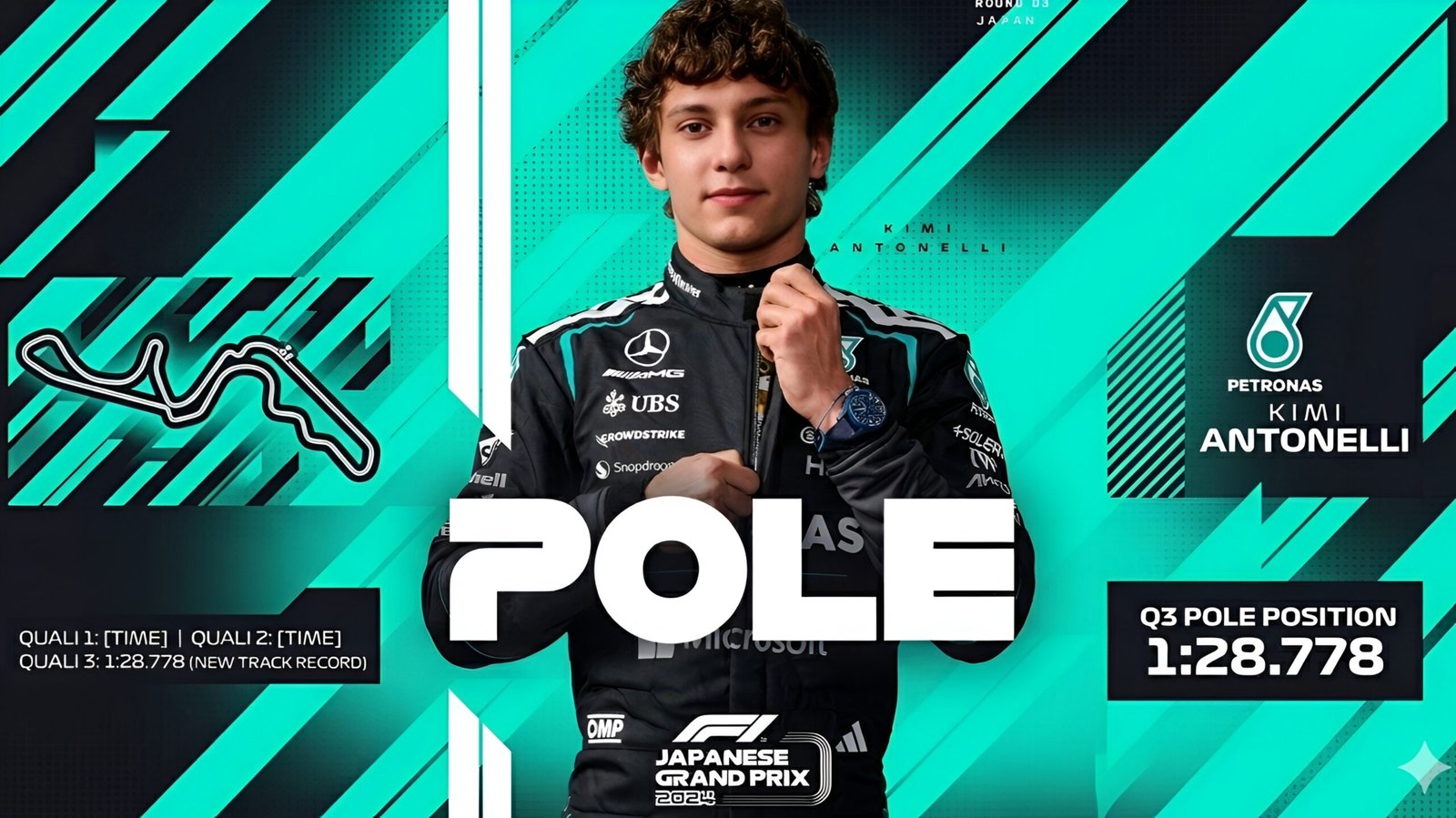
Mercedes-AMG Petronas driver Kimi Antonelli celebrates another historic pole position at the 2026 Japanese Grand Prix after setting a new Suzuka track record of 1:28.778.
Published by: AutodromeF1 Editorial Team
Mercedes’ Unrivalled Ascendancy: Kimi Antonelli Delivers Masterclass Pole Position at Suzuka, Signalling a New Era of Silver Arrows Supremacy in the 2026 Formula 1 Season
Suzuka Circuit, Japan – 28 March 2026
In the crisp, high-stakes arena of Suzuka’s legendary figure-eight layout, where precision, courage, and technical harmony converge like nowhere else on the Formula 1 calendar, Kimi Antonelli has once again etched his name into the annals of the sport. The 19-year-old Italian prodigy, driving for Mercedes-AMG Petronas, secured pole position for the Japanese Grand Prix with a scintillating lap time of 1:28.778 in Q3, outpacing his teammate George Russell by a decisive 0.298 seconds. This front-row lockout not only underscores Mercedes’ seamless adaptation to the radical 2026 regulatory overhaul but also cements the team’s status as the undisputed benchmark in the early stages of this transformative season.
The result arrives on the heels of Antonelli’s groundbreaking triumph two weeks ago at the Chinese Grand Prix, where he claimed his maiden pole and converted it into a maiden victory. That success in Shanghai marked the dawn of what many insiders are already dubbing a potential dynasty in the making. Now, at one of F1’s most revered and unforgiving circuits, the Silver Arrows have reaffirmed their dominance with clinical efficiency. Mercedes’ performance across the weekend has been nothing short of exemplary, blending raw pace, strategic acumen, and an innate understanding of the new-generation power units and active aerodynamics that define the 2026 technical landscape.
Qualifying at Suzuka unfolded as a masterclass in composure under pressure. The circuit’s demanding combination of high-speed sweeping corners—such as the iconic 130R and the daunting Spoon Curve—demands absolute fidelity from both driver and machine. Antonelli, in only his second full season at this level, navigated the session with the poise of a veteran. His final Q3 run was a study in perfection: minimal tyre degradation, flawless traction out of the chicane, and a daring yet controlled push through the high-speed esses that left observers breathless. Russell, himself a seasoned campaigner and current championship leader by a slender margin, finished a mere 0.298 seconds adrift, securing the front row in what is rapidly becoming one of the most compelling intra-team rivalries in recent memory.
This was no fluke. The qualifying highlights revealed a Mercedes package that has evolved with surgical precision to exploit the 2026 regulations. The new power units, featuring enhanced electrical deployment and sustainable fuel mandates, have been integrated into the W17 chassis with an elegance that rivals have yet to replicate. Active aero elements—moveable front and rear wings that allow dynamic adjustments between straight-line efficiency and cornering grip—have been optimised to perfection by the Brackley-based engineering team. Where McLaren and Ferrari have shown flashes of competitiveness, Mercedes has demonstrated a holistic superiority that translates directly into one-lap pace.
Delving deeper into the practice sessions provides further evidence of this methodical supremacy. In FP1, Mercedes occupied the top two positions, with Russell edging Antonelli by a razor-thin 0.026 seconds. The session was not without incident; minor on-track skirmishes and traffic in the technical sectors tested the drivers’ spatial awareness, yet the Silver Arrows emerged unscathed and fastest. FP2 saw a slight shift in the narrative, as McLaren’s Oscar Piastri topped the timesheets in a display of the papaya squad’s long-run potential. However, Mercedes remained firmly entrenched within the top three, their data logs indicating superior energy management and tyre preservation—critical factors on a circuit where rubber degradation can make or break a race strategy.
This weekend’s narrative is part of a broader season arc that has seen Mercedes surge to the forefront. Following the China double-header triumph, the team is now poised for a potential third consecutive one-two finish, a feat that would echo the glory days of the hybrid era while signalling a fresh chapter under the new paradigm. The 2026 regulations, designed to promote closer racing and sustainability, have instead—thus far—highlighted the brilliance of Mercedes’ pre-season development. While Ferrari and McLaren have closed the gap in race simulations, neither has matched the Silver Arrows’ qualifying prowess or their ability to extract maximum performance from the active aero systems during critical moments.
Antonelli’s rapid ascent continues to captivate the paddock. As the youngest driver to claim pole position in Formula 1 history, his performances exude a rare blend of youthful exuberance and precocious maturity. Observers note his feedback to the engineers—precise, articulate, and technically insightful—has accelerated Mercedes’ iterative improvements. Russell, for his part, has welcomed the challenge, describing the intra-team dynamic as “the healthiest form of competition.” The Briton’s experience provides a vital counterbalance, ensuring that Mercedes’ development remains grounded even as the spotlight intensifies on their teenage sensation.
The championship context adds another layer of intrigue. With Russell holding a narrow points advantage heading into Suzuka, the race tomorrow carries significant weight. A Mercedes one-two would not only extend their constructors’ lead but also intensify the drivers’ title battle. Ferrari, led by their experienced duo, and McLaren, buoyed by Piastri’s emerging talent and Lando Norris’s consistency, trail in the standings. Yet the gap feels more pronounced than the raw numbers suggest, owing to Mercedes’ superior race pace projection and adaptability to variable conditions—Suzuka’s changeable weather often being a decisive factor.
From a technical standpoint, the 2026 package has rewarded those who invested early in simulation and wind-tunnel correlation. Mercedes’ wind tunnel programme, long regarded as the gold standard, appears to have unlocked synergies between the power unit’s electrical architecture and the active aero deployment strategies. This is no mere incremental gain; it represents a paradigm shift in how downforce and drag are managed across the lap. Rivals have acknowledged the challenge privately, with one senior engineer from a competing team describing Mercedes’ solution as “elegantly ruthless in its efficiency.”
Beyond the stopwatch, this weekend at Suzuka carries cultural and historical resonance. The Japanese Grand Prix has long been a litmus test for technical excellence, where legends like Ayrton Senna and Michael Schumacher forged their legacies. Antonelli’s pole here feels like a passing of the torch—a young driver embodying the next generation’s potential in a sport that continues to reinvent itself. The passionate Suzuka faithful, known for their unwavering support and deep technical appreciation, have embraced the Italian with open arms, their banners and cheers adding an electric atmosphere to the proceedings.
As the sun sets over the circuit and teams finalise their race preparations, the anticipation builds. Tyre management, energy deployment, and the strategic deployment of active aero will be paramount in the 53-lap race. Will Antonelli convert this pole into back-to-back victories, further cementing his status as the breakout star of 2026? Or will Russell’s race-day nous enable a stirring fightback? The possibility of a Mercedes one-two looms large, but the depth of competition ensures that nothing can be taken for granted.
In an era where regulatory resets often level the playing field, Mercedes has instead elevated the standard. Their dominance is not born of fortune but of foresight, rigorous execution, and an unrelenting pursuit of excellence. Kimi Antonelli’s 1:28.778 lap at Suzuka is more than a qualifying result; it is a declaration of intent for the season ahead and a reminder of why Formula 1 remains the pinnacle of motorsport.
The Japanese Grand Prix promises to be a spectacle worthy of its heritage. For Mercedes, it represents another stepping stone toward sustained success. For the rest of the grid, it is a call to arms. The 2026 season is still young, yet the narrative is already taking shape around the Silver Arrows—and at its centre stands a 19-year-old whose composure belies his years.


