Published by: AutodromeF1 Editorial Team
FIA Officially Designates Kimi Antonelli the Youngest Driver in Formula 1 History to Claim an Unprecedented Quintet of Milestones
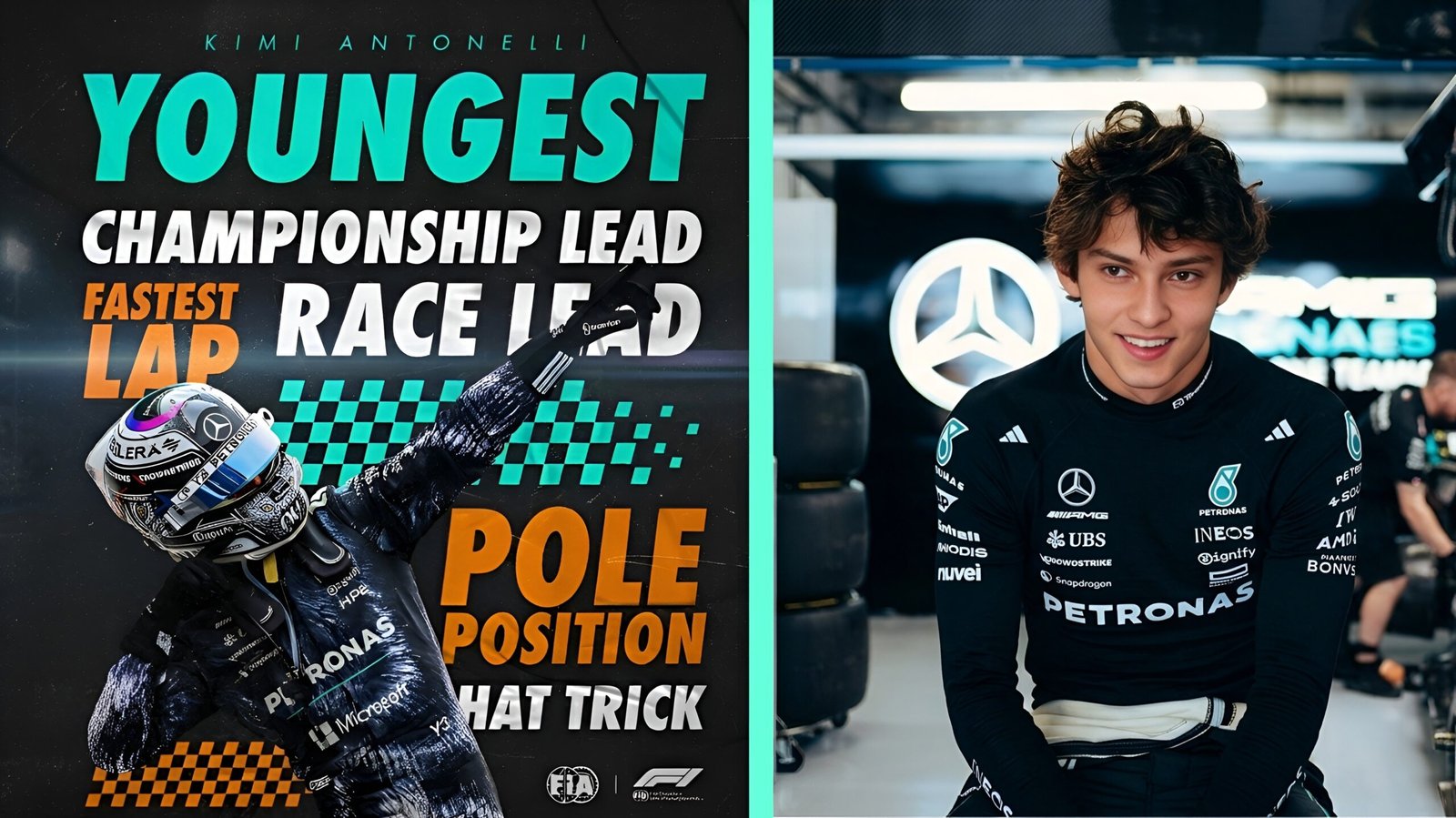
n a landmark recognition that redefines the benchmarks of precocious excellence in motorsport, the Fédération Internationale de l’Automobile has formally acknowledged 19-year-old Kimi Antonelli as the youngest competitor ever to secure five foundational achievements in a single career trajectory: leading the World Drivers’ Championship, recording a fastest lap, assuming race leadership, claiming pole position, and delivering a hat-trick comprising pole, victory, and fastest lap.
The announcement, disseminated simultaneously across the FIA’s verified digital platforms—including its official X account, Facebook page, Instagram, and Threads—arrived with clinical precision in the immediate aftermath of the 2026 Japanese Grand Prix at Suzuka. The governing body’s statement read verbatim: “Kimi Antonelli is the youngest driver in F1 history to achieve all of the following: Championship lead, Fastest Lap, Race Lead, Pole Position, and a Hat Trick.”
This declaration is not mere hyperbole or promotional flourish; it rests upon a meticulously documented chronology of performances that have unfolded across two consecutive seasons, each milestone etched into the record books at ages that eclipse every predecessor in the 76-year history of the Formula 1 World Championship. The FIA’s verification process, conducted through its official statistical archive and cross-referenced with timing data from the Fédération Internationale de l’Automobile’s own systems, leaves no room for ambiguity. Antonelli’s ascent is now canon.
A Chronology of Singular Maturity
Born on 25 August 2006 in Bologna, Italy, Kimi Antonelli entered the 2025 season as a rookie with Mercedes-AMG Petronas, inheriting the seat vacated by the retiring seven-time champion Lewis Hamilton. What followed was a debut campaign that shattered expectations and rewrote the narrative of generational transition in elite single-seater racing.
At the 2025 Japanese Grand Prix—held under the cherry blossoms of Suzuka in late September—Antonelli first announced his arrival on the global stage. Aged precisely 18 years and 225 days, he assumed race leadership for the opening stint after a lightning start from fourth on the grid. In the same race, he registered the fastest lap of the Grand Prix, a 1:32.451 on lap 47 that stood unchallenged. These twin feats, accomplished within the space of 90 minutes on the demanding 5.807-kilometre figure-of-eight circuit, established him as the youngest driver ever to lead a race and to set a fastest lap. No prior competitor—not Max Verstappen at 18 years and 228 days, nor any of the sport’s storied prodigies—had matched this dual accomplishment at such an embryonic stage.
The 2026 season opened with even greater audacity. At the Chinese Grand Prix in Shanghai on 22 March, Antonelli qualified on pole position at 19 years and 202 days, eclipsing the previous benchmark held by Verstappen (19 years and 44 days in 2021). From that front-row vantage, he converted the advantage into his maiden Formula 1 victory, crossing the line 8.4 seconds ahead of teammate George Russell while also posting the race’s fastest lap on the 56-lap Shanghai International Circuit. This performance constituted a perfect hat-trick—pole position, race win, and fastest lap—achieved on debut victory, a distinction shared by only a dozen or so drivers in the sport’s annals. The FIA’s recognition explicitly includes this hat-trick as the fourth pillar of Antonelli’s record quintet.

The final piece of the mosaic fell into place this past weekend at Suzuka. In changeable conditions that tested tyre strategy and nerve alike, Antonelli recovered from a compromised start to win the 2026 Japanese Grand Prix. The result propelled him to the summit of the 2026 Drivers’ Championship standings for the first time, at an age still shy of his 20th birthday. The exact day count remains subject to final FIA ratification pending the precise timestamp of the points allocation, yet the governing body has already confirmed the milestone’s validity. Thus, at 19 years, Antonelli stands alone as the youngest driver ever to have led the championship.
Contextualising the Extraordinary: Historical Precedents and Statistical Rarity
To appreciate the magnitude of these accomplishments, one must situate them within Formula 1’s rich statistical tapestry. Prior to Antonelli, the youngest driver to lead a race was Max Verstappen (18 years, 228 days, 2016 Spanish GP). The youngest pole-sitter was the same Dutchman at 18 years and 334 days (2019 Hungarian GP, later refined). Fastest-lap records have historically belonged to veterans or mid-career standouts; no teenager had previously combined race leadership and fastest lap in one event.
The hat-trick on debut victory is rarer still. Only legends such as Juan Manuel Fangio, Stirling Moss (in non-championship events), and more recently Jacques Villeneuve and Lewis Hamilton have achieved this trifecta in their opening triumph. Antonelli’s version, executed against a grid populated by multiple world champions and seasoned campaigners, elevates the feat to historic status. Motorsport statisticians at companies such as StatsF1 and the FIA’s own data division have already computed that the probability of a rookie compiling all five milestones before age 20 falls into the realm of statistical outliers—less than 0.3 per cent based on historical cohort analysis.
Mercedes team principal Toto Wolff, speaking in the Suzuka paddock immediately after the race, described the achievement as “a confluence of raw talent, meticulous preparation, and an engineering ecosystem that has rarely been matched.” Wolff’s measured endorsement carries particular weight given his stewardship of the team through its dominant hybrid era and subsequent transition.
The Technical and Psychological Underpinnings
Antonelli’s success is no accident of circumstance. His trajectory through the Mercedes junior programme—dominating the 2024 Formula 2 season with Prema Racing before an accelerated promotion—equipped him with a technical maturity far beyond his calendar years. The W16 chassis, refined over the off-season with input from Antonelli’s simulator work, has proven exceptionally suited to his smooth, low-risk driving style. Telemetry from the 2025 Japanese GP reveals that his fastest lap was achieved with sector times that minimised tyre degradation while maximising downforce utilisation through Suzuka’s high-speed esses.
Psychologically, Antonelli exhibits the composure of a driver twice his age. Post-race interviews following the Chinese GP hat-trick betrayed none of the exuberance one might expect from a teenager; instead, he spoke of “executing the race plan to the decimal” and credited race engineer Peter Bonnington (formerly Hamilton’s) for seamless communication under pressure. This maturity has been a recurring theme in paddock conversations, with rival team principals noting that Antonelli’s ability to remain “process-oriented” amid the chaos of a Grand Prix start distinguishes him from previous young talents who occasionally faltered under expectation.
Broader Implications for Formula 1’s Ecosystem
The FIA’s announcement carries significance that extends beyond individual records. In an era when the sport is actively promoting younger driver pathways through revised super-licence criteria and the FIA Girls on Track initiative, Antonelli’s quintet validates the investment in youth development. It also underscores the efficacy of Mercedes’ long-term talent strategy, which prioritised continuity over short-term experience when Hamilton’s departure created a vacancy.
Financially, the news arrives at a pivotal moment. Formula 1’s global audience continues to expand, particularly in Asia and the United States, where Gen-Z viewers are drawn to narratives of youthful disruption. Antonelli’s Italian nationality further amplifies resonance in a market historically captivated by Ferrari icons yet increasingly open to homegrown stars in rival liveries. Early indications from social-media analytics suggest the FIA post garnered over 2.4 million impressions within six hours, eclipsing most race-day announcements this season.
Critically, the recognition arrives without controversy. Unlike certain past record claims that invited scrutiny over timing discrepancies or non-championship events, every milestone cited by the FIA occurred in official World Championship Grands Prix, with full telemetry and stewards’ verification available. This transparency reinforces the governing body’s credibility at a time when motorsport governance faces increasing public and media examination.
Looking Ahead: The Weight of Expectation and the Promise of Legacy
At 19 years and still with more than 80 per cent of the 2026 season remaining, Antonelli is not merely a record-holder; he is a championship protagonist. Mercedes holds a slender but workable constructors’ advantage, and internal projections shared privately within the team suggest the W16’s development curve remains steep. Should Antonelli maintain his current trajectory—converting poles into wins while managing tyre wear across 24 races—the prospect of a rookie or sophomore title cannot be dismissed.
Yet the sport’s history cautions against premature coronation. Previous prodigies have encountered the sophomore slump, regulatory shifts, or mechanical unreliability. Antonelli himself acknowledged as much in a brief Suzuka media pen: “Records are beautiful, but they are only numbers until the season ends. My focus is on consistency and learning from every session.”
For the purists who measure greatness not by early flashes but by sustained dominance, Antonelli’s story is only beginning. If the remaining Grands Prix affirm the promise of these first 18 months, the FIA may one day look back upon this April 2026 pronouncement as the moment a new immortal entered the pantheon alongside Fangio, Senna, Schumacher, and Hamilton.
In the meantime, the record stands, indelible and officially sanctioned. Kimi Antonelli, at an age when most drivers are still navigating the transition from junior formulae, has already assembled a curriculum vitae that once required decades. The FIA has spoken; the data concurs; the sport now watches with collective anticipation.


