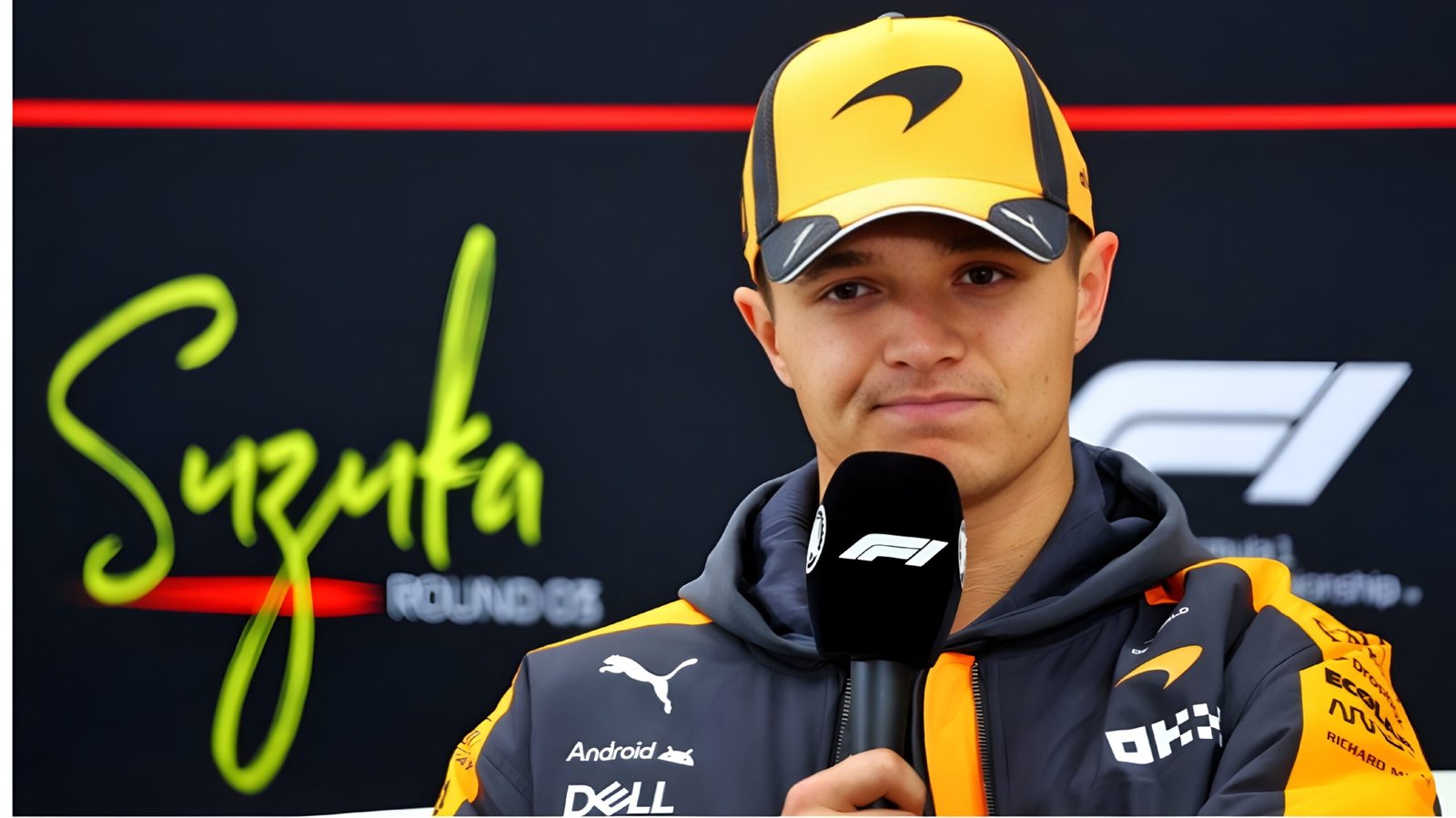
Reigning Champion Lando Norris addresses the media at Suzuka following a catastrophic Energy Store failure that sidelined his McLaren at the 2026 Chinese Grand Prix.
Published by: AutodromeF1 Editorial Team
Lando Norris and McLaren Confront Acute Battery Allocation Crisis Following Distinct Mercedes HPP Energy Store Failures at 2026 Chinese Grand Prix
Suzuka, Japan — In a development that underscores the unforgiving precision demanded by Formula 1’s 2026 power-unit regulations, reigning World Champion Lando Norris has suffered an irreparable loss to his McLaren’s battery energy store, compounding an already demanding start to his title defence. The incident, which occurred in the lead-up to the Chinese Grand Prix at the Shanghai International Circuit, not only prevented Norris from taking the start but also triggered a parallel but distinct electrical fault that sidelined his teammate Oscar Piastri. Both failures originated within the Mercedes High Performance Powertrains (HPP) hybrid system, yet McLaren has confirmed they were unrelated in root cause—one software-induced and the other hardware-adjacent—marking an early and sobering test of the new sustainable power-unit framework.
The episode unfolded with clinical finality. During final preparations on race morning, telemetry from Norris’s MCL40 revealed a catastrophic software anomaly within the primary energy store that rendered the unit permanently inoperable. Engineering protocols dictated its immediate removal from service, as any attempt at repair would have violated both safety and regulatory integrity. Piastri’s car, meanwhile, exhibited a separate auxiliary-component degradation that, while less terminal, was equally prohibitive under pre-race scrutineering. The result: a rare double DNS for the Woking-based squad on a weekend when pre-event data had positioned the papaya-liveried cars as genuine frontrunners.
This setback arrives at a moment of heightened regulatory scrutiny. The 2026 technical regulations represent the most radical overhaul of the hybrid era, mandating a precise 50/50 split between internal-combustion engine and electrical power contribution. The MGU-K has been uprated to 350 kW, energy deployment windows have been recalibrated for greater strategic nuance, and—crucially—each driver is now restricted to just three Energy Stores (the official term for the lithium-ion battery packs) across the entire 24-race calendar. With Norris’s allocation already reduced by one, the mathematical reality is stark: two certified units remain for the remaining 20 Grands Prix, an allocation that leaves zero margin for further attrition on circuits characterised by sustained high-energy demands such as Baku, Monza, or the revised Jeddah layout.
The governing body’s intent is unambiguous: to accelerate the sport’s transition toward electrification while preserving the visceral theatre of wheel-to-wheel combat. Yet the corollary, as Norris himself articulated in the pre-season media briefing at Bahrain, is that “battery management has become the single biggest operational headache on the grid.” The champion’s assessment carries the weight of hard-won experience. In an era when drivers must juggle deployment modes, regeneration thresholds, and thermal envelopes with the precision of a concert pianist, the loss of a single energy store is not merely inconvenient—it is potentially championship-defining.
Compounding the immediate operational pressure is the penalty architecture enshrined in the 2026 Sporting Regulations. Any installation of a fourth energy store beyond the permitted three incurs an automatic ten-place grid drop, a sanction that, in the hyper-competitive midfield of the new generation of ground-effect cars, can transform a potential podium into a damage-limitation exercise. Norris has already tasted the sting of electronic gremlins this weekend; a separate software anomaly in qualifying forced the team to contemplate a pit-lane start before a late clearance allowed him to line up on the grid proper. The cumulative effect is a weekend that began with genuine title-contender momentum and ended with McLaren’s technical director, Rob Marshall, describing the atmosphere in the garage as “one of quiet determination laced with forensic urgency.”
Visually, the contrast could scarcely have been more poignant. Hours before the red lights extinguished, the McLaren MCL40 sat poised under the Shanghai floodlights—its sleek aerodynamic surfaces gleaming, the distinctive papaya livery a vivid counterpoint to the night sky, every aerodynamic element optimised for the revised 2026 regulations. That image, now circulating widely among paddock photographers and social-media analysts, has become emblematic: promise abruptly curtailed by the invisible architecture of electrons and software code.
McLaren’s partnership with Mercedes HPP, renewed and deepened for the new regulations, remains a cornerstone of the team’s long-term strategy. The German manufacturer’s power unit has demonstrated class-leading peak output in winter testing and early-season running, yet the Chinese incidents expose the inherent vulnerability of pushing hybrid systems to their absolute limits under the new 50/50 mandate. A joint investigation is already under way at Brixworth and Woking, with Mercedes HPP’s managing director, Hywel Thomas, issuing a measured statement: “We are treating these events with the utmost seriousness. The two failures, while distinct, share common electrical-system architecture. Our priority is to isolate the causal factors and implement robust countermeasures before the Japanese Grand Prix.”
For Norris, the personal dimension is acute. Having clinched the 2025 Drivers’ Championship in dramatic fashion at Abu Dhabi, the 26-year-old Briton entered 2026 as the clear benchmark. Early-season form had reinforced that status: pole positions in Australia and Bahrain, a commanding victory in Saudi Arabia, and consistent points hauls that had him leading the standings by 18 points heading into China. The DNS not only erases those potential 25 points but also forces a recalibration of race-by-race resource management. With two energy stores remaining, the team must now decide whether to adopt a conservative deployment strategy on high-drain circuits—potentially ceding straight-line speed—or risk further allocation pressure in pursuit of outright pace.
Piastri’s parallel misfortune adds another layer of complexity. The Australian, widely regarded as one of the most complete young talents on the grid, had qualified within a tenth of Norris and was poised to challenge for a maiden 2026 podium. His energy-store issue, though resolved through component swap rather than permanent loss, still required an unscheduled change that would have triggered a grid penalty had the race start proceeded. The team’s decision to withdraw both cars pre-race was, in the words of team principal Andrea Stella, “the only responsible course of action when reliability data indicated an unacceptable risk to both drivers and the championship.”
The broader paddock reaction has been one of measured sympathy tempered by strategic calculation. Rivals at Red Bull and Ferrari have been quick to acknowledge the severity of the issue while privately noting that McLaren’s early-season pace had already forced them into reactive development paths. Ferrari’s Charles Leclerc, speaking in the post-race media pen, observed: “Lando and Oscar are incredibly fast right now. To lose a battery this early is tough, but it shows how tight the margins are under these rules. Everyone is watching their own allocation very carefully.” Max Verstappen, meanwhile, offered a characteristically blunt assessment: “Three batteries for 24 races? That’s going to bite someone hard before summer.”
Historically, Formula 1 has seen reliability crises reshape title battles. One recalls Mercedes’ hybrid woes in 2014 that ultimately propelled Lewis Hamilton to dominance once resolved, or Honda’s protracted struggles that delayed Red Bull’s resurgence until the 2022 regulatory reset. Yet the 2026 framework is unique in its explicit emphasis on component parcelling as a strategic lever rather than a mere reliability footnote. Energy stores, like gearboxes and internal-combustion engines, now carry strict usage limits designed to reward engineering foresight over brute force.
McLaren’s response will be telling. The team has already signalled an accelerated testing programme at their simulator facility in Woking, focusing on thermal modelling and software redundancy. Stella has emphasised that “the car’s fundamental performance window remains strong; our task is to ensure the power unit matches that potential across the full season.” Insiders suggest that minor aerodynamic and cooling revisions—already in the pipeline for Suzuka—may be brought forward to mitigate battery thermal stress without compromising the MCL40’s class-leading aerodynamic efficiency.
For Norris personally, the episode represents more than a mechanical setback; it is a test of championship mettle. His pre-season comments, delivered with characteristic candour during the launch event at the McLaren Technology Centre, now carry prophetic resonance: “We’ve got the car, we’ve got the team, but the rules are going to make every single decision matter. Battery management isn’t just engineering—it’s racecraft on steroids.” That racecraft will be required in abundance over the coming months, particularly on the high-speed, high-energy circuits that dominate the Asian leg of the calendar.
As the Formula 1 caravan departs Shanghai for the Japanese Grand Prix at Suzuka—another venue notorious for its sustained electrical demands—the narrative has subtly shifted. What began as a story of McLaren’s resurgence has become a deeper examination of whether the 2026 regulations have introduced a new layer of complexity that rewards the most disciplined operators rather than the outright fastest. Norris enters the next round still atop the standings, yet with the knowledge that every subsequent deployment decision now carries the shadow of a finite resource pool.
The championship, still in its infancy, has already delivered a masterclass in the law of unintended consequences. The 2026 cars may be visually spectacular, their hybrid systems more powerful and efficient than ever, but the invisible constraint of three energy stores has imposed a strategic discipline reminiscent of the resource-limited eras of the 1980s turbo era—albeit with 21st-century electrical sophistication.
McLaren, Mercedes HPP, and Norris himself will spend the coming days dissecting every kilojoule of data harvested from Shanghai. The objective is clear: convert a painful early-season lesson into a decisive advantage before the European summer swing. For the reigning champion, the path to a second consecutive title now runs not only through superior pace but through meticulous husbandry of the very electrical lifeblood that powers the new generation of Formula 1 machinery.
In an age when the sport prides itself on sustainability and technological leadership, the Chinese Grand Prix has provided an early, unambiguous reminder: progress exacts its price, and in 2026 that price is measured in carefully rationed electrons. The question that will define the season is whether Lando Norris and McLaren possess the discipline—and the depth—to pay it without surrendering their hard-won championship momentum.


