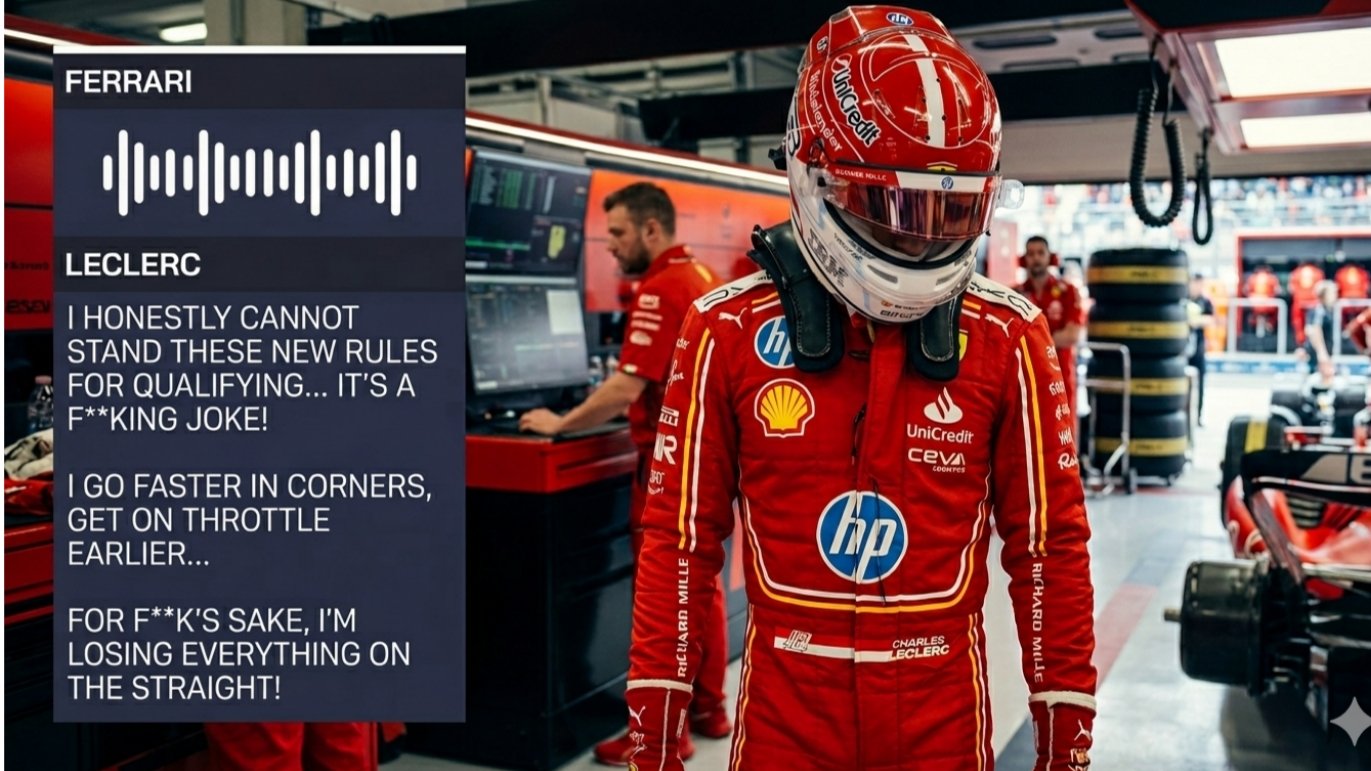
Charles Leclerc reacts to his P4 qualifying result at the 2026 Japanese Grand Prix, citing major frustrations with the new energy management regulations.
Published by: AutodromeF1 Editorial Team
Suzuka, Japan 28 March- In the high-stakes theatre of Formula 1, where the margins between glory and grievance are measured in thousandths of a second, raw emotion often broadcasts the most unfiltered truths. Today at the iconic Suzuka International Racing Course, the qualifying session for the Japanese Grand Prix culminated in a moment of visceral frustration from Ferrari’s Charles Leclerc, a cry of exasperation that echoed far beyond the confines of his cockpit and laid bare the intricate, often maddening, challenges of the sport’s new 2026 regulatory era.
After securing a P4 on the grid, a result that would be respectable for many but is a profound disappointment for a driver of his calibre, Leclerc’s radio transmission to the Ferrari pit wall was a cocktail of fury and disbelief. “I honestly cannot stand these new rules for qualifying… it’s a
fking joke!” he exclaimed, the transmission crackling with an intensity that transcended the electronic medium. “I go faster in corners, get on throttle earlier… For fk’s sake, I’m losing everything on the straight!”
This was not the calculated complaint of a driver seeking a scapegoat. It was the primal scream of a master craftsman who feels his finest work is being undone by forces beyond his control. Leclerc, a pilot renowned for his sublime ability to dance on the very edge of adhesion and extract every ounce of performance from his machinery, particularly over a single flying lap, found himself grappling with a paradox that has come to define the 2026 season: the driver can be perfect, yet the car can be fundamentally compromised.
To understand the depth of his frustration, one must delve into the radical technical overhaul that has reshaped the pinnacle of motorsport. The 2026 regulations were designed to usher in a new age of sustainability and road relevance, mandating a power unit architecture that derives approximately 50% of its power from a vastly more potent electrical system and 50% from a simplified internal combustion engine (ICE) running on fully sustainable fuels. The MGU-K (Motor Generator Unit – Kinetic) is now a titan, capable of deploying nearly 350 kW of electrical power. However, the energy available to be deployed is finite, governed by strict regulations on how much can be harvested and used per lap.
This has transformed the art of the qualifying lap. Previously a flat-out, pedal-to-the-metal sprint where drivers pushed every physical and mechanical limit, qualifying is now a complex, cerebral exercise in energy management—an intricate dance of “lift and coast” and strategic deployment. It has become, as many in the paddock have termed it, an “energy-management puzzle.” A driver must decide where on the circuit to deploy their precious electrical energy for maximum gain and where to conserve it, all while navigating the track at breathtaking speed.
Leclerc’s outburst highlights the cruel dilemma this presents. His message reveals that through Suzuka’s legendary Esses and the Degner curves, his SF-26 was a formidable weapon. He was braking later, carrying more speed through the apex, and—critically—getting on the throttle earlier on exit. These are the hallmarks of a car with immense mechanical grip and a driver in perfect harmony with it. In a previous era, this advantage in the twisty sections would have translated into a dominant lap time.
But in 2026, that very act of getting on the power early, of using the ICE to its full potential, can be a strategic disadvantage. The Ferrari’s inherent strength in the corners was seemingly forcing a compromise that left Leclerc a sitting duck on Suzuka’s long straights, most notably the 1.2km back straight between the Spoon Curve and the infamous 130R. While his rivals—particularly Kimi Antonelli, who delivered a stunning pole position for Mercedes, over half a second clear of Leclerc—were managing their energy to ensure a powerful deployment for the entire length of the straight, Leclerc felt his own electrical reserves bleeding away, leaving him exposed and hemorrhaging lap time. He was winning the battles in the corners but losing the war on the straights.
This issue is not a new one for the Maranello-based squad in 2026. The SF-26 has consistently shown formidable pace in race simulations and through challenging, high-downforce sectors. Yet, this has been repeatedly offset by a glaring deficit in qualifying trim, where the optimization of energy deployment for a single, perfect lap has proven to be the team’s Achilles’ heel. It’s a narrative of a car with a brilliant chassis that is being fundamentally hamstrung by its power unit’s operational philosophy.
The situation was further complicated by a late intervention from the sport’s governing body, the FIA. Responding to a chorus of driver complaints that the extreme level of energy management required was detracting from the “pure driving challenge” of qualifying, the FIA implemented a last-minute directive for the Suzuka weekend, reducing the maximum amount of energy that could be recharged per lap from 9.0 MJ to 8.0 MJ. The intention was to reduce the necessity for aggressive lift-and-coast tactics and allow drivers to push harder for longer. While the tweak was welcomed, Leclerc’s radio message is damning evidence that, for Ferrari, it was merely a sticking plaster on a more profound wound. It may have helped, but it clearly wasn’t enough to solve the core problem.
For Leclerc, the situation must be doubly agonizing. He has built his reputation on being a qualifying virtuoso, a “laptime magician.” His career is studded with poles that seemed to defy the perceived limitations of his machinery. To now find himself in a car that penalizes his very strengths—his ability to attack the corners and get on the power aggressively—is a cruel irony. His frustration is not just about a single P4; it’s an existential crisis for a driver whose identity is so deeply intertwined with the art of the qualifying lap.
As the sun sets over Suzuka, the stage is now set for a race of redemption. Starting from the second row, Leclerc will have a chance to prove that the SF-26’s strengths in race trim are as significant as its weaknesses in qualifying. In the race, energy management is a different game—a marathon, not a sprint. The strategy revolves around sustained pace, tyre degradation, and tactical deployment over many laps. Here, the Ferrari’s kindness to its tyres and its formidable pace in the twisty middle sector could become potent weapons.
From P4, Leclerc is perfectly placed to hunt for a podium. He will be on the attack from the moment the lights go out, channeling the white-hot frustration from today’s qualifying session into a focused, aggressive race performance. The battle with the Mercedes of Antonelli and the other front-runners will be a fascinating strategic chess match, a direct comparison of different car philosophies. Can Ferrari’s prowess in the corners overcome its straight-line speed and energy deployment deficit over 53 laps?
Tomorrow’s race is more than just another Grand Prix; it is a crucial test for both Charles Leclerc and Scuderia Ferrari. It is an opportunity to prove that their 2026 contender is a true challenger, not just a qualifying conundrum. For Leclerc, it is a chance to silence the demons of doubt and reaffirm that, no matter the regulations, a true champion can always find a way to fight at the front. The pain was palpable in his voice today, but as every follower of motorsport knows, for a driver like Charles Leclerc, that pain is often the most powerful fuel of all.


