Published by: AutodromeF1 Editorial Team
In a Masterful Display of Resilience and Adaptation, Lewis Hamilton Secures His first Ferrari Podium at the 2026 Chinese Grand Prix, Emphatically Silencing Retirement Speculation
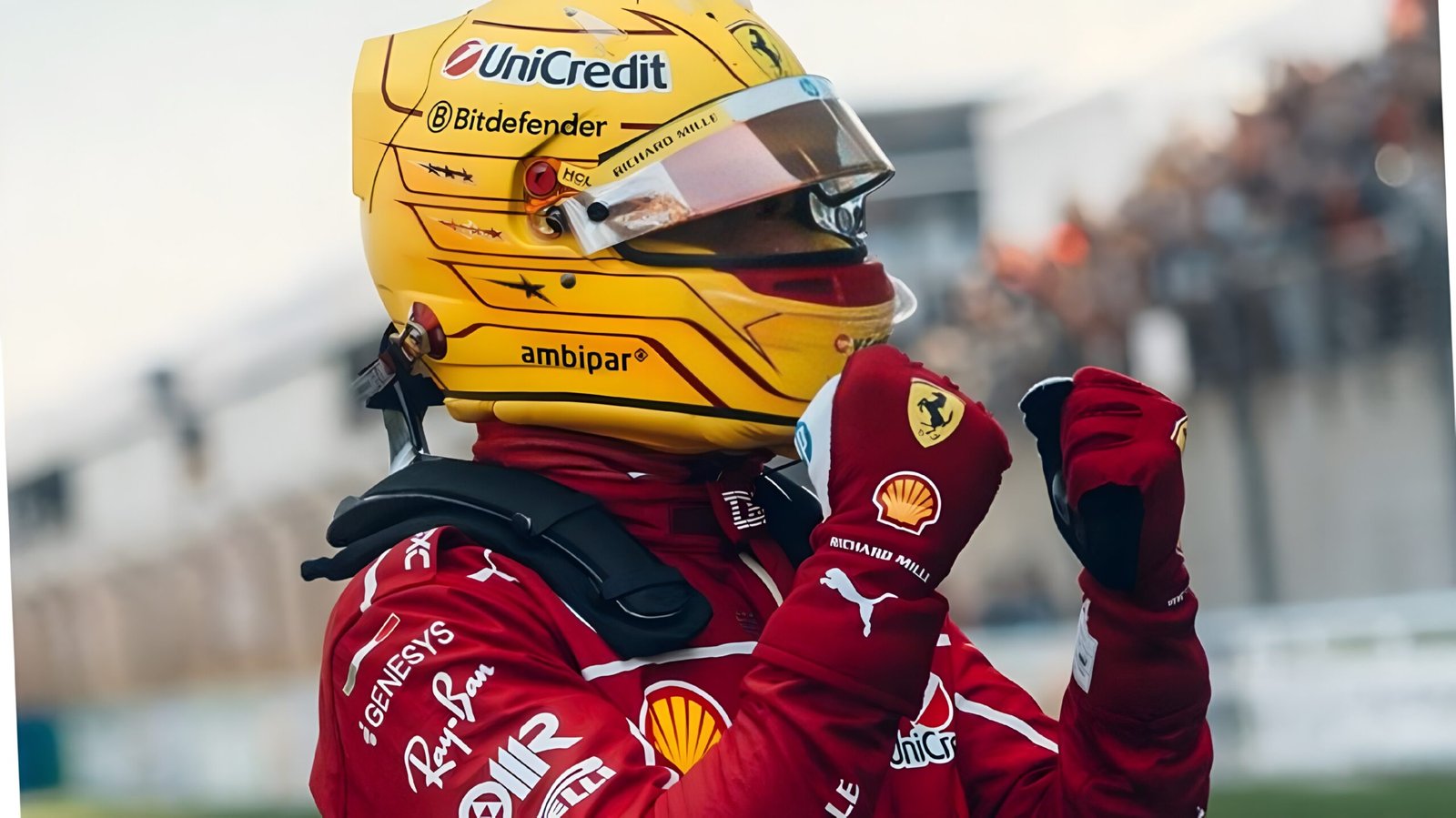
In the crucible of the Shanghai International Circuit, where the echoes of Formula 1’s evolving era reverberate through the revamped regulations, Sir Lewis Hamilton has once again rewritten the narrative of his illustrious career. Finishing third in the 2026 Chinese Grand Prix, the seven-time World Champion claimed his first podium finish in Ferrari scarlet after 26 painstaking starts with the Italian marque. This achievement not only marked his 203rd career podium but also represented a profound vindication amid swirling doubts about his competitive future at the age of 41.
The result unfolded against a backdrop of Mercedes dominance, with rookie sensation Kimi Antonelli securing a maiden victory from pole position, followed by his teammate George Russell in second. Yet it was Hamilton’s intra-team duel with Charles Leclerc that captivated observers and underscored the renewed dynamism within Scuderia Ferrari. For much of the afternoon, the two Ferrari drivers engaged in a thrilling, wheel-to-wheel contest characterised by precision, respect, and unwavering intensity. Hamilton ultimately prevailed by a narrow margin, crossing the line ahead of his teammate and injecting a palpable sense of momentum into a squad that had endured a challenging transition period in 2025.
This podium did not materialise in isolation. It followed a season in which Hamilton’s adaptation to the Prancing Horse had been fraught with difficulties. In 2025, his debut year with Ferrari yielded just a solitary sprint victory in Shanghai, accompanied by consistent struggles to match Leclerc’s pace in the Grand Prix format. Such performances fuelled persistent speculation that the move from Mercedes—his home for over a decade—might signal the twilight of a legendary tenure. Whispers of retirement grew louder, with some pundits suggesting that 2026 could serve as a farewell lap for the most decorated driver in the sport’s history. The narrative painted a picture of a champion confronting the inexorable passage of time, potentially overshadowed by younger talents and the complexities of a new technical landscape.
Yet the events in Shanghai have decisively countered that narrative. Hamilton’s drive was nothing short of brilliant: a rocket start propelled him into an early lead, showcasing the improved launch characteristics of the SF-26 under the 2026 regulations. Although tire management and the superior straight-line speed of the Mercedes duo eventually relegated him from the front, his ability to maintain pressure and outmanoeuvre Leclerc in the closing stages spoke volumes about his enduring class. Post-race, Hamilton appeared visibly invigorated, describing the contest as one of the most enjoyable races of his career. He expressed profound gratitude to the Ferrari team at Maranello for providing a competitive platform, while offering warm congratulations to Antonelli, the 19-year-old who had assumed his former seat at Mercedes. “I’m back to my best,” Hamilton declared, attributing his resurgence to both mental and physical recalibration during the off-season, coupled with the new cars’ alignment with his instinctive driving style.
Central to the discourse surrounding this performance has been the insightful commentary from former Formula 1 driver and respected analyst David Coulthard. Speaking on the Up to Speed podcast, Coulthard lauded Hamilton’s effort as irrefutable evidence that the champion “is not finished” in Formula 1. He emphasised how the podium, achieved at an age when many contemporaries have long since stepped away, demonstrates not merely survival but genuine competitiveness. Coulthard highlighted Hamilton’s visible happiness and seamless adaptation to the 2026 regulations—characterised by enhanced active aerodynamics, sustainable power units, and revised chassis dynamics—as key factors in silencing the retirement chatter. “This drive proves the fire remains,” Coulthard observed, noting that the result counters the doubts that proliferated after Hamilton’s relatively subdued 2025 campaign. In Coulthard’s view, the podium represents more than a statistical milestone; it reaffirms Hamilton’s capacity to evolve alongside the sport’s technological shifts, much as he has done throughout his two-decade odyssey.
The 2026 regulations, introduced to foster closer racing and greater sustainability, have evidently played a pivotal role in this renaissance. Unlike the previous generation of cars, which often demanded aggressive tire management and raw power that occasionally exposed age-related nuances in reaction times, the new machinery appears to reward Hamilton’s renowned smoothness and strategic acumen. Observers have noted his improved qualifying performances—edging Leclerc in Shanghai—and a more harmonious integration with the Ferrari engineering philosophy. This adaptation stands in stark contrast to the struggles of 2025, where the SF-25’s characteristics occasionally hindered his ability to extract maximum potential. The result in China thus illuminates a broader truth about elite athletes: true greatness often manifests not in unyielding dominance but in the capacity to recalibrate when the environment changes.
From a team perspective, Hamilton’s podium injects vital morale into Ferrari’s campaign. After a year in which intra-team tensions and inconsistent results tempered expectations, the sight of both Ferraris contending at the sharp end—albeit behind the Mercedes one-two—signals tangible progress. Leclerc’s fourth-place finish, though overshadowed by Hamilton’s triumph, further bolstered the constructors’ tally, while the on-track battle between the teammates exemplified the healthy rivalry that Scuderia leadership has long sought to cultivate. Team principal Frédéric Vasseur and the engineers at Maranello have every reason to view this weekend as a foundational step toward challenging Mercedes’ early-season supremacy. Hamilton’s post-race radio transmissions and media engagements radiated a renewed sense of purpose, suggesting that the personal and professional alignment he sought upon joining Ferrari is finally coalescing.
Beyond the immediate sporting implications, this achievement invites reflection on Hamilton’s unparalleled legacy. With 203 podiums to his name, he stands alone in the annals of the sport, a figure whose influence extends far beyond lap times and championship tallies. His advocacy for diversity, environmental sustainability, and social justice has redefined what it means to be a modern athlete. At 41, an age when physical demands intensify and public scrutiny amplifies, Hamilton’s refusal to yield to speculation embodies a philosophy of perpetual growth. The 2026 regulations, with their emphasis on efficiency and innovation, mirror his own evolution: from a prodigious talent in the early 2000s to a multifaceted icon who now masters hybrid complexities with the same finesse he once applied to naturally aspirated engines.
Comparisons to other late-career resurgences are inevitable yet instructive. Legends such as Alain Prost and Michael Schumacher navigated similar crossroads, proving that experience can outweigh raw speed when regulations evolve. Hamilton’s case, however, carries unique resonance given the high-profile nature of his Ferrari transition—a move that initially invited scepticism but now appears poised to yield dividends. The emotional weight of sharing the Shanghai podium with Mercedes drivers—his former team and successor—added another layer of poignancy, symbolising the cyclical nature of Formula 1 allegiances.
Moreover, the broader context of the 2026 season underscores the significance of this result. With Antonelli’s victory marking the emergence of a new generation and Mercedes’ one-two affirming their regulatory mastery, the midfield and backmarkers face intensified pressure. Ferrari’s ability to extract podiums through drivers of Hamilton’s calibre could prove decisive in the constructors’ championship. For the sport itself, Hamilton’s continued presence injects star power and narrative depth at a time when sustainability mandates and cost caps are reshaping the competitive landscape. His podium silences not only personal doubters but also those who question the viability of veteran drivers in an increasingly youthful and technologically driven era.
As the Formula 1 caravan departs Shanghai for subsequent rounds, the implications of Hamilton’s performance extend into the foreseeable future. Retirement rumours, once pervasive, have been deferred—if not entirely dispelled—granting fans and analysts alike the opportunity to witness further chapters in an extraordinary story. Coulthard’s podcast assessment resonates as a clarion call: Hamilton’s competitive spirit remains undimmed, his adaptation to the 2026 framework complete, and his contribution to Ferrari’s ambitions substantial. This podium, achieved through grit, tactical nous, and unassailable professionalism, reaffirms why he endures as one of the sport’s most compelling figures.
In an industry often preoccupied with youth and novelty, Lewis Hamilton’s triumph in China serves as a timeless reminder: excellence is not confined by age or affiliation but forged through resilience and an unwavering commitment to mastery. The seven-time champion has not merely returned to the podium; he has reclaimed the narrative, proving once more that in Formula 1, as in life, the greatest stories are those of redemption and renewal. With the season still in its infancy, one anticipates further demonstrations of this revitalised form, as Ferrari and Hamilton pursue ambitions that now appear decidedly within reach.


