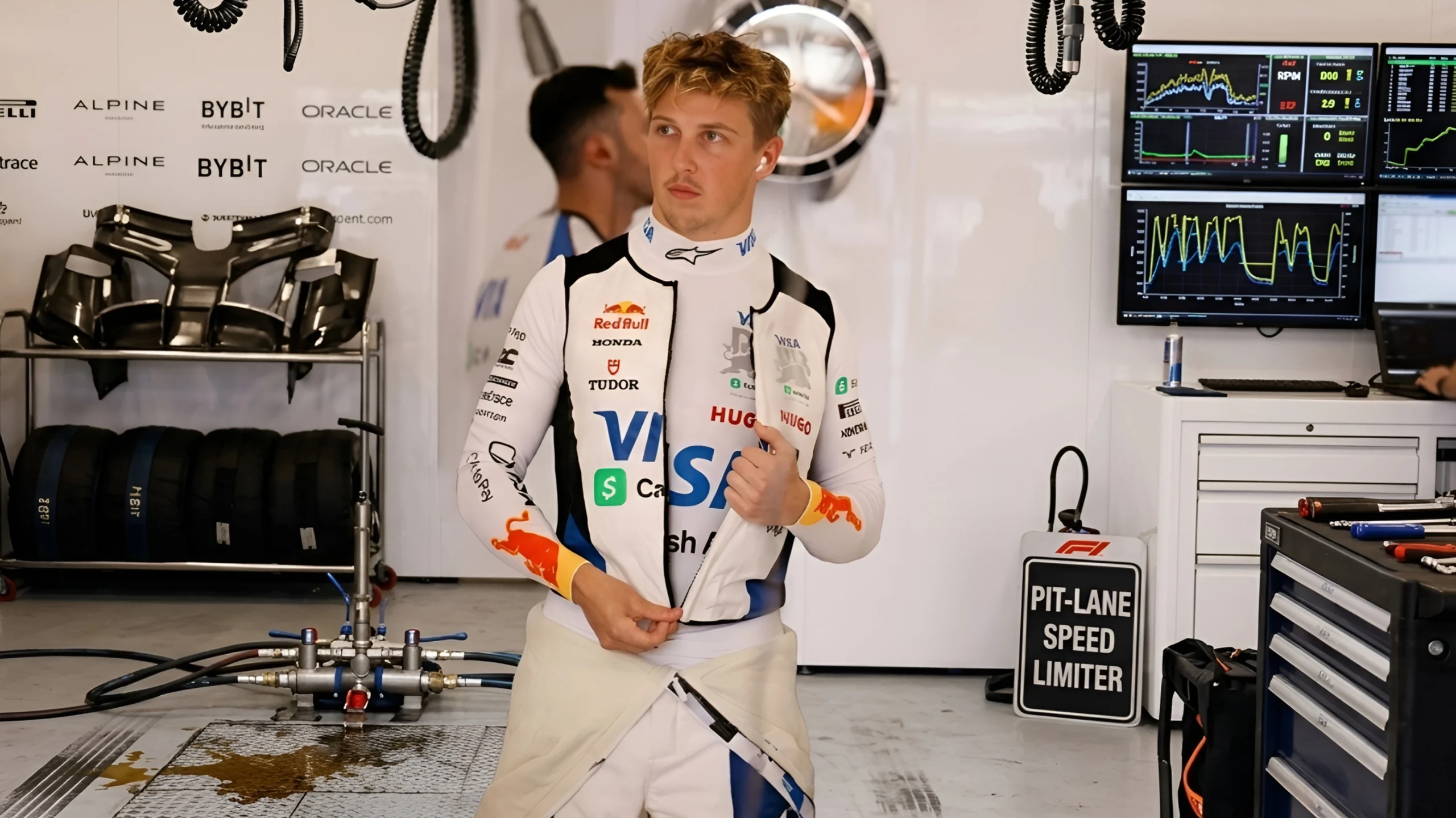
Liam Lawson in the Racing Bulls garage at the 2026 Australian Grand Prix, where power unit failures sparked a major safety debate.
Published by: AutodromeF1 Editorial Team
Liam Lawson Issues Urgent Safety Warning to FIA as 2026 Formula 1 Regulations Expose Critical Vulnerabilities Following Australian Grand Prix Near-Miss
London. 25 March – In the high-stakes crucible of Formula 1, where innovation and peril have long coexisted in a delicate equilibrium, the opening race of the 2026 season has thrust an uncomfortable truth into the spotlight. Racing Bulls driver Liam Lawson, emerging from a harrowing start-line incident at the Australian Grand Prix in Melbourne, has issued a pointed admonition to the sport’s governing body, the Fédération Internationale de l’Automobile (FIA). His message is unequivocal: the newly implemented technical regulations, heralded as a leap toward sustainability and closer competition, harbour latent dangers that could precipitate a catastrophic accident if left unaddressed. This is not mere post-race hyperbole; it is a measured call to action born of first-hand experience and shared apprehension across the grid.
The incident itself unfolded with the clinical precision of a split-second disaster averted. As the lights extinguished at Albert Park, Lawson’s VCARB machine—powered by the revolutionary 2026 specification power unit—faltered dramatically off the line. Bereft of the Motor Generator Unit-Heat (MGU-H) that had previously ensured seamless turbo spooling, the car suffered a sluggish getaway attributable to inconsistent battery priming and the inherent challenges of exhaust-driven turbo revival. Positioned eighth on the grid, Lawson’s vehicle became an unwitting stationary hazard amid the accelerating pack. Franco Colapinto, starting 16th in his Alpine, reacted with extraordinary reflexes, swerving sharply to thread an impossibly narrow corridor between Lawson’s crawling car and the pit wall. Colapinto later described the moment as “very dangerous” and confessed he considered himself “very, very lucky” to have avoided what would have been a high-speed, high-consequence collision. Lawson, for his part, admitted to bracing for impact while monitoring his mirrors, only to emerge unscathed as his car plummeted to 18th place before recovering to finish 17th.
Yet this near-miss was no isolated anomaly. It served as a visceral manifestation of systemic frailties embedded within the 2026 regulations, which represent the most profound overhaul of Formula 1’s power units since the hybrid era commenced in 2014. Central to these changes is the complete elimination of the MGU-H, a device that once harvested thermal energy from exhaust gases while simultaneously mitigating turbo lag. In its absence, the power unit’s architecture relies exclusively on an enhanced Motor Generator Unit-Kinetic (MGU-K) for energy recovery, now tasked with doubling the recoverable energy per lap to 8.5 megajoules—sourced predominantly from braking or lift-off phases. This shift, while advancing environmental credentials through greater electrification and 100 per cent sustainable fuels, has introduced pronounced inconsistencies in power delivery and vehicle behaviour.
Compounding these dynamics is the introduction of Straight-Line Mode (SLM), a driver-activated system that deploys adjustable aerodynamics—effectively opening the rear wing to minimise drag on designated straights. In isolation, SLM promises enhanced overtaking opportunities and efficiency gains. However, when coupled with abrupt battery recharging cycles, it generates sudden and unpredictable velocity differentials. Telemetry from early-season running indicates that a car transitioning into recharge mode can shed between 30 and 50 kilometres per hour almost instantaneously. For a pursuing driver operating in SLM with full deployment, the closing rate becomes unforgiving, leaving scant milliseconds for evasive action—particularly in traffic-dense scenarios or during the frenetic opening laps when energy management strategies diverge sharply between teams.
Lawson’s post-race commentary distilled the peril with clinical clarity. “If the car ahead suddenly starts recharging while you’re right behind them with SLM open, it’s almost impossible to avoid contact,” he observed. He emphasised the variability in energy deployment maps across manufacturers, noting that such disparities render proactive anticipation “almost impossible” in real-time conditions. Rather than apportioning blame to any single constructor or team, the New Zealander placed the onus squarely on the FIA: “We will give our opinions, but it’s up to the regulators to decide what changes are made.” His remarks underscore a collective driver sentiment that the regulations, while ambitious in their pursuit of a 50:50 split between internal combustion and electrical power, have inadvertently prioritised theoretical efficiency over practical safety margins.
This perspective resonates beyond Lawson’s cockpit. Multiple competitors have voiced parallel reservations, albeit with varying degrees of emphasis. Colapinto’s immediate relief at having navigated the start-line gauntlet was tempered by a broader warning; he even floated the provocative notion of adopting NASCAR-style spotters to monitor energy status and relay real-time alerts—a radical departure from Formula 1’s driver-centric ethos. McLaren team principal Andrea Stella, reflecting on preseason concerns now validated in race conditions, has urged the FIA to “do more” to refine start procedures and energy protocols. Meanwhile, established figures such as Max Verstappen and Lando Norris have critiqued the “artificial” racing dynamic fostered by these rules, suggesting that while overtaking may proliferate on paper, the resultant unpredictability erodes the organic flow that defines elite motorsport. Sergio Perez, observing the replay, echoed Lawson’s alarm, forecasting a “massive shunt” unless interventions materialise promptly.
To appreciate the gravity of these concerns, one must contextualise them within Formula 1’s storied yet cautionary history of regulatory evolution. The transition to hybrid power in 2014 similarly provoked initial teething issues—most notably turbo lag and thermal management—but the MGU-H’s presence ultimately stabilised performance. The 2022 return to ground-effect aerodynamics, by contrast, demanded meticulous ride-height calibration to avert porpoising-related safety risks. The 2026 framework, however, amalgamates greater electrical dependency with the deliberate removal of a proven stabilising technology, all while amplifying energy throughput. Engineers across the paddock acknowledge that the MGU-K’s expanded remit places unprecedented demands on braking systems and battery thermal envelopes, potentially exacerbating inconsistencies under variable race conditions such as differing track temperatures or fuel loads.
From a psychological standpoint, the implications extend beyond mere mechanical reliability. Formula 1 drivers operate at the apex of human reaction times, yet even the most gifted reflexes falter when confronted with stochastic variables. The cognitive load of monitoring energy status, SLM activation, and rival behaviour simultaneously risks inducing decision fatigue, particularly in the opening phase of a Grand Prix when adrenaline peaks and visibility is compromised by spray or proximity. Should an incident escalate to involve higher-speed sections—such as the long straights of circuits like Monza or Baku—the consequences could transcend bent metal to encompass severe injury or worse. In an era when the sport justifiably celebrates its safety advancements—halo devices, HANS systems, and virtual safety cars among them—this regression in predictability represents a profound irony.
The FIA, to its credit, has signalled an intent to monitor developments closely, with indications that a comprehensive review may follow the Chinese Grand Prix rather than precipitous mid-season alterations. Potential remedies under consideration include standardised energy deployment templates, refined SLM activation protocols, or even temporary software overrides to mitigate extreme differentials. Yet any intervention must navigate a treacherous trilemma: preserving the regulations’ core sustainability objectives, maintaining competitive parity among power-unit suppliers, and safeguarding the drivers who animate the spectacle. Over-correction risks stifling the very innovation that drew new manufacturers—such as Audi and Ford—into the fray, while inaction could undermine the sport’s hard-won reputation for prudent risk management.
Ultimately, the 2026 regulations embody Formula 1’s perennial ambition to reconcile cutting-edge technology with environmental stewardship and spectator engagement. The enhanced energy recovery systems, the shift toward greater electrification, and the aerodynamic innovations were conceived to propel the series into a greener future while delivering wheel-to-wheel racing that captivates global audiences. Yet, as Lawson’s warning illuminates, the devil resides in the dynamic interplay of these elements on the asphalt. The Australian Grand Prix served not as a damning indictment but as an early diagnostic—a moment when the theoretical met the visceral. Whether the FIA responds with targeted refinements or broader recalibrations will determine if these regulations evolve into a triumph of forward-thinking engineering or a cautionary chapter in the annals of safety oversight.
As the season progresses toward Shanghai and beyond, the eyes of the paddock—and indeed the wider motorsport community—remain fixed on the unfolding dialogue between drivers, teams, and regulators. Formula 1 has repeatedly demonstrated its capacity to adapt: from the post-Imola reforms of 1994 to the halo’s introduction after Jules Bianchi’s tragedy. The current juncture demands that same blend of humility and resolve. For in the final analysis, no technological leap, however visionary, justifies compromising the fundamental covenant that underpins the sport: the unwavering primacy of human safety amid the pursuit of speed. The coming weeks will reveal whether the 2026 regulations can be harmonised with this imperative, ensuring that the roar of the engines continues to echo not with foreboding, but with unbridled confidence in the road ahead.


