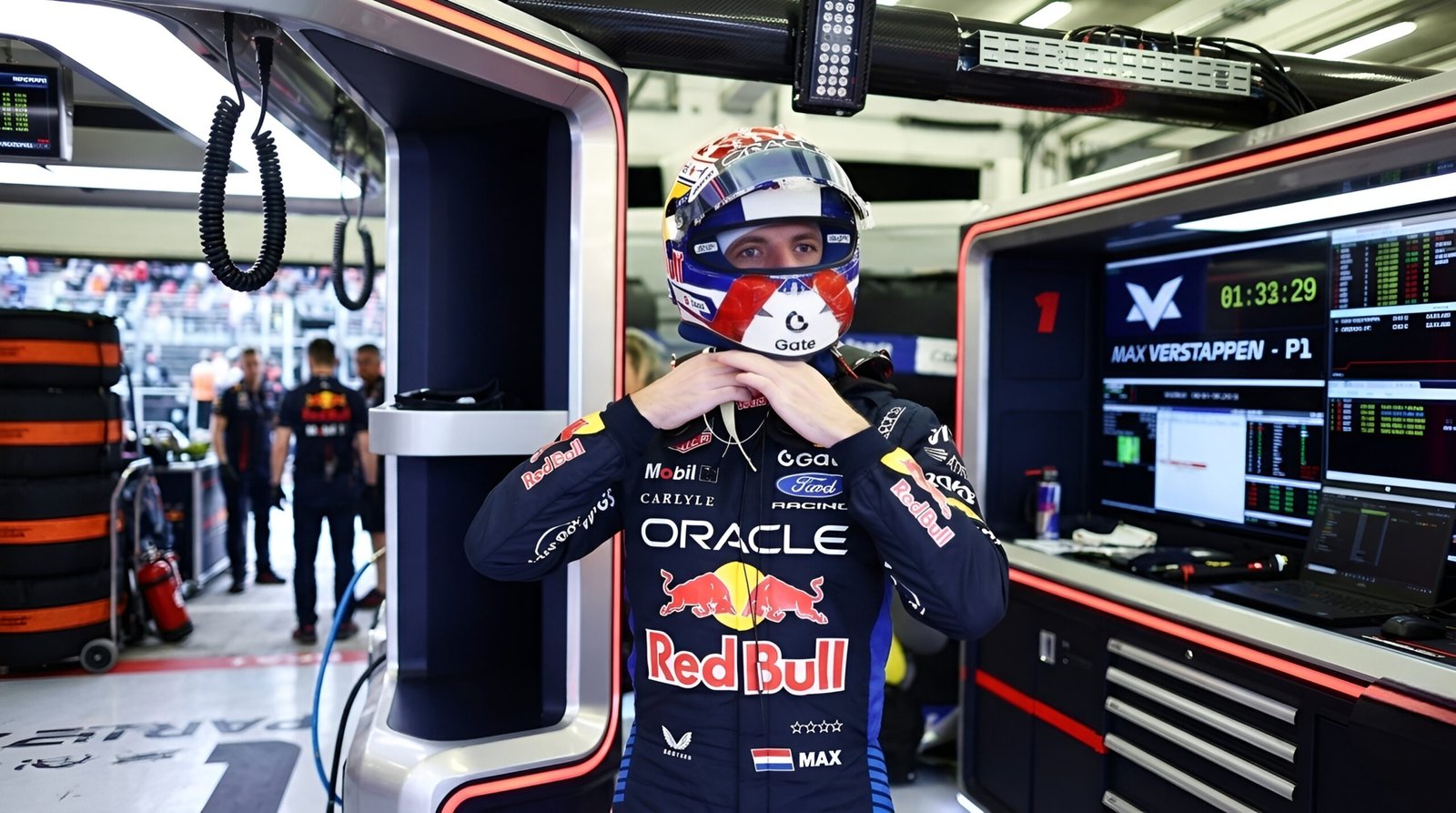
Max Verstappen prepares for the 2026 Japanese Grand Prix at Suzuka, amidst growing speculation regarding his future in Formula 1 and his frustration with the new Red Bull Ford technical package.
Published by: AutodromeF1 Editorial Team
Max Verstappen’s Pivotal Moment: A Champion’s Unvarnished Assessment of Formula 1’s Demands in the 2026 Regulatory Landscape
Suzuka, Japan – 30 March 2026
In the immediate aftermath of the Japanese Grand Prix at Suzuka Circuit, four-time Formula 1 World Champion Max Verstappen delivered a statement that has reverberated across the paddock, the boardrooms of governing body the Fédération Internationale de l’Automobile (FIA), and the global motorsport community. Finishing eighth in a race he had dominated in previous seasons, Verstappen not only saw his personal winning streak at the revered Japanese venue end but also gave voice to a deeper, more existential discontent. His words, spoken with characteristic candour to broadcasters immediately after stepping from the cockpit, have crystallised a conversation that extends far beyond one difficult weekend: the sustainability of elite athletic commitment when passion wanes and personal priorities sharpen.
Verstappen’s remarks were neither impulsive nor isolated. “Privately I’m very happy,” he began, before pivoting to the calendar’s relentless rhythm. “You also wait for 24 races. This time it’s 22. But normally 24. And then you just think about is it worth it? Or do I enjoy being more at home with my family? Seeing my friends more when you’re not enjoying your sport?” The brevity of the statement belies its weight. Delivered in the sterile glow of the media pen, it encapsulated the psychological toll exacted by a 22-race season compressed into nine months, the logistical rigours of intercontinental travel, and the evolving technical character of the 2026 machinery that many insiders now describe as fundamentally altering the driver’s relationship with the car.
To understand the significance of this moment, one must first examine the broader context of Red Bull Racing’s performance trajectory under the new regulations. The 2026 technical package—mandated by the FIA to enhance sustainability, reduce costs, and recalibrate the balance between internal-combustion power and electrical energy recovery—has introduced a chassis that is lighter, more aerodynamically efficient, and heavily reliant on battery deployment and energy-harvesting systems. While these changes were designed to produce closer racing and lower emissions, early indications suggest they have also diminished the visceral, driver-centric feedback that defined the hybrid era’s peak. Power units now emphasise instantaneous torque management and regenerative braking strategies over outright mechanical grip, leading several senior engineers, including Verstappen’s own father Jos, to characterise the cars as “anti-driving” in their handling characteristics. The result for Red Bull, long the benchmark of aerodynamic sophistication, has been a visible lag in development. What was once a dominant ground-effect package has struggled to extract consistent performance from the revised powertrain architecture, placing Verstappen in unaccustomed midfield battles.
This technical dislocation is not merely a matter of lap times. For a driver whose competitive identity has been forged through instinctive, aggressive car control, the shift represents a profound loss of agency. Verstappen has repeatedly emphasised that the joy of racing derives from the synergy between human input and mechanical response. In recent weeks he has spoken of the car feeling “disconnected,” a sentiment echoed—albeit more diplomatically—by team principal Christian Horner and chief technical officer Pierre Wache. The eighth-place finish at Suzuka, on a track historically suited to Red Bull’s strengths, served as a public exclamation point on private frustrations that have been building since pre-season testing in Bahrain.
Yet the technical narrative, while central, is only one strand of Verstappen’s reflection. A more personal dimension has emerged since his transition to fatherhood. Since the birth of his daughter with partner Kelly Piquet, Verstappen has been unequivocal about reordering his priorities. In multiple public forums he has stated that family time now supersedes the pursuit of additional championships. This is not rhetorical flourish; it is a consistent philosophical stance articulated by a man who, at 28, has already secured every major accolade the sport can offer. Four world titles, 60-plus Grand Prix victories, and a record of resilience forged in the crucible of intra-team rivalry with Sergio Pérez and earlier battles against Lewis Hamilton and Charles Leclerc have granted him the rare luxury of perspective. When the intrinsic pleasure of driving evaporates, the calculus changes. “Racing is fun only when the passion is there,” he has said on prior occasions. The 2026 season appears to be testing that threshold.
The calendar itself compounds the strain. Formula 1’s expansion to 24 races in recent years—intended to maximise global reach and commercial revenue—has imposed an unprecedented physical and mental load. Time-zone shifts, hotel living, and the constant pressure of media obligations leave scant room for recovery or normalcy. For Verstappen, whose off-track life in the Netherlands and Monaco is deliberately low-key and centred on close relationships, the contrast is stark. The question he posed—“is it worth it?”—is one that resonates with any high-achieving professional confronting the trade-off between legacy and lived experience. It is a question that elite athletes in other disciplines, from tennis to football, have increasingly asked aloud in recent years as wellness and longevity discourses gain prominence.
Speculation regarding Verstappen’s long-term future has intensified. His current Red Bull contract extends to the end of 2028, yet it contains performance-related exit clauses that become active should the team fail to deliver a competitive car. Industry analysts note that a departure at the close of 2026 would allow him to exit at the height of his powers, still chronologically young yet chronologically seasoned. Such a move would not be unprecedented; Kimi Räikkönen and Nico Rosberg both walked away while competitive, citing personal fulfilment. Verstappen himself has never hidden his admiration for drivers who prioritise mental health over contractual obligation. Should Red Bull’s recovery falter through the European summer, the narrative of voluntary retirement will only gather momentum.
From a governance perspective, Verstappen’s candour arrives at a critical juncture for the FIA and Liberty Media. The 2026 regulations were conceived to future-proof the sport amid environmental scrutiny and shifting audience demographics. Yet early feedback from drivers and teams alike suggests an unintended consequence: a dilution of the very spectacle that sustains fan engagement. The emphasis on energy management has produced races where strategic tyre preservation and battery deployment often eclipse outright speed and overtaking prowess. If the cars continue to feel “clinical” rather than exhilarating, the risk is not only driver dissatisfaction but also a gradual erosion of the sport’s emotional core. Verstappen’s words therefore serve as an early warning rather than a singular complaint.
It is instructive to compare this episode with historical precedents. Ayrton Senna once spoke of the “abyss” that opens when motivation deserts a champion; Michael Schumacher, in retirement, reflected on the necessity of total immersion. What distinguishes Verstappen is the transparency with which he navigates the tension. Unlike predecessors who maintained public stoicism until the moment of withdrawal, he has chosen to articulate the internal dialogue in real time. This authenticity enhances his stature rather than diminishing it. In an era of carefully managed athlete branding, his willingness to expose vulnerability reads as strength.
The reaction within the paddock has been measured but telling. Mercedes team principal Toto Wolff described the comments as “a wake-up call for all of us,” while Ferrari’s Fred Vasseur acknowledged the need to ensure the new regulations deliver “driving pleasure alongside performance.” Even rival drivers have offered sympathetic nods; Lando Norris, himself a father-to-be, noted the universal challenge of reconciling elite sport with family life. Meanwhile, Red Bull’s engineering brain trust has reportedly accelerated development programmes targeting the Austrian Grand Prix in June, recognising that sustained underperformance could accelerate Verstappen’s decision timeline.
Beyond the immediate competitive implications lies a deeper cultural question for Formula 1. The sport has long prided itself on being the pinnacle of human-machine endeavour. If that pinnacle now demands such profound personal sacrifice that even its most decorated exponent questions the return on investment, then a recalibration may be necessary. Shorter seasons, enhanced travel support, or further regulatory tweaks to restore mechanical engagement are all under quiet consideration. Yet none of these solutions can substitute for the internal fire that Verstappen once described as “the thing that makes you get up at 5 a.m. and still smile.”
Verstappen’s legacy is already secure. He has redefined what it means to be a modern champion: ferocious on track, disarmingly honest off it. Whether he continues that journey through 2027 and beyond, or elects to step away while the fire still smoulders rather than extinguishes entirely, will be determined in the coming months. What is certain is that his latest intervention has elevated the discourse from lap-time analysis to something more profound: the human cost of excellence in an unforgiving global arena.
As the 2026 season unfolds, the eyes of the motorsport world will remain fixed on Verstappen’s cockpit—not merely for the results it produces, but for the authenticity it continues to project. In an industry often criticised for its corporate gloss, his voice remains a rare constant: unfiltered, unafraid, and, above all, human. Formula 1 would do well to listen. The champion who once seemed invincible has reminded everyone that even the greatest drivers are, ultimately, men with families, friends, and finite reserves of joy. How the sport responds may define its trajectory for the remainder of the decade.


