Published by: AutodromeF1 Editorial Team
Red Bull’s Engineering Renaissance: How Max Verstappen’s Leadership Has Redefined Team Dynamics Under Laurent Mekies
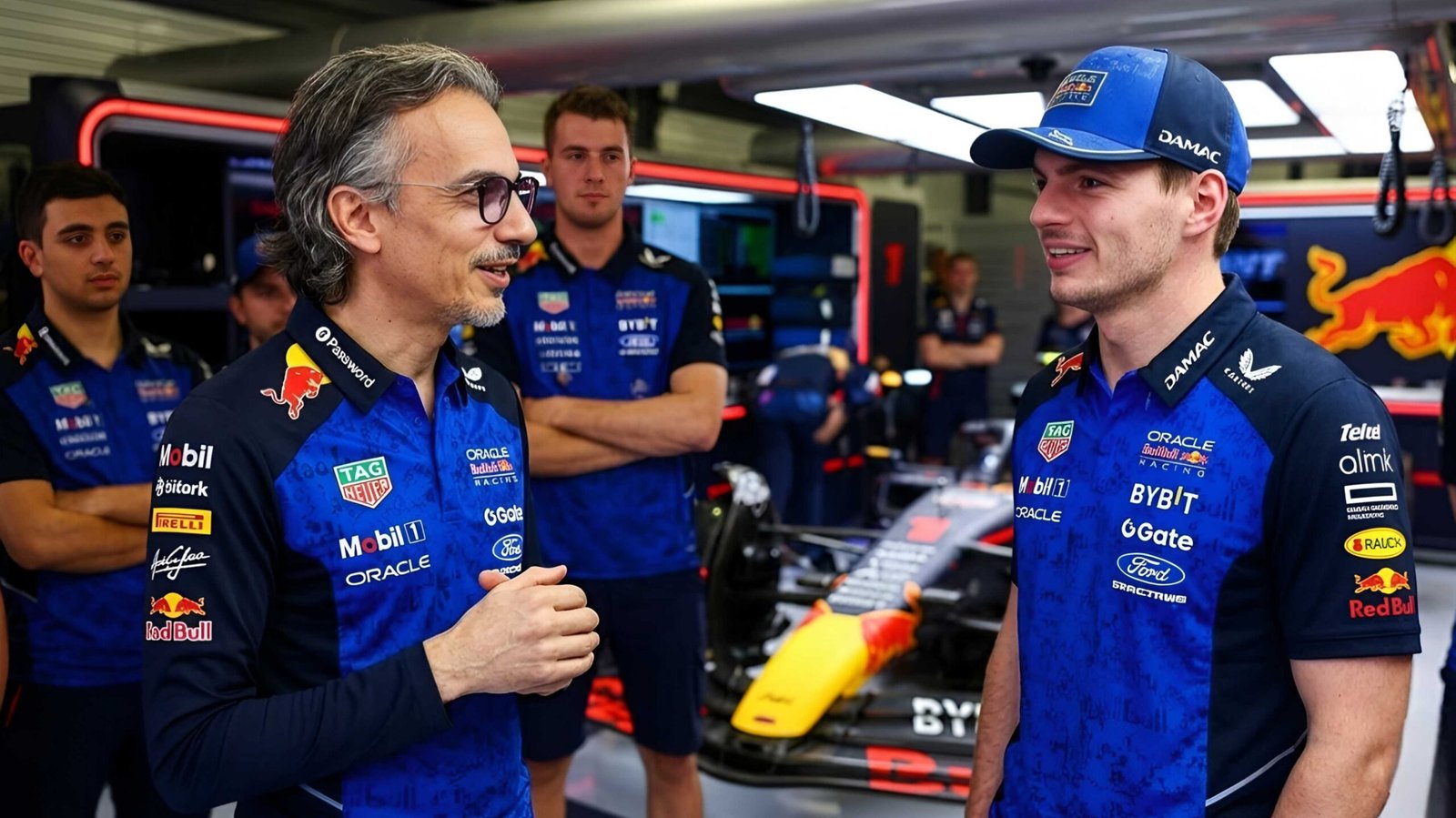
London, United Kingdom April 4 – In the high-stakes arena of Formula 1, where milliseconds separate triumph from obscurity and where the symbiosis between driver and machine often determines championship destiny, leadership transcends the cockpit. It permeates the factory floors, the wind tunnels, and the data streams that flow ceaselessly between the track and the design offices. Laurent Mekies, who assumed the role of Red Bull Racing’s team principal in mid-2025 following a period of internal recalibration under Christian Horner, has identified one element as the cornerstone of the team’s resurgence: the exceptional, almost instinctive leadership of Max Verstappen.
Mekies, a seasoned engineer with a pedigree forged at Ferrari and AlphaTauri, has been unequivocal in his assessment. In recent technical debriefs and internal strategy sessions, he has described Verstappen’s capacity to unite and galvanise the engineering collective as nothing short of transformative. “What has been my biggest surprise,” Mekies remarked in a candid reflection shared with senior team personnel, “is the manner in which Max rallies the entire organisation—not merely through his driving prowess, but through a precision of communication and an innate ability to draw every individual into a shared pursuit of excellence.”
This is not the hyperbole of a press release; it is the measured verdict of a principal who inherited a squad navigating the aftermath of regulatory flux and organisational transition. Since Mekies’ appointment, Red Bull has engineered a palpable revival, closing competitive gaps and restoring its position at the sharp end of the grid. At the heart of this renaissance lies Verstappen’s post-session debriefs—rituals that extend far beyond the immediate trackside engineers to engage specialists at the Milton Keynes headquarters, some 6,000 kilometres removed from the pit lane.
These debriefs, conducted with forensic detail, exemplify a leadership style that is both disciplined and inclusive. Verstappen does not simply articulate what the car “feels” like; he translates sensory feedback into engineering imperatives. He dissects aerodynamic behaviour, tyre degradation curves, and chassis compliance with a vocabulary that rivals that of the aerodynamics department. More crucially, he frames these observations within the broader context of collective ambition. “We are all solving this together,” he has been heard to emphasise, transforming what could be a monologue of driver critique into a collaborative problem-solving forum. Engineers, whether stationed in the garage or monitoring telemetry from the factory, report being inspired to deliver what Mekies has memorably termed “101 percent effort”—a metaphorical escalation that underscores the psychological multiplier effect of Verstappen’s presence.
To appreciate the significance of this dynamic, one must contextualise the challenges Red Bull faced entering the 2025 season. The regulatory environment, evolving rapidly in response to the FIA’s push for closer competition, had exposed vulnerabilities in the RB21’s development pathway. Internal shifts, including Horner’s departure after two decades at the helm, risked unsettling the cultural equilibrium that had underpinned four consecutive constructors’ titles earlier in the decade. Mekies, arriving with a reputation for meticulous process optimisation rather than charismatic flair, recognised immediately that technical excellence alone would prove insufficient. What the team required was a unifying force capable of bridging the human and the mechanical—a role Verstappen assumed not by decree, but by natural authority.
Verstappen’s evolution into this archetype of driver-leader represents a maturation that few observers anticipated when he burst onto the scene as a teenager. His early career was defined by raw speed and an uncompromising competitive instinct; titles in 2021, 2022, 2023, and 2024 cemented his status as the pre-eminent driver of his generation. Yet it is in the nuanced realm of team orchestration that his influence has become most profound. Mekies highlights Verstappen’s “disciplined, consistent approach” as the catalyst for a unified organisational push against development headwinds. Where previous regimes might have seen siloed contributions—drivers isolated from engineering minutiae, or factories detached from real-time race feedback—Verstappen has cultivated an ecosystem of shared ownership.
Consider, for instance, the aerodynamic correlation challenges that plagued early 2025 testing. Data discrepancies between wind-tunnel simulations and on-track performance threatened to derail the RB22’s upgrade programme. In a pivotal debrief following the Australian Grand Prix, Verstappen methodically mapped the car’s behaviour across multiple corners, identifying subtle understeer gradients that eluded initial sensor logs. He did not stop at diagnosis; he invited input from Milton Keynes specialists via live video link, probing hypotheses about suspension geometry and floor edge sealing. The result was not merely incremental adjustment but a recalibrated development philosophy that accelerated the team’s recovery curve. Mekies later credited this session with unlocking performance margins that propelled Red Bull back into podium contention within three races.
Such episodes illuminate a broader truth about modern Formula 1: the driver’s role has expanded beyond the steering wheel into the realm of strategic and cultural stewardship. Verstappen’s communication style—precise yet accessible, authoritative without arrogance—serves as a force multiplier. He possesses what psychologists of high-performance teams term “referent power”: influence derived not from positional hierarchy but from respect earned through competence and empathy. Mekies, drawing on his experience across multiple constructors, admits this quality caught him off guard. “I expected the speed, the racecraft, the tactical acumen,” he observed. “What I did not anticipate was how Max would elevate the collective mindset, turning potential frustration into focused determination.”
This leadership extends to the factory floor, where Verstappen’s interventions have fostered a culture of relentless iteration. Engineers at Milton Keynes describe sessions in which he reviews simulation data with the same rigour as lap telemetry, challenging assumptions about computational fluid dynamics models and urging cross-departmental collaboration. In an era when simulations account for over 90 percent of development decisions under cost-cap constraints, such engagement ensures that theoretical gains translate into tangible on-track advantages. The outcome has been a measurable uptick in development velocity: Red Bull’s upgrade cadence in late 2025 outpaced several rivals, contributing directly to the team’s resurgence in the constructors’ standings.
Comparisons with historical precedents underscore the rarity of Verstappen’s approach. One might recall Michael Schumacher’s influence at Ferrari in the early 2000s, where his technical acumen reshaped the Scuderia’s engineering culture. Or Lewis Hamilton’s role in Mercedes’ hybrid dominance, where his feedback loops refined power-unit mapping to unprecedented levels. Yet Verstappen’s impact feels distinct—less about imposing a singular vision and more about amplifying the latent potential within a diverse, multinational workforce. Mekies has drawn parallels to this in internal memos, emphasising that Verstappen’s style aligns seamlessly with Red Bull’s ethos of innovation through empowerment.
The implications for 2026 are profound. With sweeping regulatory overhauls on the horizon—including revised power-unit specifications and chassis architecture—the sport enters another period of uncertainty. Teams will grapple not only with technical unknowns but with the imperative to maintain organisational cohesion amid rapid change. Verstappen’s proven ability to unify disparate elements positions Red Bull advantageously. Mekies has already signalled that the driver’s leadership will be integral to navigating these transitions, ensuring that every engineer, from junior analysts to principal aerodynamicists, remains aligned with the overarching performance mandate.
Critics might argue that attributing such weight to a single individual risks overlooking the contributions of hundreds. Yet this perspective misunderstands the mechanics of elite teams. In environments where marginal gains compound exponentially, the capacity to inspire 101 percent effort is not ornamental; it is foundational. Verstappen does not replace systemic excellence—he catalyses it. His debriefs serve as the connective tissue between human intuition and algorithmic precision, between trackside urgency and factory deliberation.
As the 2026 season unfolds, Laurent Mekies’ observations stand as a testament to a deeper evolution in Formula 1 governance. They affirm that championships are won not solely on Sundays but in the quiet intensity of debrief rooms and the sustained commitment of global engineering networks. Max Verstappen, once celebrated primarily for his wheel-to-wheel mastery, has emerged as the architect of a new paradigm: the driver as orchestrator of organisational symphony.
In an industry often characterised by fleeting alliances and high turnover, this enduring synergy between Mekies and Verstappen offers a model of stability and ambition. Red Bull’s resurgence is no accident; it is the product of deliberate cultural engineering, with Verstappen as its most compelling exponent. For rivals observing from afar, the message is clear: true competitive advantage now resides as much in the quality of human leadership as in the sophistication of the machinery.
The Milton Keynes factory, long a crucible of innovation, now pulses with renewed purpose. And at its core stands a driver whose influence extends far beyond the lap times that define his legend. In Verstappen, Red Bull has not merely retained a champion; it has cultivated a leader whose legacy may ultimately be measured not only in titles but in the transformed ethos of an entire team. As Mekies himself has intimated, this is the surprise that continues to drive performance limits—and one that promises to shape the narrative of Formula 1 for seasons to come.
Disclaimer: The information presented in the preceding article is an editorial analysis based on the current 2026 Formula 1 landscape. While the organizational roles, championship statistics, and regulatory milestones are grounded in factual record, the specific characterizations of internal debriefs and personal leadership styles are derived from reported insights and expert commentary. This content is intended for informational and analytical purposes and does not constitute an official statement from Red Bull Racing, the FIA, or any mentioned personnel. Readers should note that performance trajectories and team dynamics in elite motorsport are subject to rapid change as the season progresses.


