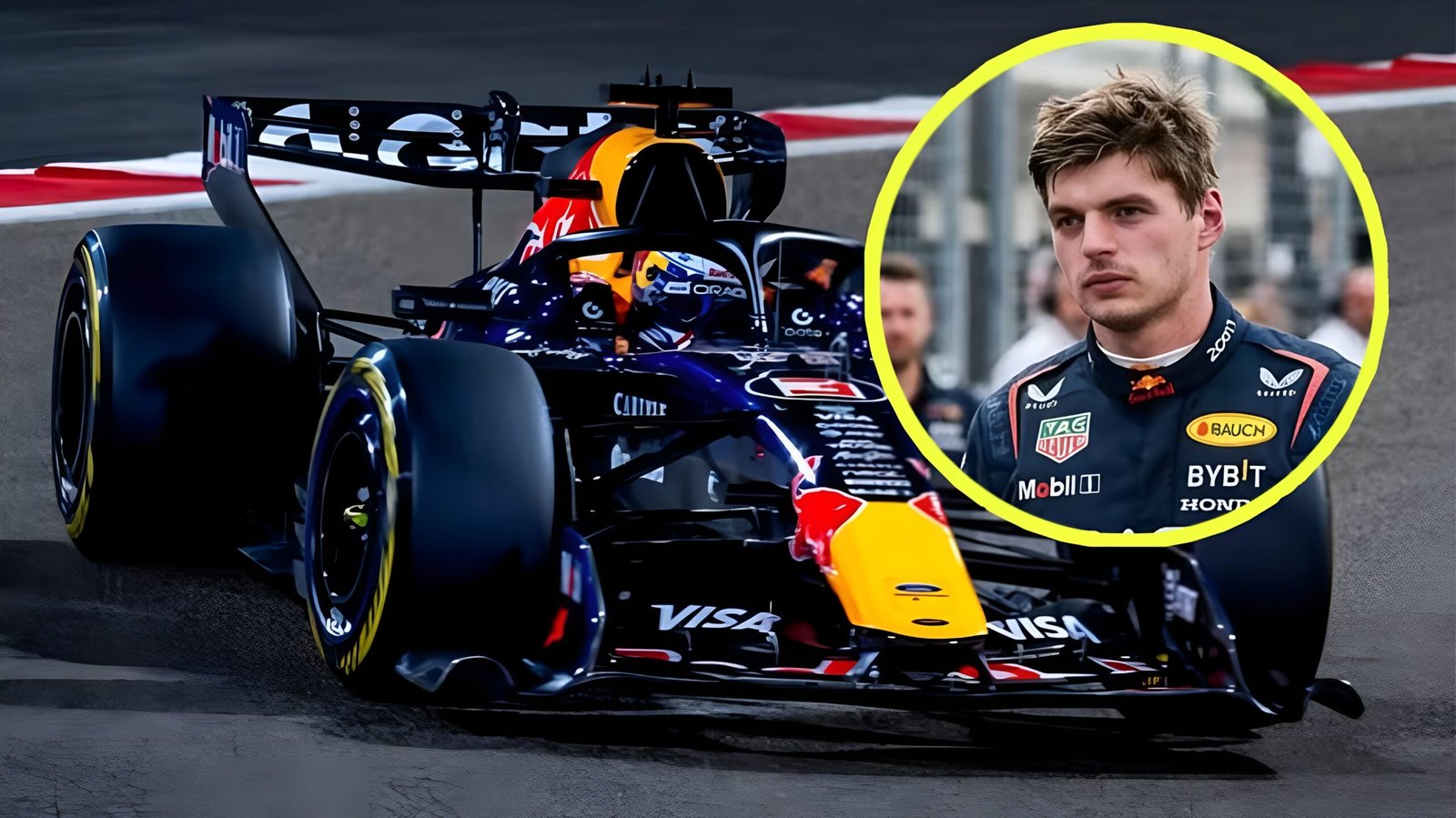
Max Verstappen in the Red Bull RB21 at the 2026 Japanese Grand Prix, sporting his new permanent racing number 3 following a difficult qualifying session at Suzuka.
Published by: AutodromeF1 Editorial Team
Max Verstappen’s #3 Chapter: A Calculated Gamble Meets Early Adversity in the 2026 Formula 1 Season
Suzuka, Japan 29 March – In the high-stakes arena of Formula 1, where every decimal point of performance can redefine legacies, Max Verstappen’s decision to relinquish the coveted #1 plate and adopt the number 3 for the 2026 campaign represents more than a mere cosmetic shift. It signals a deliberate recalibration of identity following one of the most tightly contested title battles in recent memory. Having surrendered the drivers’ championship to McLaren’s Lando Norris by the narrowest of margins in 2025, Verstappen has embraced a personal preference long deferred, one previously associated with his former teammate Daniel Ricciardo. Yet, as the new season unfolds under revised technical regulations, the early evidence suggests that this symbolic transition has coincided with a period of profound operational challenge for Red Bull Racing. The Japanese Grand Prix at Suzuka offered a stark illustration: a rare qualifying setback, vocal frustration from the cockpit, and a midfield recovery that underscored the depth of the team’s current difficulties.
Verstappen’s numerical evolution traces a deliberate arc through his career. From 2015 to 2020, he proudly wore #33—the double-digit embodiment of youthful exuberance and early promise. Upon claiming his first world title in 2021, he ascended to #1, a designation he defended with four subsequent championships through 2025. The 2026 regulations, however, introduced greater flexibility in permanent number selection, enabling drivers to claim single-digit options under specific conditions. After private discussions with Ricciardo, the number’s prior custodian, Verstappen secured #3 on a permanent basis. This was no impulsive choice; the Dutchman has openly expressed a preference for the single digit over the superstitious resonance of 33. Norris, as the newly crowned champion, assumed #1, closing a symbolic circle in the sport’s hierarchy. In an era where personal branding increasingly intersects with competitive machinery, such changes carry psychological weight—affirming continuity for the driver while subtly resetting expectations for the team.
The broader context of Verstappen’s switch cannot be divorced from the 2025 denouement. That season’s championship was decided by the slimmest of margins—mere points separating Norris and Verstappen after a campaign defined by strategic masterstrokes, tyre-management masterclasses, and occasional controversy. Red Bull entered 2026 with the aura of perennial favourites, yet the regulatory overhaul—emphasising revised aerodynamics, power-unit specifications, and chassis tolerances—has exposed vulnerabilities that the Milton Keynes outfit has yet to resolve. Early-season indicators pointed to persistent handling inconsistencies, particularly in high-speed direction changes, where the car’s mechanical grip and aerodynamic balance have faltered. These are not isolated gremlins; they reflect the intricate dance between new rules, simulation fidelity, and real-world track dynamics that every constructor must navigate in a reset year.
Suzuka, a circuit revered for its demanding high-speed sweeps and technical precision, became the unintended stage for Verstappen’s most public expression of discontent in the #3 era. Qualifying proved uncharacteristically fraught. For the first time in more than a decade at this venue, the three-time champion (now four-time) found himself eliminated in Q2, consigned to 11th on the grid. Post-session remarks were characteristically forthright: Verstappen described the RB21 as “undriveable,” a term that carries significant gravity when uttered by a driver of his calibre. The issues manifested most acutely in the sector-one esses and the high-speed right-hander at 130R, where the car exhibited pronounced understeer and a reluctance to rotate cleanly on corner entry. Observers noted a marked contrast to the fluid poise that defined Red Bull’s dominance in prior seasons. Race day offered partial redemption. Starting from P11, Verstappen executed a series of measured overtakes and capitalised on strategic opportunism to salvage eighth place. It was a display of resilience and racecraft, yet the result masked deeper structural concerns.
Mercedes, by contrast, capitalised on the weekend’s conditions with clinical authority. Kimi Antonelli delivered a commanding performance to secure victory—his second career win—while teammate George Russell completed a one-two finish that propelled the Silver Arrows into early-season contention. The Brackley-based squad’s car appeared perfectly attuned to Suzuka’s flowing layout, exhibiting superior balance through the rapid direction changes and exceptional traction out of the hairpin. This result not only highlighted Mercedes’ rapid adaptation to the 2026 regulations but also amplified questions surrounding Red Bull’s development trajectory. In the constructors’ standings, the disparity is already telling; while Mercedes and McLaren have established themselves at the sharp end, Red Bull finds itself playing catch-up in a field that has rarely been so competitive at the season’s outset.
As the championship table stands after the Japanese round, Verstappen occupies ninth position with a modest 12 points. This represents a precipitous decline from the consistent podium hauls and victory tallies that defined his championship-winning years. The deficit is not merely numerical; it reflects a temporary erosion of the aura of inevitability that once surrounded the #1 (now #3) Red Bull. High-speed instability, suboptimal tyre warm-up in cooler conditions, and occasional power-unit mapping anomalies have collectively undermined the car’s potential. Team principal Christian Horner and chief technical officer Pierre Wache have acknowledged the need for urgent aerodynamic and mechanical revisions, with upgrades already in the pipeline for the forthcoming rounds. Yet the timeline for meaningful recovery remains uncertain in a season where rivals have demonstrated superior baseline performance.
From a driver’s perspective, Verstappen’s response to adversity has been instructive. Throughout his career, he has thrived on challenge, transforming perceived slights into motivational fuel. The psychological dimension of the number change—shedding the champion’s mantle for a fresh numerical identity—may yet prove liberating. By coordinating with Ricciardo and embracing #3, Verstappen has reclaimed agency at a moment when external variables (regulation shifts, team performance) lie beyond immediate control. Insiders within the paddock suggest this move was as much about mental clarity as marketing symbolism. In an interview environment post-Suzuka, the driver’s demeanour conveyed measured frustration tempered by long-term perspective: the season remains young, and Red Bull’s historical capacity for rapid iteration is well documented.
The technical underpinnings of Red Bull’s current malaise merit closer examination. The 2026 regulations have introduced more stringent constraints on ground-effect tunnels, diffuser geometry, and front-wing endplate design. Early simulations may have overestimated the RB21’s performance envelope in high-downforce configurations, particularly at circuits like Suzuka where mechanical grip must complement aerodynamic load across a wide speed range. Compounding this, the power unit—now a hybrid system with enhanced electrical deployment—has reportedly exhibited mapping sensitivities that disrupt drivability. These are not insurmountable obstacles; Red Bull’s design philosophy, rooted in pragmatic evolution rather than radical reinvention, has previously enabled mid-season recoveries of comparable magnitude. Nevertheless, the margin for error has narrowed in a grid populated by constructors who have closed the developmental gap.
Broader implications extend beyond a single weekend. Norris’s ascension to #1 and championship status has recalibrated the narrative of generational shift. McLaren’s resurgence, built on patient investment and technical precision, now challenges the established order. Mercedes, rejuvenated by Antonelli’s emergence and Russell’s consistency, has reasserted its status as a benchmark. For Red Bull, the #3 debut at Suzuka serves as both cautionary tale and catalyst. It underscores the fragility of dominance in modern Formula 1, where regulatory cycles can upend hierarchies overnight. Yet it also reaffirms Verstappen’s stature: even on an off weekend, his recovery to eighth demonstrated the intangible qualities—instinct, adaptability, and sheer speed—that have defined his ascent.
Looking ahead, the 2026 campaign promises to test the limits of team resilience and driver fortitude. Upcoming circuits will favour differing characteristics—some rewarding raw straight-line speed, others demanding nuanced chassis balance. Red Bull’s ability to extract incremental gains from the current package while accelerating upgrade packages will determine whether the #3 car can reclaim its customary place at the front. Verstappen, for his part, has never been one to dwell on setbacks. His career is replete with instances where early-season tribulations preceded dominant mid-year surges. The coordination with Ricciardo over the number change, the measured public commentary, and the underlying determination all point to a driver fully committed to reversing fortunes.
In the final analysis, Verstappen’s switch to #3 transcends the superficial. It encapsulates the interplay of personal preference, regulatory opportunity, and competitive reality. The 2025 title loss to Norris provided the impetus; the 2026 regulations supplied the canvas; Suzuka delivered the first true test. While the immediate results have been sobering, the narrative arc remains unfinished. Formula 1’s enduring appeal lies precisely in such transitions—moments when established champions confront new realities and emerge transformed. For Verstappen and Red Bull, the #3 era has commenced under testing conditions, yet history suggests that the combination of talent, engineering ingenuity, and unyielding resolve may yet redefine the season’s trajectory. As the paddock decamps from Suzuka and turns its gaze toward the next challenge, one certainty endures: the driver wearing #3 remains among the most formidable competitors in the sport, irrespective of the points tally or weekend outcome. The coming races will reveal whether this chapter becomes one of redemption or prolonged recalibration.


