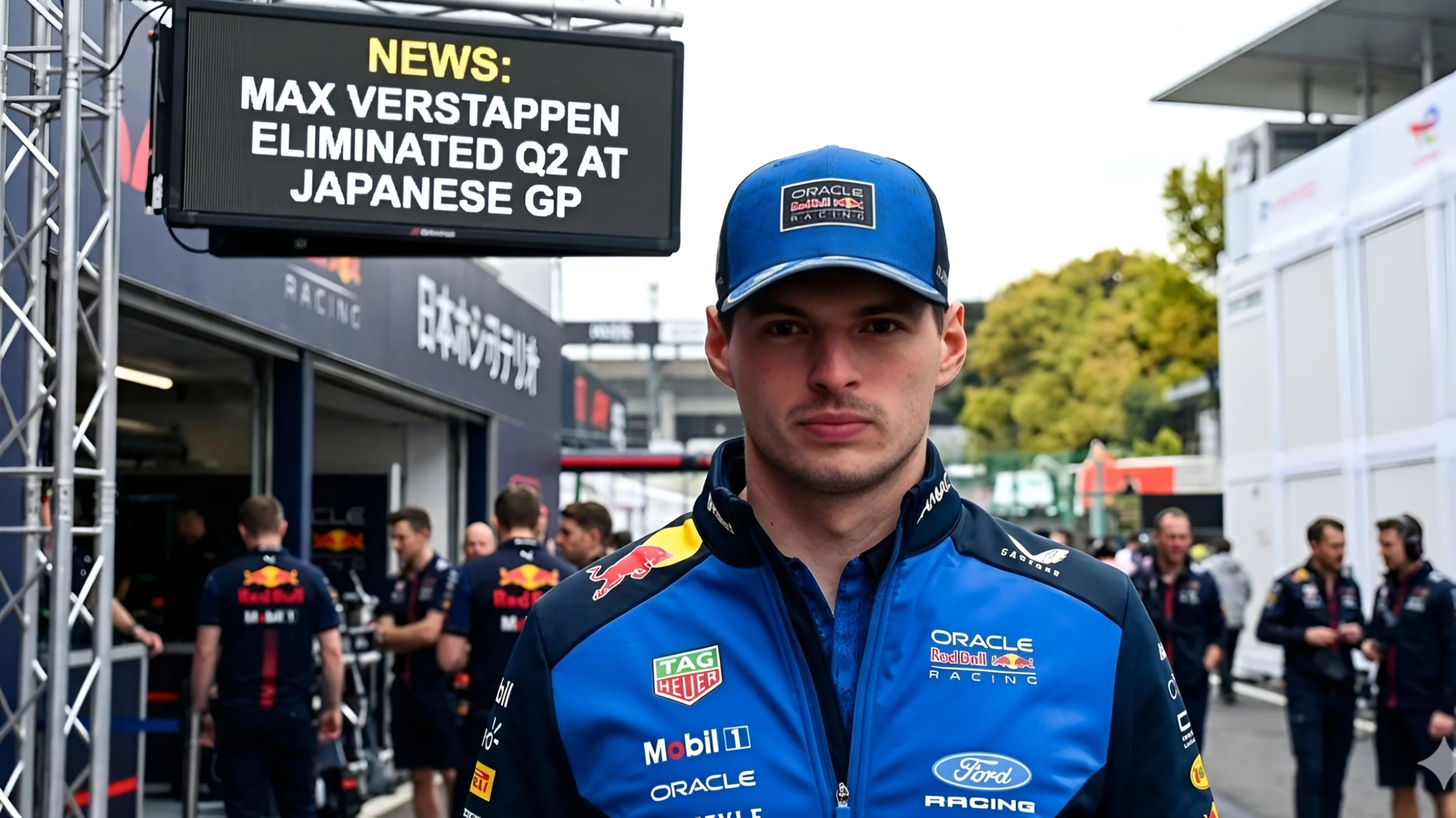
Max Verstappen reacts to a shock Q2 elimination at the 2026 Japanese Grand Prix, highlighting systemic balance issues with the Ford-powered Red Bull RB22.
Published by: AutodromeF1 Editorial Team
Max Verstappen’s Suzuka Qualifying Catastrophe: P11 Start Exposes Systemic RB22 Deficiencies as Red Bull’s 2026 Campaign Reaches Inflection Point
Suzuka, Japan – March 28, 2026
In one of the most startling sessions of the 2026 Formula 1 season, four-time world champion Max Verstappen was eliminated in Q2 of qualifying for the Japanese Grand Prix, securing only 11th position on the grid for Sunday’s race at the legendary Suzuka Circuit. The Dutchman’s uncharacteristic exit, compounded by a late surge from Racing Bulls rookie Arvid Lindblad, marks the latest and most emphatic symptom of a deepening aerodynamic and mechanical malaise afflicting the Red Bull RB22.
For a driver who has historically treated Suzuka as a personal fiefdom—securing four consecutive poles and victories in the preceding seasons—the result represents far more than a single off-day. It signals a profound shift in competitive hierarchy, with Mercedes, Ferrari, and McLaren now operating at a level of consistent excellence that has relegated the once-dominant Milton Keynes outfit to the midfield. Verstappen’s decision to relinquish the champion’s number 1 in favour of his traditional number 3 on the RB22 further underscores a psychological recalibration born of mounting frustration.
Qualifying unfolded under the familiar pressure of Suzuka’s high-speed sweeps and technical demands. From the outset, Verstappen voiced acute dissatisfaction with the RB22’s balance. Oversteer on corner entry transitioned abruptly into pronounced understeer through the apex, rendering the car “undriveable” in his words to race engineer Gianpiero Lambiase. Despite overnight and intra-session setup adjustments aimed at stabilising mechanical grip and refining front-end responsiveness, the issues persisted. In the dying moments of Q2, Lindblad’s clean final lap displaced Verstappen from the top-ten cut-off by a scant margin, while teammate Isack Hadjar—making his second appearance in Q3 this season—advanced comfortably.
Pole position was claimed by Mercedes’ Kimi Antonelli, the 19-year-old Italian prodigy who continues to impress in only his second full campaign. George Russell lined up alongside him in second, with McLaren’s Oscar Piastri completing the front row in third. The session’s outcome crystallised the narrative that has defined 2026 thus far: Red Bull’s erstwhile supremacy has evaporated, supplanted by rivals whose cars exhibit superior tyre management, aerodynamic efficiency, and predictable handling across varying track temperatures and surface conditions.
The RB22’s deficiencies are no longer isolated anomalies but systemic shortcomings that have haunted the team since pre-season testing. Poor tyre degradation—particularly on the medium and hard compounds favoured at Suzuka—has been exacerbated by an inherent understeer in medium- to high-speed corners. Engineers have repeatedly cited excessive sensitivity to ride-height changes and rake adjustments, a trait that renders the car unforgiving when fine-tuning is required. Verstappen himself, in post-qualifying remarks, articulated a deeper resignation: “I’m not even frustrated anymore, I’m beyond that.” He highlighted persistent difficulties with race starts and the absence of straightforward developmental pathways, observations that carry particular weight coming from a driver renowned for extracting maximum performance from suboptimal machinery.
This technical fragility stands in stark contrast to the RB22’s predecessors, which thrived on aggressive rake, potent ground-effect aerodynamics, and a forgiving balance that allowed Verstappen to dominate qualifying and race stints alike. The current iteration, by comparison, appears caught between competing design philosophies. Internal sources within Red Bull have acknowledged that the 2026 regulatory framework—emphasising revised power-unit specifications and sustainable fuel blends—has exposed vulnerabilities in the team’s chassis philosophy that were masked by outright performance margins in prior years. The result is a car that demands perfection from its driver yet refuses to reward it, a dynamic that has visibly eroded confidence within the garage.
Hadjar’s progression to Q3, while a personal milestone for the young Frenchman, serves as an uncomfortable yardstick for Verstappen’s struggles. The rookie’s ability to coax consistent lap times from an identical chassis underscores that the RB22’s limitations are not uniformly insurmountable but are amplified by the precise demands Verstappen places upon it. His willingness to push boundaries—historically the cornerstone of his success—now exposes the car’s narrow operating window. Lindblad’s opportunistic Q2 advancement, meanwhile, illustrates the depth of talent emerging from Red Bull’s junior programme even as the senior team falters.
Beyond the stopwatch, Saturday’s proceedings carried an undercurrent of interpersonal tension. Verstappen declined to participate in the post-qualifying press conference until British journalist Giles Richards of The Guardian departed the room. The gesture stemmed from unresolved grievances dating to last year’s Abu Dhabi Grand Prix coverage and a prior on-track collision penalty involving George Russell. While such incidents are not unprecedented in motorsport’s high-stakes environment, they reflect a champion operating under sustained pressure. Verstappen’s terse directive—“I’m not speaking before he’s leaving”—revealed a level of emotional strain rarely witnessed in public.
The number change to 3, quietly implemented ahead of the Suzuka weekend, carries symbolic resonance. By forgoing the champion’s 1, Verstappen appears to signal that the 2026 season has entered uncharted territory—one in which defending a title is no longer the default assumption but a hard-fought objective. In an era when regulatory upheaval and power-unit parity were expected to compress the grid, few anticipated Red Bull’s descent to be so precipitous or so persistent.
Historically, Suzuka has amplified Red Bull’s strengths. Its combination of high-speed corners, elevation changes, and relentless rhythm rewarded the RB18 through RB21’s exceptional mechanical grip and aerodynamic stability. Verstappen’s lap records here were once considered untouchable. The 2026 iteration, however, has inverted that advantage. Mercedes’ W17 and McLaren’s MCL40 demonstrate superior balance and tyre longevity, enabling their drivers to maintain qualifying momentum where the RB22 falters. Ferrari, though slightly behind the leading duo, remains competitive enough to capitalise on any Red Bull misstep.
From a championship perspective, the implications are significant. Verstappen entered the Japanese weekend trailing the leaders in the drivers’ standings, a position that once seemed inconceivable. A P11 start on a circuit notoriously difficult for overtaking—particularly in the first sector—places an enormous premium on race-day execution. Red Bull’s race strategists must now contemplate aggressive tyre-management tactics, potential undercut opportunities, and opportunistic safety-car deployments. Yet the underlying car pace suggests that even flawless execution may yield only a handful of points rather than the podium finishes that defined earlier campaigns.
The broader constructor’s championship battle has similarly tilted. Mercedes and McLaren have traded blows at the summit, their respective development programmes yielding incremental yet decisive gains in aerodynamic efficiency and power delivery. Red Bull’s wind-tunnel correlation issues, long rumoured but now manifest in on-track performance, have hindered the RB22’s iterative progress. Team principal Christian Horner and technical director Pierre Wache face mounting scrutiny to deliver a competitive upgrade package before the European leg of the calendar intensifies.
Verstappen’s resilience remains the team’s greatest asset. A driver who has repeatedly engineered victories from adversity—most memorably in the 2021 title decider—possesses the skill set to extract more from the RB22 than its raw data suggests. However, even his prodigious talent cannot indefinitely compensate for fundamental design shortcomings. The coming race will test whether Red Bull can mitigate its weaknesses through strategy or whether the midfield battle will become the new normal.
As the sun sets over Suzuka’s iconic figure-eight layout, the 2026 Japanese Grand Prix stands as a watershed moment. For Verstappen and Red Bull, it is a call to arms: a demand for radical introspection, accelerated development, and renewed cohesion. For the sport at large, it reaffirms the cyclical nature of Formula 1 supremacy. What once appeared an unbreakable dynasty now confronts the harsh realities of regulatory evolution and engineering parity.
Sunday’s race promises drama. Starting from 11th, Verstappen will require every ounce of his renowned racecraft—late braking into Turn 1, precise positioning through the Esses, and opportunistic overtakes under DRS—to salvage a respectable result. Whether the RB22 can deliver the necessary pace remains an open question. One certainty endures: the champion’s response to adversity has always defined his legacy. At Suzuka in 2026, that response may prove more consequential than ever before.


