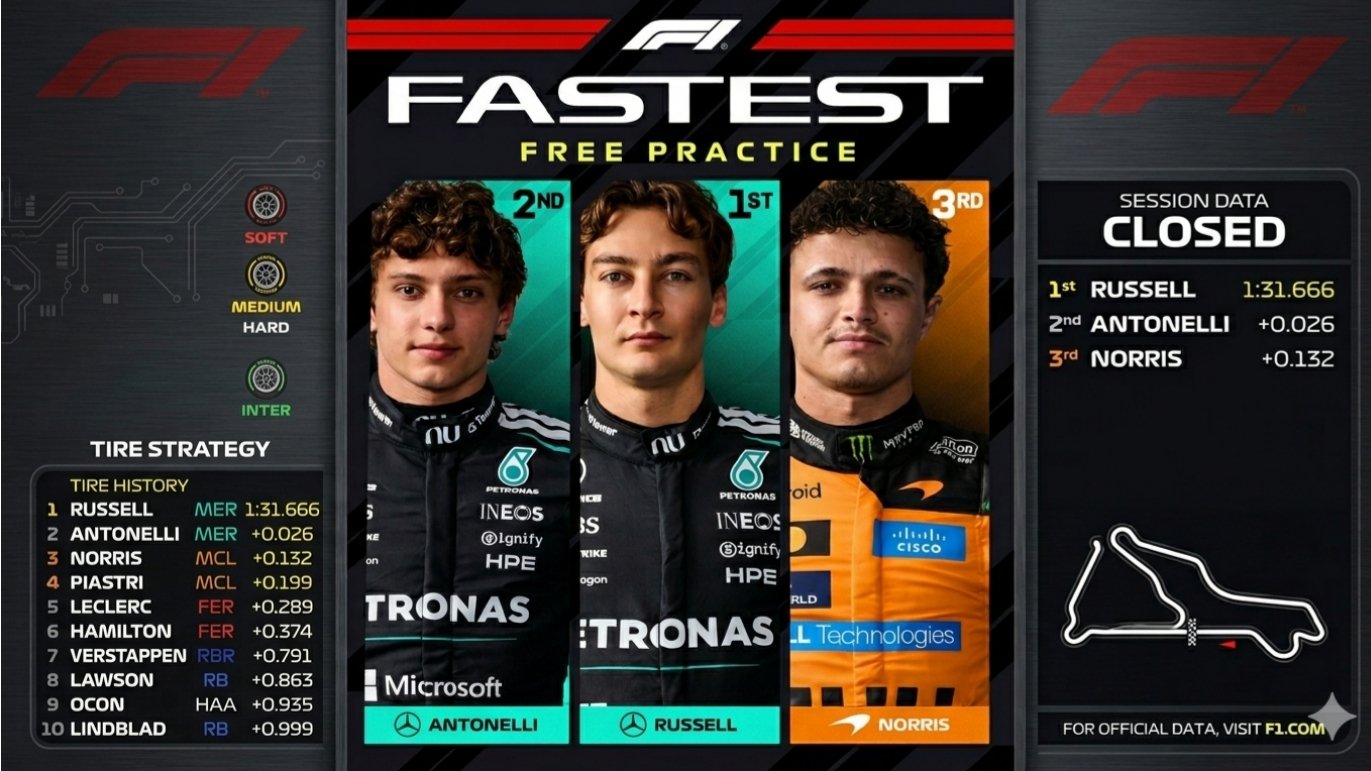
George Russell (1st) and Kimi Antonelli (2nd) secure a Mercedes front-row lockout in the Suzuka FP1 timing sheets, ahead of McLaren’s Lando Norris (3rd).
Published by: AutodromeF1 Editorial Team
Mercedes Asserts Commanding Authority in Suzuka FP1: Russell Secures Provisional Pole Pace as Antonelli Delivers Masterclass Rookie Performance
Suzuka Circuit, Japan – Friday, March 27, 2026
In the crisp, high-stakes environment of the Suzuka International Racing Course, where precision and courage have defined Formula 1 legends for decades, Mercedes-AMG Petronas has issued an unequivocal statement of intent. George Russell, the British driver who has steadily evolved into one of the grid’s most complete operators, delivered a benchmark lap of 1 minute 31.666 seconds during the opening free practice session for the Japanese Grand Prix. That time stood as the fastest of the 60-minute session, eclipsed only by his rookie teammate Kimi Antonelli, who finished a mere 0.026 seconds adrift in second place.
The result marks a seamless Mercedes 1-2 that carries profound significance. It not only underscores the Brackley-based outfit’s technical refinement over the winter but also signals a renewed competitive edge following their encouraging performances in the season-opening rounds in Australia and China. For a team that has navigated periods of transition in recent years, this early dominance at one of the calendar’s most technically demanding venues offers tangible evidence that their 2026 chassis and power-unit package are operating in harmony.
Antonelli’s achievement is particularly noteworthy. Thrust into the spotlight as Mercedes’ youngest-ever full-time driver, the Italian teenager displayed composure and raw speed that belied his limited prior experience at this level. His ability to extract near-identical pace to Russell on a circuit renowned for punishing mistakes—particularly through the sweeping 130R and the deceptive chicane—suggests a prodigious talent who has absorbed the team’s data and feedback with remarkable rapidity. In an era where rookie integration often demands patience, Antonelli’s FP1 showing injects immediate credibility into Mercedes’ long-term driver development strategy.

Trailing the silver arrows but maintaining close proximity were McLaren’s formidable duo. Lando Norris, a consistent frontrunner in recent seasons, posted the third-quickest time, 0.132 seconds off Russell’s benchmark. Teammate Oscar Piastri followed in fourth, just 0.199 seconds behind. The papaya-liveried cars exhibited the balanced handling and aerodynamic efficiency that have become hallmarks of the Woking operation. Their performance hints at a strong recovery trajectory after any early-season teething issues, positioning McLaren as the primary threat to Mercedes’ early supremacy. The gap between the top four cars—less than two-tenths of a second—underscores the razor-thin margins that now characterise modern Formula 1, where simulation accuracy and real-time setup tweaks can swing entire weekends.
Ferrari, fielding an intriguing pairing of Charles Leclerc and Lewis Hamilton, occupied fifth and sixth respectively. Leclerc, the Monegasque who has long shouldered the Scuderia’s hopes, was 0.289 seconds off the pace, while Hamilton—now in his second season with the Italian marque—trailed by 0.374 seconds. Their times reflect a solid foundation rather than outright dominance, yet the partnership between two of the sport’s most analytically astute drivers promises rich data for Ferrari’s engineers. Hamilton’s seamless adaptation to the Prancing Horse’s philosophy continues to impress observers; his feedback on tyre management and chassis balance at Suzuka will be invaluable as the team seeks to close the gap to the leading pack.
Further down the order, defending champions Red Bull Racing found themselves in unfamiliar territory. Max Verstappen, the three-time world champion whose precision has become legendary, could manage only seventh place, 0.791 seconds adrift. While such margins in FP1 are rarely definitive—given the session’s focus on long-run data collection and tyre evaluation—the deficit will undoubtedly prompt urgent analysis within the Milton Keynes camp. Verstappen’s session was further complicated by an on-track incident that has already drawn official scrutiny (detailed below), adding another layer of complexity to Red Bull’s weekend preparations.
The midfield provided several intriguing subplots. Liam Lawson, driving for the rebranded Racing Bulls outfit, secured an impressive eighth place, 0.863 seconds behind the leader. His result highlights the steady maturation of the Faenza-based squad and Lawson’s growing confidence in high-downforce configurations. Esteban Ocon, now at Haas, demonstrated his characteristic resilience by claiming ninth (+0.935s), while young Arvid Lindblad rounded out the top ten for Racing Bulls (+0.999s). These performances illustrate the depth of talent across the grid and the narrowing performance band that has emerged under the current regulatory framework.
Beyond the raw timing sheets, the session was punctuated by two notable incidents that will shape the narrative heading into FP2. Stewards have initiated an investigation into a clash at the high-speed Turn 15—universally known as 130R— involving Verstappen and Hamilton. Reports indicate Verstappen was on a flying lap when he encountered Hamilton, necessitating evasive action. The 130R has long been one of Formula 1’s most iconic corners, demanding absolute commitment and flawless car control; any disruption here can cascade into significant time loss. Both drivers will be required to provide telemetry and video evidence, and the outcome could influence grid penalties or future driving standards briefings.
Separately, a minor collision occurred at Degner 2 between Williams’ Alex Albon and Cadillac’s Sergio Pérez. The incident resulted in Albon finishing 18th and Pérez 19th, underscoring the challenges of traffic management on Suzuka’s flowing layout. Multiple drivers across the field reported difficulties negotiating the 130R and the subsequent chicane, where aerodynamic sensitivity and brake balance become critical. These moments serve as a reminder that Suzuka remains one of the purest tests of driver skill and mechanical sympathy on the calendar.
From a strategic standpoint, FP1 at Suzuka traditionally serves as a diagnostic window rather than a definitive performance indicator. Teams utilise the hour to evaluate tyre compounds—particularly the softest rubber that will prove decisive in qualifying—while calibrating ride height, suspension geometry, and engine mapping for the unique demands of the figure-eight circuit. Mercedes’ ability to occupy the front row of the timing screen suggests their aerodynamic package is exceptionally well-suited to the combination of high-speed sweeps and technical low-speed sections that define this venue.
The session also highlighted broader seasonal themes. Mercedes’ early-season momentum from Australia and China appears undiminished, reinforcing the notion that their development curve has steepened at precisely the right moment. Conversely, Red Bull’s seventh-place finish invites scrutiny of their latest specification updates. In a championship where constructors’ points are increasingly contested by tightly packed groups, even small increments in lap time can translate into significant championship implications.
Kimi Antonelli’s near-match with Russell is perhaps the most compelling storyline. At an age when most drivers are still acclimatising to Formula 2 machinery, the Italian has demonstrated an innate understanding of tyre temperature management and corner-entry precision—skills that separate the merely fast from the genuinely elite. His performance will be closely monitored by paddock veterans who recall past prodigies; if sustained across the weekend, it could herald a genuine changing of the guard within Mercedes.
McLaren’s proximity to the leaders further intensifies the intra-team battle between Norris and Piastri. Both drivers have matured into championship contenders, and their ability to extract maximum performance from identical machinery will be a fascinating subplot. Norris’s third-place finish, achieved despite reported traffic on his quicker runs, suggests untapped potential that could materialise once the track rubbered in during subsequent sessions.
Ferrari’s fifth and sixth positions reflect a pragmatic approach. With Leclerc and Hamilton pooling their considerable experience, the Maranello outfit is methodically building toward a competitive qualifying performance. Hamilton’s presence has already influenced the technical direction of the SF-26, and his input on high-speed stability through sectors two and three will be pivotal.
The stewards’ investigation into the Verstappen-Hamilton incident at 130R carries additional weight given the drivers’ histories. Both are renowned for their uncompromising racing style, yet the corner’s unforgiving nature leaves little margin for error. The outcome of the review—expected before FP2—will be watched with interest by the entire paddock, as it may set a precedent for how similar high-speed avoidance manoeuvres are adjudicated under the current regulations.
Meanwhile, the midfield skirmish between Albon and Pérez at Degner 2 illustrates the relentless pressure on every driver to maximise track time. Albon’s Williams and Pérez’s Cadillac entry both suffered minor aerodynamic damage, limiting their ability to complete meaningful long-run programmes. Such incidents, while regrettable, are an inevitable consequence of Suzuka’s narrow lines and the intensity of Friday practice.
As the sun begins its descent over the Suzuka hills, attention now turns to FP2, where teams will shift focus toward race simulation and qualifying-specific runs. The data gathered this afternoon will inform overnight adjustments, with particular emphasis on brake cooling, tyre degradation, and energy deployment strategies—elements that become decisive under race conditions.
Mercedes enters the remainder of the weekend with genuine optimism. Their 1-2 result is not merely a statistical curiosity; it reflects a cohesive engineering philosophy that has translated simulation gains into tangible on-track advantage. Russell’s lap, executed with the clinical precision that has become his trademark, sets a standard that rivals must now match. Antonelli’s contribution elevates the narrative further, proving that youth and experience can coexist harmoniously within a top-tier team.
For the sport’s enthusiasts, this Japanese Grand Prix weekend promises to be a compelling chapter in the 2026 narrative. Suzuka has historically rewarded the bold and the technically astute; today’s proceedings suggest Mercedes currently embodies both qualities. Whether McLaren can harness their evident pace, whether Ferrari’s dual-driver brain trust can unlock additional performance, and whether Red Bull can diagnose and rectify their deficit will define the coming days.
One certainty remains: the 2026 Formula 1 season continues to deliver intrigue at every turn. George Russell’s early mastery of Suzuka, paired with Kimi Antonelli’s precocious speed, has set a formidable benchmark. The full implications of this FP1 will only crystallise as the weekend unfolds, but the opening act has already provided a masterclass in modern Grand Prix engineering and driver talent.


