Published by: AutodromeF1 Editorial Team
Mercedes’ 2026 Title Campaign: Toto Wolff Declares Russell and Antonelli “Off the Leash” as a Historic Intra-Team Rivalry Takes Shape
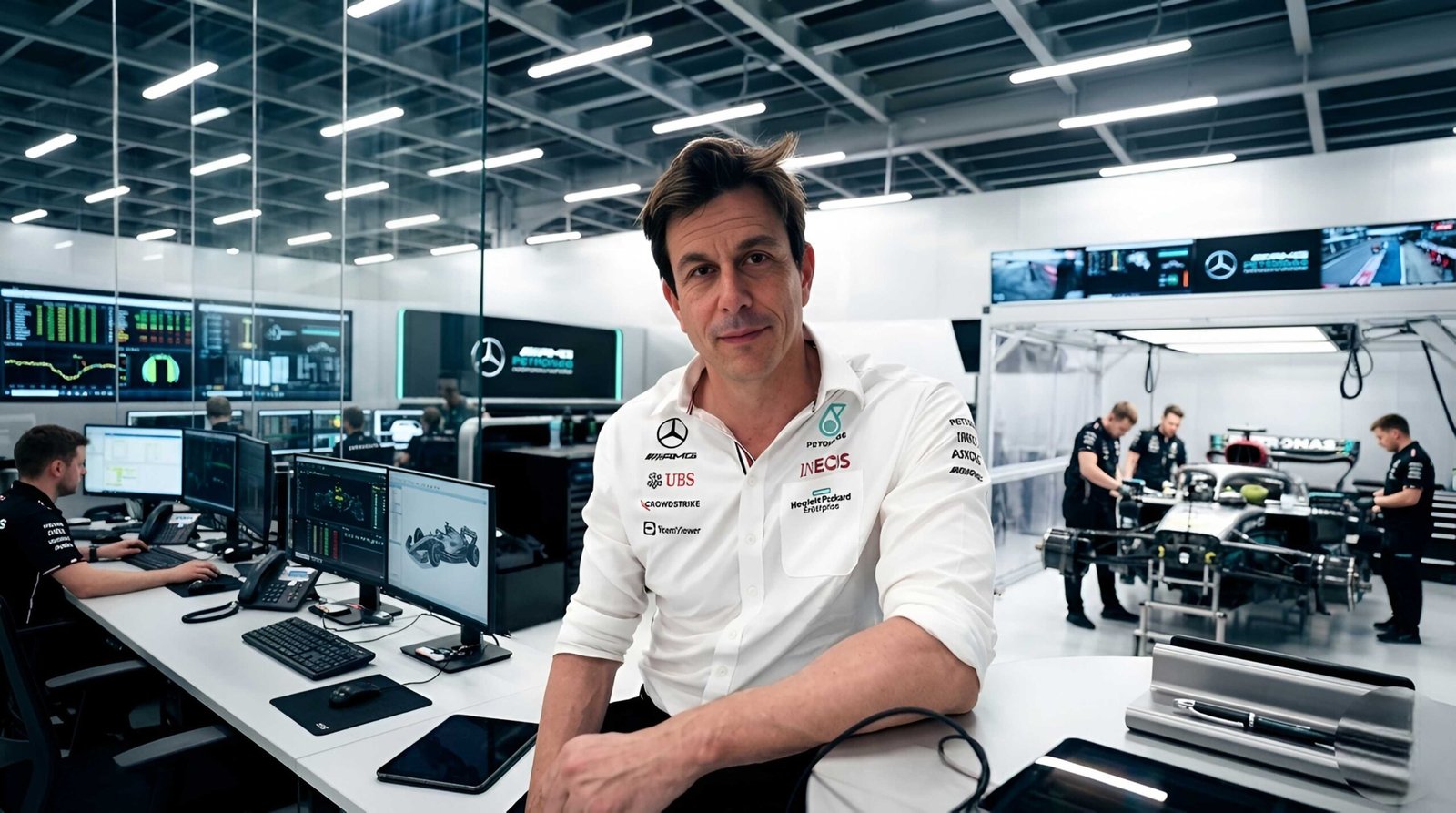
London, United Kingdom April 5 – In the rarefied world of Formula 1, where split-second decisions and billion-dollar engineering programmes converge, few declarations carry the weight of a single phrase from a team principal. Yet when Mercedes-AMG Petronas Formula One Team principal and CEO Toto Wolff stated that drivers George Russell and rookie Kimi Antonelli are currently “off the leash,” he did more than offer a colourful metaphor. He articulated a deliberate, high-stakes strategic posture for a squad that finds itself unexpectedly dominant in the opening phase of the all-new 2026 regulatory era.
The remark, delivered in the aftermath of the Japanese Grand Prix at Suzuka, signals that Mercedes will permit its two drivers to contest every position on track for the foreseeable future. Team orders, Wolff emphasised, remain a contingency measure to be invoked only “if the championship demands it.” At present, the championship is demanding excellence rather than restraint. After three races – the Australian, Chinese and Japanese Grands Prix – Mercedes occupies the top two places in the drivers’ standings, heads the constructors’ table by a commanding margin, and has secured pole position and victory in every event. The Silver Arrows are not merely competitive; they are the benchmark against which every rival must measure itself.
Central to this narrative is the precocious talent of 19-year-old Kimi Antonelli. The Italian, promoted directly from the Mercedes junior programme after a single season of Formula 2, has wasted no time in rewriting the record books. He currently leads the drivers’ championship, an achievement that marks him as the youngest driver ever to head the standings at this stage of a campaign. His performances have combined clinical racecraft with an instinctive feel for the revised 2026 machinery – smaller, lighter, and powered by a new generation of sustainable hybrid power units that place unprecedented emphasis on electrical deployment and energy recovery. Observers who have followed Antonelli’s ascent through karting, Formula Regional, and Formula 2 note a maturity that belies his years: zero unforced errors, flawless tyre management in variable conditions, and a qualifying pace that has already yielded one pole position.
Sitting nine points behind in second place is George Russell, the 28-year-old Englishman who has served as Mercedes’ de facto lead driver since Lewis Hamilton’s departure to Ferrari at the end of 2024. Russell’s consistency has been the bedrock of the team’s renaissance. A driver who once carried the burden of a midfield car at Williams now commands a front-running machine with the quiet authority of a veteran. His race starts have been exemplary, his defensive lines precise, and his feedback to engineers has been instrumental in refining the W17’s aerodynamic package across the early flyaway races.
That two such capable performers should be locked in direct combat inside the same garage is not without precedent at Mercedes. Between 2014 and 2016, the intra-team contest between Lewis Hamilton and Nico Rosberg produced some of the most compelling – and occasionally combustible – racing of the hybrid era. That rivalry yielded four consecutive constructors’ titles for the team but also tested internal cohesion to breaking point. Wolff, who lived through those seasons, has repeatedly described them as a masterclass in managed tension. The current pairing, he insists, feels “fundamentally different” in tone: professional respect rather than personal animosity, shared ambition rather than zero-sum conflict.
Yet the echoes are unmistakable. For the first time since Rosberg’s retirement at the end of 2016, Mercedes faces a genuine, season-long internal title fight. The 2026 regulations – radical in their ambition to reduce car size by 10 per cent, introduce active aerodynamics, and mandate 50 per cent sustainable fuels – have levelled the playing field in ways few predicted. Mercedes entered the season expecting a transitional year; instead, the Brackley-based outfit has produced the most driveable and efficient package on the grid. The result is a surplus of performance that allows both drivers to push without immediate fear of external threat.
Wolff’s “off the leash” directive is, on one level, a statement of confidence in his drivers’ maturity. It is also a calculated risk-management strategy. Permitting wheel-to-wheel combat while the points gap remains manageable fosters the kind of racecraft that sharpens both competitors. Russell gains the opportunity to demonstrate why experience still matters in an era of data-driven precision. Antonelli, meanwhile, is afforded the platform to prove that his junior-category dominance was no statistical anomaly. The team’s engineers benefit from dual streams of high-quality feedback, accelerating development of the W17’s floor, suspension geometry, and power-unit mapping.
The caveat, however, is explicit. Should the drivers’ championship tighten beyond a threshold that threatens either the team’s constructors’ ambitions or the integrity of the season, Wolff will not hesitate to reimpose hierarchy. “We are not in the business of manufacturing drama at the expense of silverware,” he noted in a later clarification. “Our responsibility is to the shareholders, to the 1,200 people at Brackley and Brixworth, and to the sport itself. If the mathematics dictate that one driver must support the other, we will make that call – calmly, transparently, and at the appropriate moment.”
Such pragmatism is the hallmark of Wolff’s leadership. Since assuming the role of executive director in 2013, he has steered Mercedes from a midfield also-ran to an eight-time constructors’ champion. His approach blends Austrian directness with an almost corporate-level discipline: clear communication channels, data-backed decision-making, and an insistence on psychological resilience. In the current context, that means monitoring not only lap times but also radio traffic, body language in the garage, and the subtle dynamics of the driver pairing during debriefs.
For Russell, the situation presents both opportunity and pressure. As the senior driver, he is expected to set the standard in race management and tyre preservation – areas where his experience should confer an edge. Yet he must also adapt to a teammate whose raw speed appears, at times, almost telepathic. Publicly, Russell has welcomed the contest. “Kimi is incredibly quick and incredibly mature,” he said after the Chinese Grand Prix. “That pushes me to be better, and that’s what this team has always thrived on.” Privately, those close to the garage suggest Russell views the rookie’s pace as the ultimate validation of Mercedes’ talent pipeline – a pipeline he himself once represented.
Antonelli’s perspective is simpler and more youthful: he is racing to win, every single lap. The Italian has spoken of his “dream” to emulate the great Ferrari and Mercedes champions of the past, yet his focus remains resolutely on the present. His management team, led by those who guided him through the junior ranks, has emphasised the importance of learning from Russell without deference. The result is a dynamic that feels less like a traditional mentor-protégé relationship and more like two thoroughbreds released onto the same straight.
The broader implications for the 2026 season are profound. With Red Bull, Ferrari, and McLaren all showing flashes of competitiveness but struggling with consistency under the new regulations, Mercedes’ early supremacy has reframed the narrative. What began as a year of regulatory reset has become a referendum on execution. If the Silver Arrows maintain their current trajectory, the internal battle between Russell and Antonelli could decide not only the drivers’ crown but also the constructors’ title by a margin not seen since the dominant years of 2014-2020.
Critics may argue that early-season dominance risks diminishing the spectacle. Yet history suggests otherwise. The 2014 Mercedes intra-team war, for all its tension, produced some of the most memorable duels in modern F1. The 2021 title fight between Max Verstappen and Lewis Hamilton elevated the sport’s global profile to new heights. Healthy rivalry, when contained within professional boundaries, generates the tension that sustains interest across 24 races.
Mercedes’ infrastructure is uniquely equipped to manage such tension. The team’s simulator programme at Brackley, its advanced wind-tunnel facilities, and its data-analytics department – all operating at the cutting edge of 2026 technology – provide an objective arbiter for performance disputes. Telemetry does not lie; nor does it take sides. Should either driver begin to compromise the other’s result through over-aggression, the numbers will reveal it long before the stewards intervene.
Looking further ahead, the season’s narrative will hinge on several variables: the development race as rivals close the performance gap, the introduction of sprint weekends that compress strategy windows, and the psychological toll of sustained pressure on a 19-year-old navigating his debut campaign. Antonelli’s youth is both his greatest asset – unburdened by the weight of expectation that accompanies multi-year veterans – and his greatest vulnerability. The learning curve in F1 is steep; the consequences of miscalculation are instantaneous.
Wolff, ever the realist, has already begun preparing the organisation for every contingency. “We have the car, we have the drivers, and we have the process,” he observed. “Now we must prove we also have the temperament.” That temperament will be tested repeatedly in the coming months – through the European leg, the triple-header in the Americas, and the decisive flyaways that traditionally sort the contenders from the pretenders.
For Formula 1 enthusiasts, the prospect of a genuine Mercedes civil war is a welcome reminder of the sport’s enduring drama. The 2026 season was billed as a year of technical revolution; it may yet be remembered as the year two teammates, granted temporary freedom, redefined what it means to race for the same flag. Whether that freedom endures until Abu Dhabi or yields to calculated team discipline remains the central question. One thing is certain: Toto Wolff will decide when – and if – the leash is reapplied. Until that moment, George Russell and Kimi Antonelli will continue to chase every tenth of a second, every apex, and every point, secure in the knowledge that the team that built the fastest car on the grid has also granted them the rarest of luxuries in modern Formula 1: the right to race each other without restraint.
In an era increasingly defined by cost caps, power-unit parity mandates, and regulatory convergence, such moments of unfiltered competition are to be cherished. Mercedes, once again, finds itself at the centre of the narrative – not merely as a constructor, but as the custodian of a rivalry that could shape the championship for years to come.


