Published by: AutodromeF1 Editorial Team
Mercedes’ Garage Divide: George Russell’s Mounting Frustrations Signal Deeper Early-Season Challenges in the 2026 Title Fight
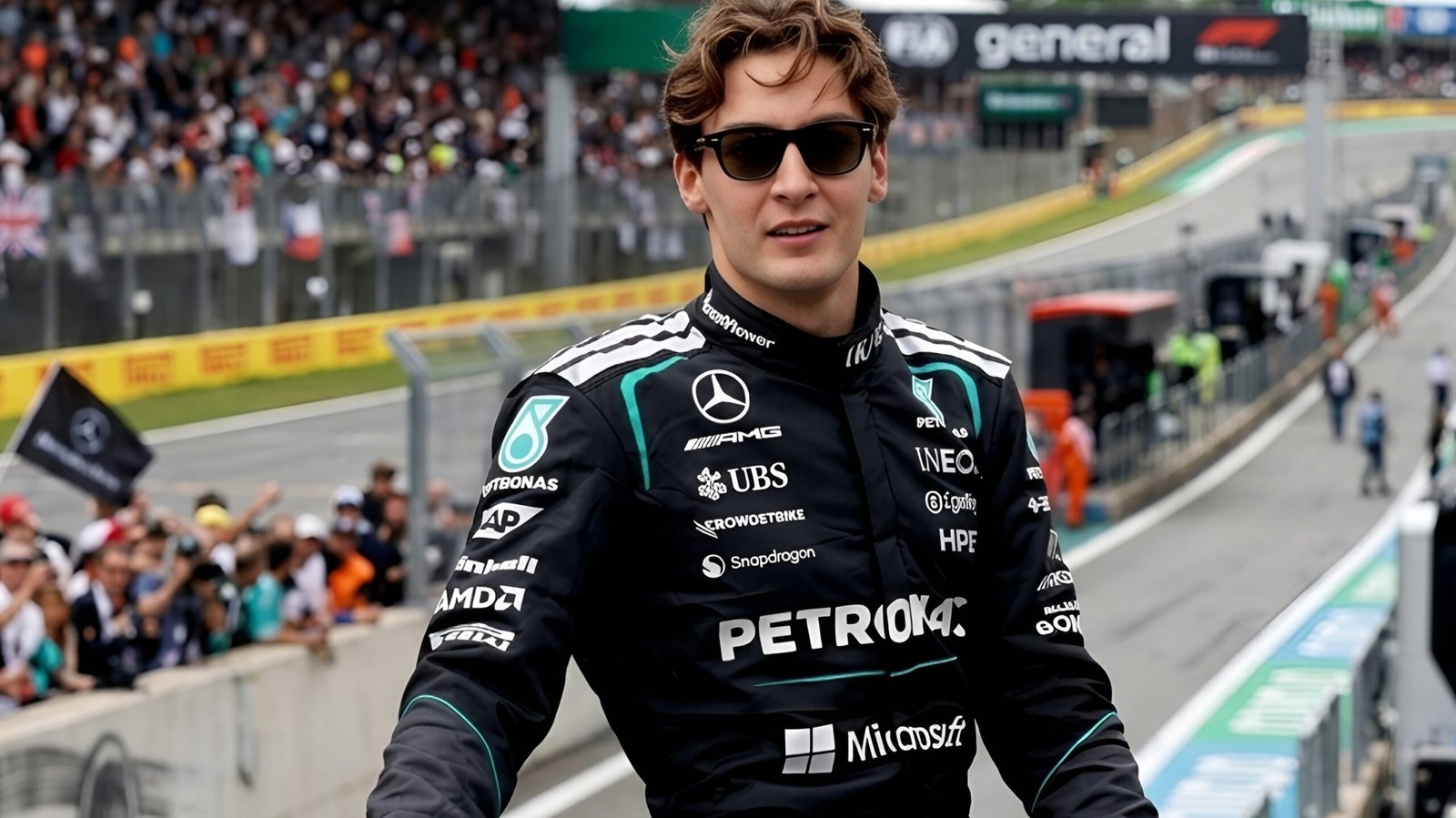
London, United Kingdom 1 April + In the high-stakes arena of Formula 1, where milliseconds separate triumph from disappointment, the delicate equilibrium within a top-tier team can shift with remarkable speed. As the 2026 season enters its fourth race weekend, Mercedes-AMG Petronas finds itself confronting not only the technical intricacies of a newly evolved regulatory framework but also an emerging asymmetry in performance and fortune between its two drivers. George Russell, the seasoned British campaigner and 2025 vice-champion, has publicly articulated a growing sense that the team’s early-season technical and strategic vulnerabilities are manifesting disproportionately on his side of the garage. This perception has crystallised in the wake of back-to-back victories by his rookie teammate, Kimi Antonelli, who now commands a nine-point advantage in the Drivers’ Championship after just three Grands Prix.
Russell’s candid assessment, delivered in the immediate aftermath of the Japanese Grand Prix at Suzuka, underscores a narrative that transcends mere race-day misfortune. It points instead to systemic sensitivities within the W17 chassis—sensitivities that, while inherent to the entire Mercedes operation, appear to have exacted a heavier toll on the more experienced driver’s results. The Italian prodigy Antonelli, thrust into the spotlight as Lewis Hamilton’s successor, has capitalised with clinical precision, converting opportunities into maximum points. The contrast could scarcely be more pronounced: Russell began the campaign with a commanding victory in Melbourne, yet subsequent weekends in Shanghai and Suzuka have yielded a cascade of setbacks that have collectively eroded his early momentum.
To appreciate the gravity of this intra-team dynamic, one must revisit the season’s opening chapter. The Australian Grand Prix at Albert Park delivered a masterclass in resilience from Russell. Starting from pole, he navigated variable weather conditions and a late safety-car intervention with aplomb, securing Mercedes’ first win of the new era. The result not only reaffirmed the W17’s latent pace but also positioned Russell as the early championship pacesetter. At that juncture, few observers could have foreseen the reversal that would unfold over the ensuing fortnight.
The Chinese Grand Prix at the Shanghai International Circuit marked the onset of Russell’s difficulties. A technical glitch—later attributed by the team to a transient software anomaly in the power-unit energy deployment system—compromised his qualifying performance, relegating him to a suboptimal grid slot. Despite an aggressive recovery drive that showcased his trademark racecraft, the incident proved costly. Antonelli, benefiting from a clean qualifying and an opportunistic strategy during a virtual safety-car period, claimed his maiden Formula 1 victory. The rookie’s composure under pressure was exemplary, a portent of the maturity that would define his subsequent performances.
Suzuka, Japan’s iconic figure-of-eight circuit, amplified the pattern. Mercedes opted for an aggressive setup adjustment on Russell’s car in pursuit of enhanced qualifying pace, a decision informed by data from free practice but ultimately undermined by unpredictable track evolution and tyre degradation characteristics. The modification yielded the opposite effect: diminished balance through the high-speed esses and a pronounced understeer in the final sector. Russell crossed the line in a frustrated fourth place, while Antonelli once again demonstrated superior adaptability. The young Italian’s car exhibited none of the same handling quirks, allowing him to maintain a consistent rhythm and secure a second consecutive win. The nine-point swing in the standings—Antonelli on 72 points, Russell on 63—now places the rookie atop the championship table, a scenario that would have seemed improbable mere weeks earlier.
The most visceral manifestation of Russell’s discontent surfaced during the Japanese Grand Prix itself. As the race entered its critical closing phases, a safety-car deployment triggered a strategic inflection point. Mercedes’ energy-management protocols, governed by the stringent 2026 battery-harvest limits, restricted Russell’s ability to deploy maximum electrical assistance on the restart. Over the team radio, his exasperation was palpable: a pointed commentary on the cumulative misfortunes that had befallen his car. Team Principal Toto Wolff, ever the measured strategist, responded with characteristic restraint: “George, see what you can do from here, yeah. Super unlucky.” The exchange, while outwardly supportive, carried an undertone of gentle redirection—an implicit reminder that externalising frustration risks unsettling the garage’s collective focus.
Sky Sports F1 pundit Ted Kravitz, a veteran observer with decades of insight into the paddock’s psychological undercurrents, offered a measured critique in the post-race analysis. He described Russell’s radio communications as “tetchy,” cautioning that such displays, however understandable, could inadvertently alienate engineers and mechanics who pride themselves on impartiality across both sides of the garage. In Formula 1, where human capital is as critical as aerodynamic efficiency, maintaining harmonious internal dynamics is paramount. Wolff’s leadership has historically excelled at fostering such equilibrium, yet the early 2026 evidence suggests this particular pairing—veteran reliability versus rookie exuberance—will test that acumen.
From an engineering standpoint, the issues Russell has encountered are emblematic of the W17’s developmental stage. The 2026 regulations, which introduced a more aggressive power-unit architecture and revised aerodynamic constraints, have produced a car that is blisteringly quick in isolation yet demanding in its operational envelope. Energy-harvest limits, in particular, impose a delicate trade-off between deployment and regeneration—a balance that appears more forgiving on Antonelli’s setup. Telemetry comparisons, while not publicly released in granular detail, indicate subtle divergences in ride-height calibration and suspension mapping that have favoured the rookie’s side. Whether this stems from divergent development philosophies, overnight setup iterations, or simply the capricious nature of early-season data correlation remains a matter of intense internal scrutiny.
Mercedes’ historical resilience in overcoming such asymmetries provides context. Recall the 2022 campaign, when Russell’s maiden pole and victory at the São Paulo Grand Prix heralded a new era of competitiveness following the turbulent ground-effect transition. Or the 2023–2024 seasons, during which the team methodically refined the W14 and W15 packages despite persistent porpoising and tyre-wear challenges. The current predicament, while acute, is not unprecedented. What distinguishes 2026 is the presence of a genuine title contender in the rookie seat—an element that injects both opportunity and pressure into the equation.
Antonelli’s ascent has been nothing short of meteoric. Promoted directly from Formula 2 with minimal testing mileage, the 18-year-old has exhibited a preternatural ability to extract performance from the W17 without apparent drama. His two wins have not been fortuitous; they reflect a synthesis of instinctive race management and seamless integration with the team’s strategy group. In Shanghai, a perfectly timed pit stop under virtual safety car; in Suzuka, an unerring defence against Ferrari’s Charles Leclerc. The youngster now sits nine points clear, with Leclerc third on 49 points. The mathematical reality is that Russell retains every chance of reclaiming the lead—nine points equates to less than a single race victory in modern scoring—but the psychological momentum has palpably shifted.
This intra-team tension invites broader reflection on the psychology of elite motorsport. Drivers of Russell’s calibre, forged through years of pressure at the pinnacle, develop an acute sensitivity to perceived inequities. When technical gremlins or strategic missteps recur on one side of the garage, the human response is often to internalise them as personal affronts. Wolff, a master of motivational calibration, must now navigate a fine line: validating Russell’s concerns without diminishing Antonelli’s achievements. The team’s forthcoming technical directives—expected to address energy-management software robustness and setup predictability—will be pivotal. Bahrain, with its abrasive surface and high-energy demands, looms as an immediate litmus test. A circuit where tyre management and power-unit efficiency are decisive, it may yet allow Russell to reassert his authority.
Analysts within the paddock emphasise that early-season narratives rarely dictate final championship outcomes. The 2026 calendar spans 24 Grands Prix, encompassing diverse demands from the street-circuit confines of Monaco to the high-altitude challenges of Mexico City. Mercedes’ long-term development roadmap, anchored in the new power-unit partnership with INEOS and Petronas, remains on track. Yet the immediate priority is internal synchronisation. As one senior team insider noted on condition of anonymity, “The car is the same, but the execution window is narrow. George’s feedback is invaluable; Kimi’s results are the validation. Bridging that gap is where championships are won—or lost.”
Looking ahead, the Bahrain International Circuit promises a reset. Russell has historically performed strongly in the desert heat, and the team’s simulation work post-Suzuka has targeted the precise issues that plagued his Japanese outing. Antonelli, for his part, has demonstrated an ability to learn at an exponential rate—an attribute that could prove decisive if the W17 evolves favourably. The championship battle, already infused with youthful dynamism and veteran resolve, is poised to intensify.
In the final analysis, George Russell’s frustration is not a symptom of weakness but a testament to his unrelenting pursuit of excellence. Mercedes, long regarded as the benchmark of technical and operational rigour, faces the quintessential challenge of elite sport: converting latent potential into consistent dominance. The coming weeks will reveal whether the current garage divide represents a temporary aberration or the opening chapter of a compelling intra-team rivalry. For now, the scoreboard favours the rookie sensation, but the narrative—and the engineering evolution—remains firmly in Mercedes’ hands.


