Published by: AutodromeF1 Editorial Team
Mercedes’ Commanding Start to the 2026 Formula 1 Season: Insights from Oscar Piastri on the Intricate Balance Between Power, Aerodynamics, and Cornering Prowess
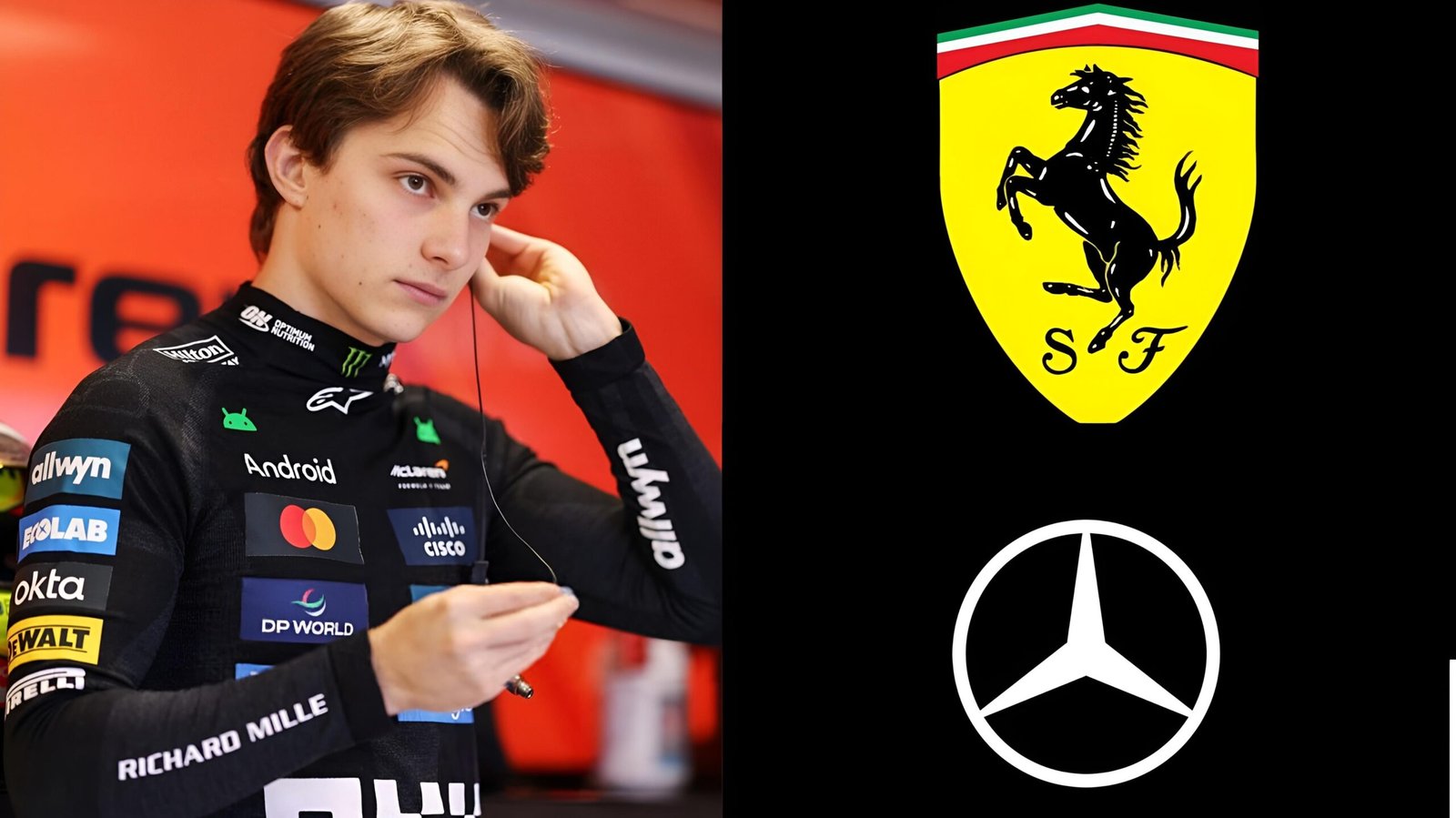
London, United Kingdom April 6 – As the 2026 Formula 1 World Championship unfolds under a transformative regulatory framework, the early rounds have illuminated a compelling narrative of technological evolution and competitive nuance. Mercedes-AMG Petronas has asserted a formidable presence, securing dominant 1-2 finishes in both the Australian and Chinese Grands Prix. Yet, behind the Silver Arrows’ qualifying supremacy and race-day consistency lies a more layered dynamic—one astutely observed by McLaren driver Oscar Piastri. His measured analysis underscores not merely the strengths of the leading contenders but the intricate trade-offs shaping performance in this new era of hybrid propulsion and active aerodynamics.
Piastri’s commentary, drawn from telemetry comparisons and on-track observations during the season’s inaugural races, reveals a grid where outright pace is segmented by distinct vehicle characteristics. “I think the Ferrari is interesting as well, because it almost looks like they’re even better in the corners, but maybe a bit worse on the straights—whether it’s the power unit or drag, I don’t know,” the Australian remarked. He further emphasized that Mercedes holds a “clear advantage” in qualifying, yet Ferrari’s ability to contend—particularly at race starts—offers valuable lessons beyond singular focus on the leaders.
This perspective aligns seamlessly with teammate Lando Norris’s post-Australian Grand Prix assessment. Norris, the reigning 2025 World Champion, described Ferrari’s cornering speeds as “unbelievable,” asserting that the Scuderia’s SF-26 chassis appeared to possess the “best car” in terms of mechanical grip and mid-corner stability, even as Mercedes capitalized on superior overall package integration and power delivery.
The 2026 Regulatory Overhaul: A Catalyst for Differentiation
The 2026 regulations represent one of the most significant technical resets in Formula 1 history. Designed to enhance sustainability and spectacle, they mandate a near 50/50 split between electrical and internal combustion power, with the MGU-K (Motor Generator Unit – Kinetic) now delivering up to 350 kW—nearly triple the previous output—while the 1.6-litre V6 turbocharged engine contributes a reduced share. The removal of the MGU-H (Heat) simplifies the power unit architecture, shifting emphasis toward advanced sustainable fuels and battery energy management.
Complementing these powertrain changes is the introduction of full-time active aerodynamics. Cars now operate in distinct “Straight Mode” and “Corner Mode,” dynamically adjusting front and rear wing angles to minimize drag on straights while maximizing downforce in turns. This system replaces the Drag Reduction System (DRS) with a more integrated, automated approach, targeting a 30% reduction in overall downforce and a 55% cut in drag compared to prior generations. Minimum car weight has also decreased to 768 kg, promoting agility but demanding precise energy deployment.
These alterations have amplified the importance of chassis philosophy. Teams must now balance aggressive cornering performance—where electrical power surges on exit can overwhelm tires—with efficient straight-line speed, where aerodynamic drag and power unit output prove decisive. Piastri himself noted the “crazy amount of power” available out of corners as a significant management challenge, particularly in variable conditions.
Mercedes’ Early Mastery: Qualifying Edge and Race Management
Mercedes entered the season with a polished integration of their in-house power unit and chassis. In Australia, George Russell converted pole position into victory, leading home rookie teammate Kimi Antonelli in a controlled 1-2. Charles Leclerc and Lewis Hamilton completed the podium positions for Ferrari in third and fourth, respectively, after an intense early battle that ultimately favored Mercedes’ one-stop strategy under Virtual Safety Car periods.
The pattern repeated in China, where Antonelli claimed his maiden Grand Prix victory ahead of Russell, with Hamilton securing third—his first podium for Ferrari. These results highlight Mercedes’ strengths: exceptional qualifying pace, superior energy management across stints, and robust performance on straights where their power unit delivers consistent, deployable output without excessive drag penalties.
As of early April 2026, following the Japanese Grand Prix, the Drivers’ Championship standings reflect Mercedes’ dominance:
- Kimi Antonelli (Mercedes): 72 points
- George Russell (Mercedes): 63 points
- Charles Leclerc (Ferrari): 49 points
- Lewis Hamilton (Ferrari): 41 points
- Lando Norris (McLaren): 25 points
- Oscar Piastri (McLaren): 21 points
In the Constructors’ standings, Mercedes leads comfortably ahead of Ferrari, with McLaren occupying third.
Mercedes’ advantage appears rooted in holistic optimization rather than any singular “magical” element, as Piastri candidly observed. Higher downforce levels in key sectors, combined with efficient power unit usage, allow the Silver Arrows to maintain consistent lap times while managing tire degradation effectively. Their starts, however, have occasionally proven vulnerable—Ferrari drivers have capitalized on superior traction and corner exit drive in the opening laps.
Ferrari’s Cornering Supremacy and Straight-Line Trade-Offs
Ferrari’s SF-26 has emerged as the benchmark for mechanical grip and high-speed cornering. Norris’s description of “unbelievable” cornering speeds points to a chassis that generates exceptional lateral force, enabling drivers to carry more speed through medium- and high-speed turns. This strength manifests particularly in race conditions, where sustained cornering performance translates into stronger overall pace once tire management enters the equation.
Yet, as Piastri astutely noted, this edge comes with potential compromises on straights. Speculation centers on either a power unit shortfall—despite the standardized yet manufacturer-specific development—or higher aerodynamic drag in Straight Mode. Ferrari has contested Mercedes closely in races, leveraging strong launches and intra-team battles (notably between Leclerc and Hamilton), but has struggled to match the Silver Arrows’ qualifying one-lap pace or long-run consistency on power-sensitive circuits.
The partnership of Leclerc and Hamilton brings complementary experience: the Monegasque’s qualifying brilliance paired with the seven-time champion’s racecraft and setup intuition. Their results in Australia (3rd and 4th) and China (4th and 3rd) demonstrate Ferrari’s capacity to challenge at the front, provided they can mitigate straight-line deficits through strategic energy deployment and active aero optimization.
McLaren’s Progressive Adaptation and Learning Curve
McLaren, running customer Mercedes power units in the MCL40, has endured a challenging initiation. Piastri’s non-starts in Australia (crash on the reconnaissance lap, attributed partly to a sudden electrical power spike) and China (electrical issue) delayed the team’s momentum. However, flashes of potential emerged in Japan, where Piastri secured a podium—hailed by the driver as “as good as a win” given the circumstances—and demonstrated improved understanding of the car’s limits.
Piastri’s analysis reflects a mature, data-driven approach. Rather than fixating solely on Mercedes, he advocates drawing inspiration from multiple sources, including Ferrari’s cornering prowess. McLaren’s progress in practice sessions and selective race pace indicates that the team is systematically addressing gaps in downforce, power unit calibration, and driver adaptation to the new power delivery characteristics.
The customer status of the Mercedes power unit has not proven an insurmountable barrier, as Piastri dismissed concerns over inherent limitations, focusing instead on operational execution and chassis development. With Norris and Piastri’s proven synergy, McLaren remains poised to close the gap as the season matures, particularly on circuits favoring their traditional strengths in high-downforce configurations.
Comparative Analysis: A Nuanced Pecking Order
The following table encapsulates the observed characteristics across the top three teams based on early-season data and driver feedback: Aspect Mercedes Ferrari McLaren Qualifying Pace Clear leader; superior one-lap optimization Competitive; strong but secondary to Mercedes Improving; solid but behind leaders Cornering Performance Strong; well-balanced with power delivery Best-in-class; exceptional mechanical grip and speed through turns Solid; progressing with better understanding Straight-Line Speed / Power Delivery Excellent; efficient energy deployment and low drag Potential weakness; possible PU or aero drag trade-off Under development; benefiting from customer PU but requiring calibration Race Starts & Traction Occasionally vulnerable Strong; effective corner exit drive Variable; showing flashes of competitiveness Overall Race Management Highly consistent; effective strategy execution Resilient; capitalizes on chassis strengths Adaptive; learning from incidents and data
This breakdown illustrates that no single team possesses universal superiority. Mercedes excels in integrated performance, Ferrari in dynamic cornering, and McLaren in incremental gains through rigorous analysis.
Broader Implications for the 2026 Championship
The season’s early phase underscores the fluidity inherent in major regulatory changes. Active aero and enhanced electrical deployment introduce new variables in energy management, tire preservation, and overtaking opportunities. Circuits will likely favor different packages: power-sensitive tracks may amplify Mercedes’ edge, while twisty, technical venues could elevate Ferrari’s cornering advantage.
Piastri’s emphasis on operational excellence—”even when you have the best car you still need to operate it at an incredibly high level”—serves as a timely reminder. Mercedes’ early leads are impressive, yet history demonstrates rapid convergence as teams refine setups, unlock software efficiencies, and introduce upgrades.
For McLaren, the path forward involves synthesizing insights from both rivals: enhancing downforce without compromising drag, optimizing power unit mapping for the new hybrid demands, and refining driver techniques for the pronounced power surges on corner exit. Piastri’s podium in Japan signals that such progress is underway, bolstering confidence that the team can challenge for victories as the calendar advances.
Looking Ahead: Evolution Over Revolution
As Formula 1 navigates this technological renaissance, the interplay between chassis philosophy, powertrain sophistication, and human ingenuity will define the narrative. Oscar Piastri’s insightful dissection—free from hyperbole and grounded in observable data—exemplifies the analytical depth required at the pinnacle of motorsport. Mercedes may currently hold the initiative, but Ferrari’s cornering brilliance and McLaren’s methodical ascent suggest a championship that will reward adaptability and precision rather than static dominance.
The coming races, including upcoming European rounds, will test these observations under varying conditions. Teams will continue iterating on active aero calibration, battery deployment strategies, and suspension geometries to reconcile the competing demands of speed, efficiency, and drivability. In this context, Piastri’s balanced perspective not only illuminates current realities but also highlights the enduring truth of Formula 1: true excellence emerges from relentless learning across the entire competitive landscape.


