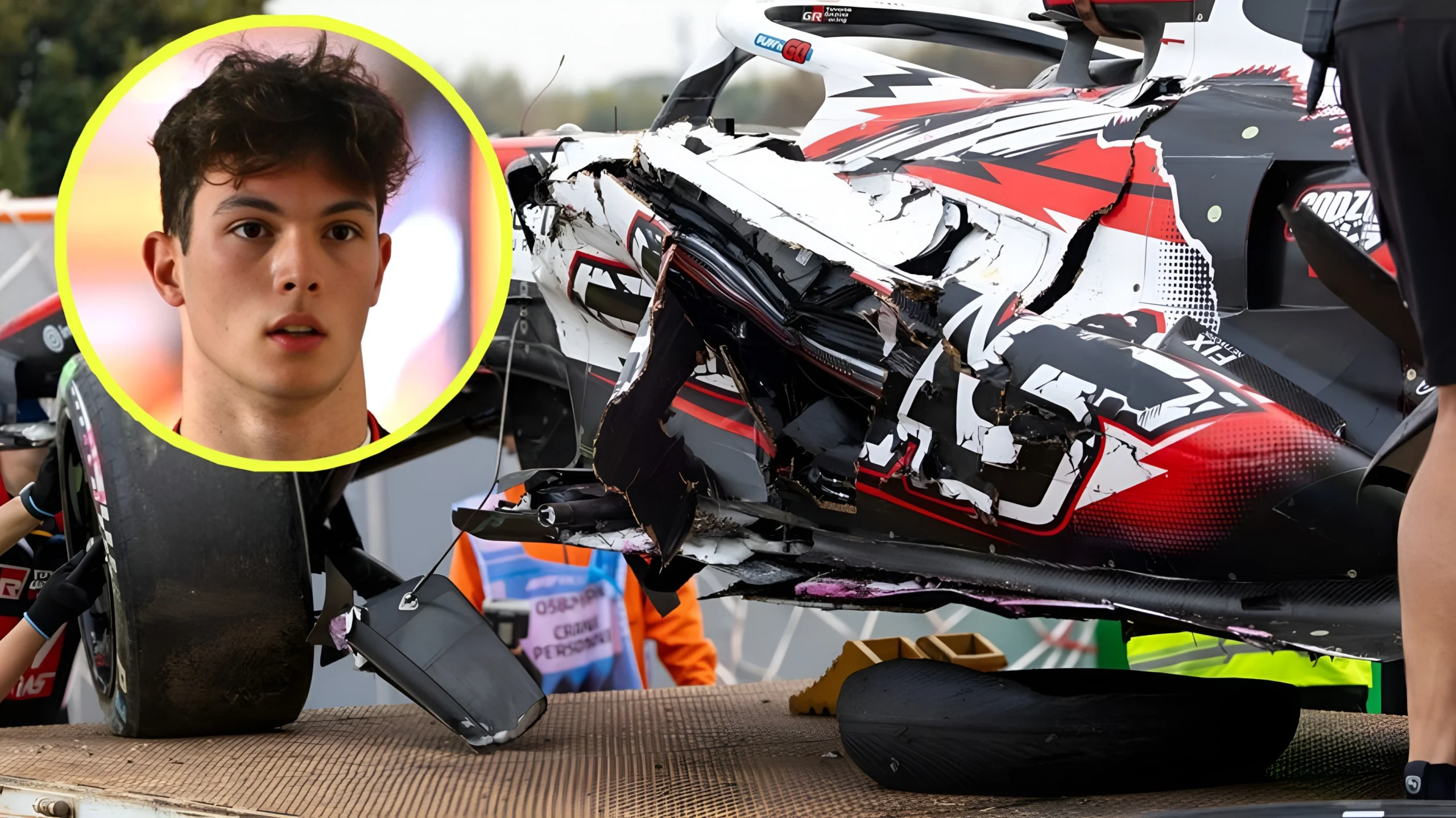
The decimated sidepod of Oliver Bearman’s Haas VF-26 following a 50G collision at Spoon Curve during the 2026 Japanese Grand Prix.
Published by: AutodromeF1 Editorial Team
Oliver Bearman’s High-Speed Impact at Suzuka Exposes Fundamental Flaws in Formula 1’s 2026 Powertrain Philosophy
Suzuka, Japan – 29 March 2026 – In the crucible of one of motorsport’s most demanding circuits, a single moment on Lap 22 of the Japanese Grand Prix has crystallised the tension between innovation and safety that now defines Formula 1’s much-vaunted 2026 regulations. Oliver Bearman, the 21-year-old British driver making his mark with Haas, emerged from a 50G barrier strike at Spoon Curve with nothing more than a right-knee contusion and a profound reminder of the sport’s unforgiving physics. No fractures, no life-threatening injuries—only the sobering realisation that the very technology intended to propel the championship into a sustainable future had created the conditions for an accident that, but for the resilience of modern safety systems, could have ended far differently.
The incident unfolded with clinical precision and terrifying rapidity. Running at approximately 308 km/h on the approach to the high-speed left-hander that is Spoon Curve, Bearman attempted to capitalise on a passing opportunity against Franco Colapinto’s Alpine. The Argentine driver’s car, operating under a more conservative energy-harvesting phase, presented a sudden and substantial closing-speed differential. To avoid contact, Bearman was forced to lift and veer onto the grass. The loss of grip was instantaneous. The Haas VF-26 snapped into a violent spin, pitching the car sideways into the tyre wall and then the rigid barrier beyond. Telemetry data released by the team confirmed a peak deceleration of 50G—force levels that, in an earlier era of the sport, would have been catastrophic.
Yet Bearman walked away, albeit with assistance from marshals and a noticeable limp. Post-incident medical imaging at the circuit’s medical centre, followed by further evaluation at a Suzuka hospital, confirmed the absence of skeletal damage. In a brief statement issued through Haas, Bearman described the moment as “one you never forget” while expressing gratitude to the team’s medical staff and apologising for the inevitable repair costs to a chassis already under pressure in a tightly contested Constructors’ Championship. His recovery is expected to be swift; he is provisionally cleared to participate in the next round, subject to final FIA fitness protocols.
The crash triggered an immediate Safety Car deployment, freezing the field and injecting an unwelcome variable into race strategy. George Russell, then fighting for a potential podium with Mercedes, was visibly frustrated on team radio as the timing of the intervention coincided with his own pit-stop window, a detail that underscored how safety interventions, while essential, can reshape competitive outcomes in ways that feel arbitrary to those directly affected.
What elevates this incident beyond a routine high-speed shunt is its direct link to the architectural choices embedded in the 2026 technical regulations. At the heart of the matter lies the recalibrated hybrid power unit. The MGU-K—Motor Generator Unit-Kinetic—now delivers up to 350 kW of electrical assistance, a significant increase from previous generations. Combined with revised battery capacity and energy-recovery protocols, the system demands hyper-precise management of deployment and harvesting phases. In theory, this configuration promotes greater efficiency and closer racing by encouraging strategic energy use throughout a lap. In practice, as Bearman’s crash illustrates, it can generate instantaneous and unpredictable velocity differentials when cars on divergent energy strategies converge in traffic.
Drivers had anticipated this vulnerability. Carlos Sainz Jr, competing for Williams in his post-Ferrari chapter, did not mince words in the immediate aftermath. Speaking to broadcasters trackside, the Spaniard—widely respected for his technical acumen—reiterated warnings he and others had delivered during pre-season testing and early-season briefings. “We told the FIA these closing speeds would create exactly this kind of scenario,” Sainz stated. “It was an accident waiting to happen. The energy-management differences are too extreme, too unpredictable at the velocities we are now carrying through high-speed corners. We need targeted adjustments before Miami, not blanket dismissals of driver feedback.”
Sainz’s comments echoed earlier observations from Sergio Perez, who during the opening rounds of the season had highlighted similar risks when slower cars in harvest mode became moving obstacles for those in full deployment. Franco Colapinto, the innocent party in this particular incident, has so far limited his public remarks to relief at Bearman’s well-being. Yet the broader driver cohort, through the Grand Prix Drivers’ Association, has maintained a consistent line: the 2026 package, while conceptually bold, requires calibration to preserve the fundamental principle that overtaking should not equate to Russian roulette.
Haas team principal Ayao Komatsu, whose squad has shown encouraging pace under the new rules, was more visceral in his assessment. “When you see the replay, it’s scary,” he told assembled media. “The speed at which Ollie closed in, the moment he had to react—it was not a margin for error; it was a cliff edge. We cannot keep asking drivers to manage these differentials lap after lap without addressing the root cause.”
The FIA’s initial response has been measured, perhaps predictably so. A spokesperson described calls for immediate regulatory intervention as “premature,” noting that full telemetry analysis and the forthcoming stewards’ report would inform any future discussion. The governing body points to the success of the halo, the HANS device, and the survival cell as evidence that the sport’s safety architecture continues to evolve faster than the dangers it confronts. Yet history demonstrates that Formula 1’s most meaningful regulatory shifts—post-Imola 1994, post-Bianchi 2014, post-Grosjean 2020—have often followed precisely these “near-miss” moments when data and driver testimony align.
To understand the technical underpinnings, one must revisit the regulatory philosophy that shaped 2026. The overhaul sought to reduce overall car width and weight, introduce active aerodynamics, and mandate 100% sustainable fuels while dramatically increasing the electrical component of power delivery. The objective: make Formula 1 a laboratory for road-relevant hybrid technology while delivering the spectacle of wheel-to-wheel combat. The unintended consequence, now laid bare at Spoon Curve, is that energy deployment is no longer merely a performance tool; it has become a variable that can alter relative velocity by tens of kilometres per hour within a single corner. At 300 km/h-plus, even a 15 km/h differential transforms a routine overtake into a closing-speed crisis measured in milliseconds.
Independent safety analysts, speaking on condition of anonymity given the sensitivity of ongoing reviews, have drawn parallels with historical precedents. The 1994 Ayrton Senna regulations, the 2009 return of slick tyres, and the 2017 wider-car experiment each introduced new dynamics that required subsequent refinement. What distinguishes 2026 is the degree to which software and battery management now govern physics that were once the sole province of mechanical grip and driver intuition.
The human element remains paramount. Bearman, thrust into Formula 1’s spotlight after his 2024 Ferrari cameo, represents a generation of drivers raised on simulators and data dashboards yet still reliant on seat-of-the-pants feel when systems exceed their predictive models. His survival speaks volumes about the engineering excellence poured into the carbon-fibre monocoque, the energy-absorbing structures, and the medical protocols that now activate within seconds of impact. The FIA’s medical delegate confirmed that Bearman’s vital signs remained stable throughout extraction and transfer—a testament to protocols refined over decades of hard-won experience.
Beyond the immediate race narrative, the incident compels a wider examination of Formula 1’s identity in the 2020s. The championship’s commitment to net-zero by 2030 is genuine and necessary. Yet sustainability cannot be pursued at the expense of the core bargain between drivers, spectators, and regulators: that the spectacle must remain thrilling without becoming reckless. Teams are already modelling potential mitigations—sector-specific energy-deployment caps, revised power-unit mapping requirements in high-speed zones, or even temporary adjustments to MGU-K output until software solutions mature. Whether such measures can be implemented before the Miami Grand Prix in May remains an open question, but the momentum generated by Suzuka will be difficult to ignore.
Financially, the repercussions are already rippling. Haas faces a significant chassis repair bill at a time when budget-cap discipline is paramount. Alpine, while blameless in the collision, must contend with the narrative that their energy strategy inadvertently contributed to the drama. For Liberty Media, the commercial rights holder, the challenge is to maintain fan engagement when the very regulations marketed as “revolutionary” risk being perceived as flawed at launch.
As the paddock decamps from Suzuka, the conversation has shifted from lap times to legacy. Oliver Bearman’s ordeal will not define his career; it may, however, accelerate the maturation of a regulatory framework still finding its equilibrium. The 2026 cars are faster, more efficient, and visually striking. They must also be demonstrably safer in the precise conditions where human reaction times meet silicon-controlled power delivery.
Formula 1 has never been static. Its genius lies in the capacity to interrogate failure, extract lessons, and legislate with both courage and humility. The telemetry from Spoon Curve now sits with the FIA’s technical department, the drivers’ association, and the power-unit manufacturers. What emerges from that analysis will determine whether the 2026 regulations are remembered as a bold leap forward or a cautionary chapter requiring urgent correction.
Bearman himself, already back in the simulator preparing for the next challenge, embodies the resilience that has sustained the sport through every technological iteration. His message, delivered with characteristic understatement, was simple: “I’m fine. The car took the hit. Now let’s make sure we learn from it.”
In the high-stakes arena of Formula 1, learning is never optional. At Suzuka on this March afternoon, the sport received an unambiguous lesson—one that demands a response as precise and uncompromising as the engineering that produced the cars themselves. The eyes of the paddock, the fans, and the governing body now turn toward Miami, where the next chapter of this evolving story will be written not merely in lap times, but in the quiet, rigorous work of ensuring that innovation and safety remain inseparable companions on the long road ahead.


