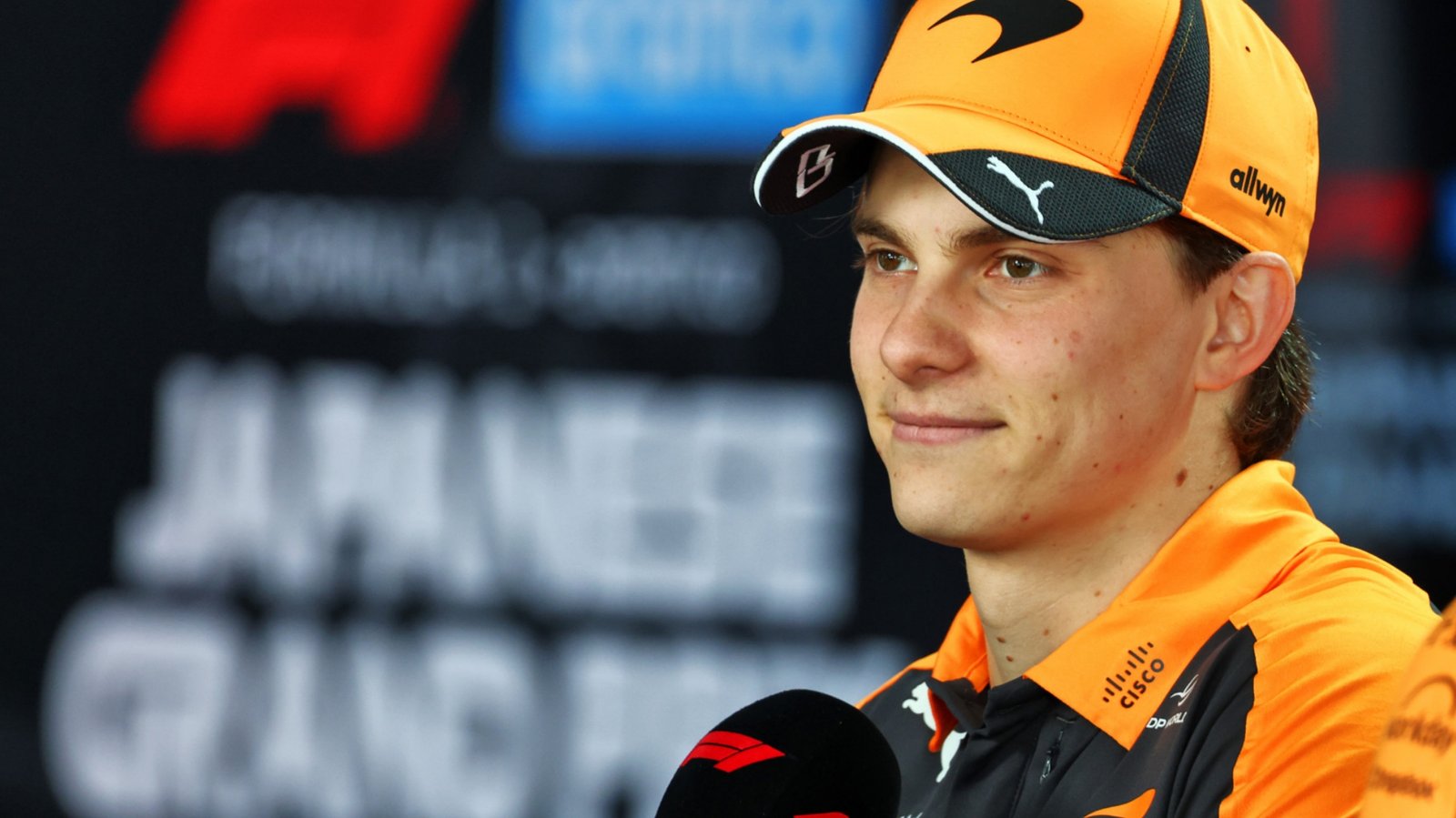
Oscar Piastri addresses the media at Suzuka ahead of the 2026 Japanese Grand Prix, focused on resolving McLaren’s early-season power unit integration challenges.
Published by: AutodromeF1 Editorial Team
Oscar Piastri Targets Measured Redemption at Suzuka: A Professional Reset Amid Early-Season Adversity in the 2026 Formula 1 Campaign
In the rarefied world of Formula 1, where milliseconds separate triumph from catastrophe, few drivers embody quiet resilience quite like Oscar Piastri. As the 2026 season unfolds under the intense scrutiny of a grid reshaped by new technical regulations and power-unit partnerships, the young Australian finds himself confronting an unprecedented personal challenge: zero competitive race starts through the opening two rounds. Yet, ahead of this weekend’s Japanese Grand Prix at Suzuka, the McLaren driver is projecting not frustration, but focused determination — a deliberate recalibration that underscores both his maturity and the team’s underlying technical promise.
Piastri’s season began in the most unforgiving circumstances on home soil in Melbourne. During the reconnaissance lap at the Australian Grand Prix, a confluence of cold tyres and an abrupt engine surge at Turn 4 precipitated a heavy impact with the barriers. The front-end damage to the MCL39 was extensive, rendering any prospect of a race start impossible. For a driver who had shown flashes of genuine championship calibre in prior campaigns, the early exit carried a particular sting — not merely because it occurred before the lights had even extinguished, but because it denied him the opportunity to showcase the car’s potential on a circuit where he has historically excelled.
Compounding the disappointment was the Shanghai round that followed. Having successfully navigated the complexities of qualifying and reached the grid, Piastri’s weekend unravelled once more before the formation lap could commence. A power-unit electrical failure forced an immediate retirement to the garage, mirroring — though not replicating identically — a similar issue that sidelined teammate Lando Norris. The result was a rare double DNS for McLaren, leaving the squad with zero points from the first two events. In post-incident remarks, Piastri described the episode as “disappointing” yet refrained from assigning blame, choosing instead to emphasise the analytical value of reviewing telemetry and onboard footage in preparation for Japan. Such measured commentary is characteristic of a driver who has consistently demonstrated emotional intelligence beyond his years.
The technical root of these setbacks has been traced to the Mercedes High Performance Powertrains (HPP) unit supplied to McLaren under the 2026 power-unit regulations. While the partnership was widely hailed as a strategic masterstroke when announced, early-season gremlins have exposed the inherent complexities of integrating next-generation hybrid systems. Electrical anomalies, particularly under the thermal and load stresses of pre-race procedures, have proven especially elusive. McLaren’s engineering staff, working in close collaboration with Mercedes HPP technicians at Brixworth, have already implemented targeted software and hardware revisions. Insiders indicate that these modifications were validated through rigorous dyno and simulation work in the week following Shanghai, though final confirmation of their efficacy will only come under the demanding conditions of Suzuka’s high-speed sweeps.
Against this backdrop, Piastri’s public stance ahead of the Suzuka weekend is instructive. In a characteristically understated media interaction, he quipped about his primary objective simply being “to see the lights come on” — a light-hearted acknowledgment of the double DNS without descending into self-pity. The remark reveals a driver prioritising process over outcome: a solid, incident-free weekend takes precedence over headline-chasing heroics. This mindset is particularly prudent given McLaren’s current standing. The team occupies third place in the constructors’ championship, trailing the resurgent Mercedes and Ferrari squads that have capitalised on early reliability advantages. While the MCL39 has demonstrated competitive pace in sector times and qualifying simulations, consistency remains the missing variable.
Suzuka, with its unique blend of high-speed corners, technical demands, and unforgiving kerbs, offers an ideal venue for such a reset. The circuit’s figure-eight layout and rapid elevation changes test not only mechanical grip but also driver precision and tyre management — attributes that have long been Piastri’s strengths. His ability to extract maximum performance from the medium and hard compound Pirelli tyres without excessive degradation was a defining feature of his 2025 campaign, and the 2026 regulations, which have placed greater emphasis on aerodynamic efficiency and energy deployment, play to those same qualities. Moreover, Suzuka’s historical significance for McLaren — site of multiple title-clinching moments in the team’s storied past — adds a layer of motivational resonance, even if the current focus remains firmly on incremental progress rather than silverware.
From an engineering perspective, the weekend presents McLaren with multiple data-gathering opportunities. The team is expected to introduce a modest package of aerodynamic and suspension refinements, calibrated specifically to address the front-end instability observed in Australia. Power-unit mapping revisions, informed by the Shanghai electrical diagnosis, will be scrutinised across practice sessions. Piastri’s feedback loop — renowned within the paddock for its clarity and technical acuity — will be instrumental. Unlike more emotive drivers who might demand wholesale changes, Piastri’s approach is methodical: identify, quantify, and execute. This professionalism has earned him the quiet respect of senior engineers at both McLaren and Mercedes HPP.
It is worth contextualising Piastri’s current predicament within the broader narrative of his career trajectory. Since graduating from the Alpine academy and securing a race seat at McLaren in 2023, the 24-year-old has cultivated a reputation as one of the grid’s most complete performers. His maiden victory in Hungary in 2024, achieved under intense pressure and against team orders, showcased tactical maturity. Subsequent podiums and consistent points hauls have reinforced the view that he possesses the rare combination of raw speed, racecraft, and emotional composure required at the pinnacle of the sport. The early 2026 setbacks, while statistically stark, do not alter that assessment; rather, they test the very resilience that will define his long-term legacy.
Comparisons with teammate Norris are inevitable and instructive. Both drivers have encountered power-unit-related disruptions, yet Norris’s greater experience within the McLaren ecosystem has perhaps afforded him slightly more latitude in public commentary. Nevertheless, the intra-team dynamic remains collaborative, with shared data accelerating the resolution of the electrical issues. Team principal Andrea Stella has repeatedly emphasised that the squad’s long-term vision remains intact: a championship-contending package by mid-season, underpinned by the 2026 regulatory reset that favours those who master the new power-unit architecture.
Looking ahead, a successful Suzuka weekend for Piastri would be measured not in victory but in completion. A clean run through all three practice sessions, a competitive qualifying position, and a points-scoring finish would represent a significant psychological and technical milestone. Should the upgraded power unit demonstrate the reliability now expected, Piastri’s innate race pace — particularly his renowned one-lap qualifying speed and ability to manage tyre wear through Suzuka’s Esses and Spoon Curve — could see him mixing with the front runners. Even a conservative strategy targeting fifth or sixth place would restore momentum and provide the team with the race data essential for further development.
Beyond the immediate weekend, the implications extend to the remainder of the 2026 calendar. With 22 races still to run and significant upgrade windows scheduled for Imola and Barcelona, McLaren retains every opportunity to ascend the standings. Piastri’s ability to convert this reset into sustained performance will be pivotal. His focus on “forward execution” rather than retrospective analysis of the double DNS reflects a driver who understands that Formula 1 rewards those who absorb lessons swiftly and move on without emotional baggage.
In an era where social media amplifies every minor setback into a narrative of crisis, Piastri’s measured approach stands out as refreshingly professional. He has consistently demonstrated that true expertise lies not in avoiding adversity — an impossibility in such a complex sport — but in responding to it with clarity, technical insight, and unyielding focus. As the Suzuka paddock assembles under the cherry blossoms, the spotlight will fall once more on the young Australian. For those who appreciate the deeper rhythms of Formula 1, this weekend represents far more than another race: it is a litmus test of character, engineering resilience, and the quiet confidence that separates contenders from the rest.
The image captured in the immediate aftermath of the Australian incident serves as a stark visual reminder of the fine margins involved. Piastri’s McLaren, front wing shattered and nose section crumpled, sits against the barriers at Turn 4 — a testament to forces far beyond a driver’s control on a cold-tyre reconnaissance lap. Yet even in that moment of mechanical failure, the driver’s poise remained intact. That same composure now informs his preparation for Suzuka.
As the lights finally prepare to illuminate for Piastri in 2026, the expectation within informed circles is not for fireworks, but for something more enduring: a professional, error-free weekend that re-establishes the trajectory many had predicted for him at the season’s outset. In the unforgiving arena of Formula 1, such resets are the foundation upon which genuine championship challenges are built. Suzuka, with its unforgiving demands and rich heritage, could scarcely offer a more fitting stage.


