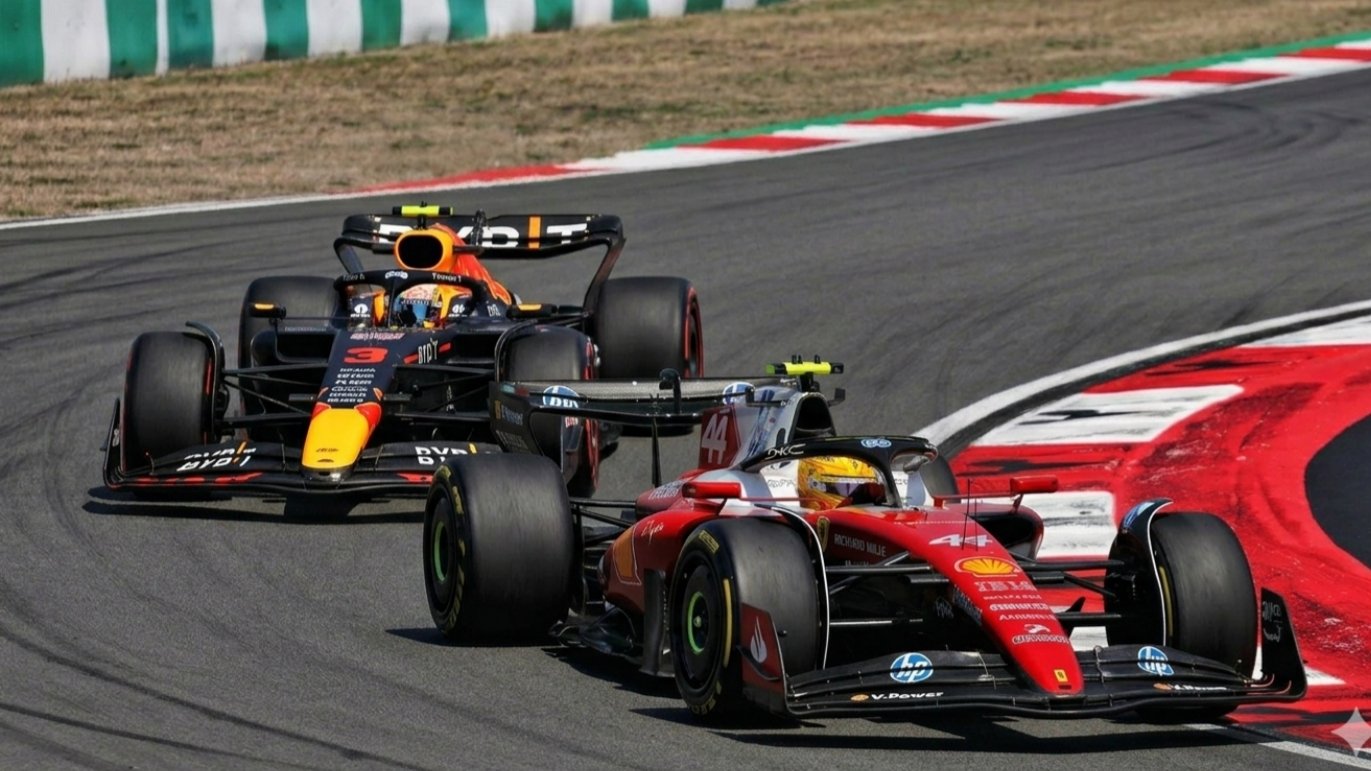
Lewis Hamilton and Max Verstappen struggling through the high-speed curves of Suzuka during the 2026 Japanese Grand Prix practice.
Published by: AutodromeF1 Editorial Team
Red Bull and Ferrari Unveil Precision-Targeted Aerodynamic and Flow Enhancements for the 2026 Japanese Grand Prix at Suzuka: Engineering Precision Meets Circuit-Specific Demands
Suzuka, Japan – March 27, 2026
As the 2026 Formula 1 World Championship enters its early phase, the Japanese Grand Prix at the legendary Suzuka Circuit stands as a pivotal litmus test for chassis development and aerodynamic refinement. This demanding 5.807-kilometer layout, renowned for its high-speed sweeps, technical chicanes, and relentless elevation changes, places extraordinary emphasis on front-end stability, efficient cooling under sustained loads, and seamless airflow management. In response, Red Bull Racing and Scuderia Ferrari have each introduced meticulously calibrated upgrade packages for their respective RB22 and SF-26 machines. These modifications, focused on sidepod geometry, engine-cover integration, floor architecture, brake-duct optimization, and localized flow fairings, reflect the highest standards of modern Formula 1 engineering—where marginal aerodynamic gains can translate into decisive performance advantages on a circuit that rewards precision over raw power.
The upgrades arrive at a critical juncture. Mercedes-AMG Petronas has demonstrated formidable early-season pace under the new regulatory framework, which introduced more compact chassis dimensions, revised power-unit architecture, and enhanced active-aerodynamic elements. Both Red Bull and Ferrari find themselves in pursuit, with the championship battle already exhibiting the sort of technical chess match that has defined the sport’s most compelling eras. What distinguishes these latest evolutions is their targeted nature: rather than broad overhauls, the packages address specific Suzuka-induced challenges while preserving compatibility for subsequent rounds. This strategic restraint underscores the maturity of both organizations’ design philosophies and their capacity to iterate with surgical accuracy.
Red Bull Racing’s RB22: Enhancing Flow Efficiency and Front-End Authority
Red Bull’s RB22 package centers on a comprehensive reworking of the sidepod and upper-body architecture, elements that serve as the aerodynamic nerve center of any modern grand prix car. The revised sidepod inlets have been reshaped to ingest higher-pressure air originating from the forward sections of the vehicle. By repositioning and contouring the inlet lips, the design capitalizes on the relatively undisturbed flow field ahead of the front wheels, channeling this energetic air mass more effectively into the internal ducts. The result is an improvement in overall aerodynamic efficiency—specifically, a reduction in parasitic drag while maintaining or even enhancing the mass flow required for heat rejection from the power unit and associated systems.
Complementing this is a redesigned engine cover that achieves seamless integration with the updated sidepod contours. The new profile not only streamlines the transition between the sidepod shoulder and the rearward bodywork but also optimizes the pressure distribution across the cooling exits. This refinement mitigates turbulence in the critical “dirty air” zone immediately downstream of the power unit, ensuring that the airflow feeding the rear diffuser and beam wing remains cleaner and more attached. In high-speed sectors such as Suzuka’s Esses and the 130R, where the car operates at sustained high lateral loads, such flow cleanliness directly contributes to increased rear downforce and improved yaw stability.
Perhaps most significant for Suzuka’s unique demands is the tweaked upper floor surface. Aligned precisely with the new sidepod geometry, this modification generates additional downforce in the forward underbody region. The adjustment addresses a known early-season characteristic of the RB22: a slight deficiency in front-end grip during high-speed direction changes. By subtly altering the camber and curvature of the floor’s upper surface, Red Bull’s aerodynamicists have created a more favorable pressure gradient that augments the low-pressure zone beneath the front section of the car. The net effect is enhanced mechanical grip at the front axle without compromising the underfloor’s primary role in generating the bulk of total downforce.
These changes are not merely cosmetic. Computational fluid dynamics (CFD) simulations and wind-tunnel validation—conducted under the sport’s stringent testing restrictions—have confirmed measurable improvements in the lift-to-drag ratio and front-to-rear aerodynamic balance. Paddock analysis suggests the package could yield a lap-time benefit in the region of two- to four-tenths of a second around Suzuka, depending on weather and tire-compound behavior. Critically, the updates maintain the RB22’s renowned driveability, a hallmark of Red Bull’s design ethos since the team’s resurgence in the ground-effect era.
Scuderia Ferrari’s SF-26: Aerodynamic Prioritization and Adaptive Flow Management
Ferrari’s approach, while more understated, demonstrates equal engineering acumen. The SF-26 package introduces smaller front brake ducts, a deliberate trade-off that sacrifices a measure of brake-cooling capacity in favor of aerodynamic refinement. Suzuka’s layout, characterized by relatively light braking zones compared with street circuits or high-deceleration venues such as Bahrain, permits this compromise. The reduced duct exits minimize frontal area and disrupt fewer streamlines, resulting in cleaner flow over the front wing and into the underbody tunnels. This gain is particularly valuable in the high-speed corners where any reduction in turbulence ahead of the floor can enhance overall downforce generation.
Importantly, Ferrari has signaled that the smaller ducts are not exclusively track-specific. Wind-tunnel data indicate the configuration offers a net aerodynamic benefit even on circuits with more demanding braking profiles, suggesting the change may become a permanent feature of the SF-26’s specification. Such forward-thinking modularity is emblematic of a team that has historically balanced short-term competitiveness with long-term development cycles.
The second element—a new front floor fairing—represents a subtle yet potent geometric intervention. Positioned at the junction between the chassis and the floor’s leading edge, this minor tweak optimizes local airflow vectors directed toward the rear diffuser. By redirecting and conditioning the boundary layer that forms along the floor’s underside, the fairing reduces separation and improves the efficiency of the diffuser’s extraction process. The result is a more uniform pressure recovery across the rear underbody, contributing to increased rear downforce and a more predictable aerodynamic balance under varying ride-height conditions.
Together, these modifications reflect Ferrari’s philosophy of incremental, high-fidelity optimization. Rather than chasing headline-grabbing complexity, the team has focused on refining established concepts to extract latent performance. Early indications from simulation suggest the SF-26’s updated package will enhance stability through Suzuka’s rapid direction changes, particularly in the sector-two chicane and the Spoon curve, where precise front-end response is paramount.
Technical Context and Strategic Implications
To fully appreciate the significance of these upgrades, one must consider the broader regulatory and competitive landscape of 2026. The new technical regulations emphasize sustainability, reduced drag, and active-aerodynamic devices, compelling teams to rethink traditional airflow management. Both Red Bull and Ferrari have navigated these constraints with evident expertise, ensuring their packages remain within the tight homologation windows while delivering tangible on-track benefits.
Suzuka’s characteristics amplify the value of such refinements. The circuit’s combination of high-speed corners (130R exceeds 300 km/h in race trim) and technical sections demands an aerodynamic envelope that provides consistent downforce across a wide range of ride heights and yaw angles. Front-end grip issues, common in ground-effect cars when entering high-load turns, can lead to understeer that erodes lap times and increases tire degradation. By addressing these precisely, both teams demonstrate a sophisticated understanding of the vehicle dynamics at play.
From a championship perspective, the upgrades carry weight beyond this weekend. Red Bull, historically adept at rapid mid-season development, appears intent on reclaiming the initiative after a measured start. Ferrari, buoyed by recent strides in power-unit efficiency and chassis rigidity, is positioning the SF-26 as a versatile platform capable of challenging on any circuit. Should either package deliver the anticipated step, the intra-team and inter-team battles could intensify, transforming what has been a Mercedes-led narrative into a genuine three-way contest.
Looking Ahead: Practice, Qualifying, and Race Outlook
As free practice sessions commence under the Suzuka skies, the paddock’s attention will turn to real-world validation of the new components. Telemetry will reveal whether the revised flow paths translate into the predicted balance improvements, while tire-wear data will indicate any secondary benefits in mechanical grip. For Red Bull, the priority will be restoring Max Verstappen’s trademark confidence in high-speed corners; for Ferrari, it will be ensuring Charles Leclerc and Lewis Hamilton can exploit the SF-26’s enhanced rear-end stability.
In an era where aerodynamic development is increasingly constrained by cost caps and testing limits, the ability to identify and rectify specific performance bottlenecks remains the ultimate differentiator. Red Bull and Ferrari have exemplified this discipline with their Suzuka packages—elegant, purposeful, and engineered to the highest professional standards.
The 2026 Japanese Grand Prix thus promises more than spectacle; it offers a masterclass in applied aerodynamics. As the lights extinguish for the formation lap, the true measure of these upgrades will be written not in technical bulletins, but in sector times, cornering speeds, and, ultimately, the chequered flag. In the relentless pursuit of performance, every contour, every fairing, and every optimized inlet represents another chapter in Formula 1’s enduring engineering narrative.


