Published by: AutodromeF1 Editorial Team
Sergio Perez Delivers Emphatic Rebuttal to Mario Andretti’s “Rusty” Assessment as Cadillac Demonstrates Tangible Progress in Its Inaugural 2026 Formula 1 Campaign
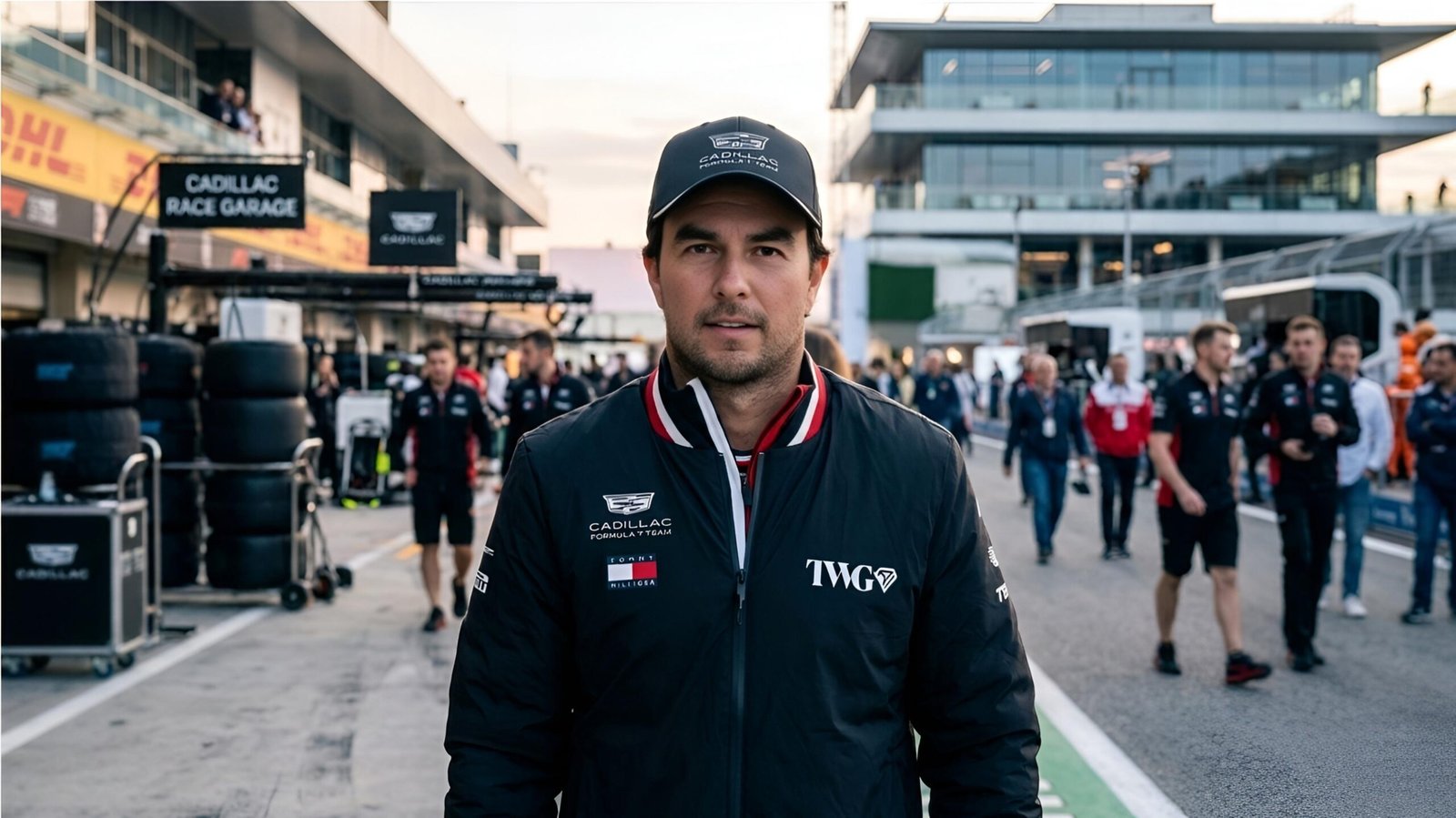
New York, United States April 5 -In the high-stakes arena of Formula 1, where every tenth of a second is dissected under the unforgiving glare of global scrutiny, veteran driver Sergio Perez has issued a measured yet unequivocal response to recent commentary from Mario Andretti. The legendary American champion and Cadillac team ambassador had suggested that Perez and his teammate Valtteri Bottas appeared “rusty” in the early stages of the 2026 season following their respective returns to the grid after a year-long hiatus. Perez, however, has firmly rejected that characterisation, underscoring not only his personal satisfaction with his performance levels but also the broader operational maturation of Cadillac Racing as it navigates the formidable challenges inherent in establishing a new constructor in the pinnacle of motorsport.
This exchange, unfolding against the backdrop of Cadillac’s debut campaign, encapsulates far more than a simple difference of opinion between two titans of the sport. It highlights the nuanced realities faced by an entirely new entrant in a regulatory environment that demands instantaneous competitiveness, while simultaneously illuminating the resilience and adaptive capacity of two of Formula 1’s most experienced campaigners. With the season still in its formative phase, the narrative emerging from the Cadillac garage is one of deliberate, data-driven advancement rather than the chaos often associated with rookie outfits.
Perez, who last competed in a full-time capacity in 2024 before stepping away for a sabbatical that included family commitments and exploratory roles within the sport, has been candid about the complexities of reintegration. Speaking in the aftermath of recent races, the Mexican driver emphasised the qualitative leap he perceives in his own pace, particularly during qualifying sessions. “I am extremely satisfied with where my performance sits,” he stated, drawing specific attention to his showing in Melbourne. There, despite the inevitable teething troubles that accompany any new machinery, Perez extracted lap times that reflected a driver operating at a level commensurate with his extensive pedigree—over 250 Grand Prix starts, multiple podiums, and a reputation as one of the grid’s most consistent performers under pressure.
The adaptation process has not been without incident. Early-season encounters with car damage—whether stemming from on-track skirmishes or the unforgiving demands of learning an unfamiliar chassis and power-unit package—tested the team’s resource management. Yet Perez has repeatedly highlighted the speed with which both he and the engineering crew have recovered. “We’ve had our setbacks, but the way we’ve come back each time shows the character we’re building,” he noted. This sentiment is not mere rhetoric; telemetry and sector analysis from the opening rounds reveal a driver whose braking points, throttle application, and tyre management have rapidly converged toward the benchmarks established during his most competitive years. The year away, far from inducing rust, appears to have afforded Perez a refreshed perspective—one that prioritises precision over raw aggression, a hallmark of seasoned maturity in an era dominated by hybrid powertrains and ground-effect aerodynamics.
Valtteri Bottas, Perez’s Finnish counterpart and fellow returnee, echoes many of these observations. A driver whose career trajectory includes multiple race victories and near-miss championship challenges during his Mercedes tenure, Bottas has similarly embraced the role of pioneer within Cadillac’s nascent project. The pairing of these two veterans—each bringing institutional knowledge from championship-contending environments—represents a strategic masterstroke by the American squad. In an age when many new teams lean heavily on youthful talent to absorb developmental lessons, Cadillac has instead opted for proven custodians capable of providing immediate, articulate feedback to accelerate the learning curve.
The tangible manifestation of this philosophy materialised most convincingly at the Japanese Grand Prix, an event that stands as Cadillac’s most accomplished performance to date. Prior to Suzuka, the team introduced a suite of aerodynamic revisions centred on a revised diffuser design. In Formula 1 parlance, the diffuser is the critical underbody component responsible for managing the high-velocity airflow exiting beneath the car, thereby generating downforce without incurring prohibitive drag penalties. The upgrades yielded precisely the gains the technical department had modelled: enhanced rear-end stability through high-speed corners, improved traction out of slower turns, and—crucially—more efficient energy deployment from the hybrid power unit.
Both Cadillac cars completed the 53-lap Suzuka distance on the lead lap for the first time in the team’s short history, a statistical milestone that belies the scale of the achievement. Perez crossed the line ahead of both Aston Martin entries, while Bottas maintained a similarly competitive rhythm. Post-race, the Mexican driver was unequivocal: “This was our best race so far—without question.” The sentiment was shared across the garage. Energy deployment, a perennial headache for new power-unit installations, showed marked improvement, allowing the drivers to deploy the electric motor’s additional horsepower with greater confidence and frequency. In the context of 2026’s revised technical regulations—emphasising sustainable fuels, tighter aerodynamic constraints, and enhanced energy-recovery systems—such progress is not incremental; it is foundational.
This Japanese breakthrough did not occur in isolation. It followed a methodical development programme that began the moment the cars rolled out of the factory. Cadillac’s engineering cohort, bolstered by strategic technical partnerships and an infusion of talent drawn from established manufacturers, has demonstrated an ability to iterate rapidly. Where other debutant teams in recent memory have suffered protracted reliability woes or aerodynamic stagnation, the American outfit has maintained a relatively clean operational record. Incidents of car damage, while costly in terms of spares and set-up time, have been addressed with the sort of clinical efficiency one associates with squads further up the pecking order.
Looking ahead, the focus shifts decisively to the Miami Grand Prix—the team’s home event on the calendar and the venue for its most ambitious upgrade package yet. Both Perez and Bottas have confirmed in recent media briefings that the Miami specification represents the largest single-step evolution of the C01 chassis since its launch. The package is understood to encompass not only further aerodynamic refinements but also power-unit calibration enhancements and chassis-stiffness modifications designed to unlock additional mechanical grip. For a squad whose primary objective in 2026 remains the establishment of a robust baseline rather than immediate championship contention, these updates carry outsized significance.
Perez has already articulated his expectations with characteristic clarity. “Miami will put us into the mix a lot more,” he observed, alluding to the potential for genuine midfield battles rather than the rear-guard actions that have defined the opening rounds. The Miami International Autodrome, with its combination of long straights, tight hairpins, and high kerbs, will serve as an exacting litmus test for the revised package. Should the upgrades deliver the projected performance delta—estimated internally at several tenths per lap—the narrative surrounding Cadillac could pivot from “promising newcomer” to “legitimate midfield protagonist” within a single weekend.
Such optimism is grounded in more than hope. It rests on the empirical evidence accumulated across the first handful of races: consistent lap-time improvements, driver confidence indices trending upward, and a technical roadmap that is both ambitious and realistic. In an era when Formula 1’s cost-cap regulations and power-unit homologation rules have levelled the playing field more than at any point in the sport’s modern history, the window for a well-resourced new entrant to establish itself has arguably never been wider. Cadillac’s approach—pairing battle-hardened drivers with a methodical engineering ethos—positions the team favourably within that window.
Yet challenges remain. The midfield in 2026 is fiercely contested, populated by constructors with decades of cumulative knowledge and, in some cases, recent championship pedigree. Environmental variables—weather, track evolution, and the perpetual chess game of tyre strategy—will continue to test Cadillac’s operational resilience. Moreover, the psychological dimension cannot be overlooked. Perez and Bottas, while outwardly composed, carry the weight of expectation: not merely to perform, but to validate the entire Cadillac project in the eyes of stakeholders, sponsors, and the Formula 1 community at large.
Mario Andretti’s initial “rusty” observation, though candid, must now be viewed through the prism of subsequent events. The Italian-American icon’s commentary was never intended as a slight; rather, it reflected the honest assessment of a man who has witnessed the sport’s evolution across seven decades. That Perez has responded not with defensiveness but with performance-based rebuttal speaks volumes about his character and the team’s internal culture. In Formula 1, where perception can shape reality, such clarity of purpose is an asset of incalculable value.
As the 2026 season unfolds, Cadillac Racing stands at a critical inflection point. The Japanese Grand Prix provided proof of concept; the Miami package will determine whether that concept can translate into sustained competitiveness. Sergio Perez, for his part, has already signalled his intent: he is not here to participate—he is here to compete. And in doing so, he is helping to write a new chapter in Formula 1’s rich history—one defined not by the inevitability of struggle for a newcomer, but by the possibility of rapid, credible ascent.
The coming races will reveal whether that ascent continues its upward trajectory. For now, however, the evidence from the garage is clear: the veterans are far from rusty. They are, in fact, sharpening the blade of a team that is only just beginning to reveal its true edge.


